
What are the 6 Phases of the Threat Intelligence Lifecycle?
Editor’s Note: Over the next several weeks, we’re sharing excerpts from the newly released second edition of our popular book, “The Threat Intelligence Handbook: Moving Toward a Security Intelligence Program.” Here, we’re looking at chapter two, “The Threat Intelligence Lifecycle.”
On your journey to security intelligence, comprehensive, real-time intelligence must be woven tightly into your security processes, third-party risk management program, and brand protection strategy. But in order to get there, how can you develop threat intelligence that truly adds value to your organization? And how can you ensure the intelligence you deliver is actionable for teams across security functions?
To answer these questions, it’s important to view threat intelligence production as a multi-step, cyclical process — not a point-in-time task.
Defining the Threat Intelligence Cycle
First, the goals of the cyber threat intelligence cycle must be defined by key stakeholders. These objectives may vary widely from organization to organization depending on use cases, priorities, and risk. From there, data must be gathered from a range of sources — internal, technical, and human — to develop a complete picture of potential and actual cyber threats. Then, this data must be processed and turned into actual intelligence that is timely, clear, and actionable for everyone — whether they’re staffing a SOC, responding to security incidents, managing vulnerabilities, analyzing third-party risk, protecting your digital brand, or making high-level security decisions. This finished intelligence output then goes back to key stakeholders, who can use it to continuously improve future intelligence cycles and hone their decision-making process.
The following excerpt from “The Threat Intelligence Handbook: Moving Toward a Security Intelligence Program” has been edited and condensed for clarity. In it, we'll examine each of the six phases of the threat intelligence lifecycle, review sources of threat intelligence, and look at the roles of threat intelligence tools and human analysts.
Threat Intelligence Lifecycle in 6 Steps
Threat intelligence is built on analytic techniques honed over several decades by government and military agencies. Traditional intelligence focuses on six distinct phases that make up what is called the “intelligence cycle”: direction, collection, processing, analysis, dissemination, and feedback.
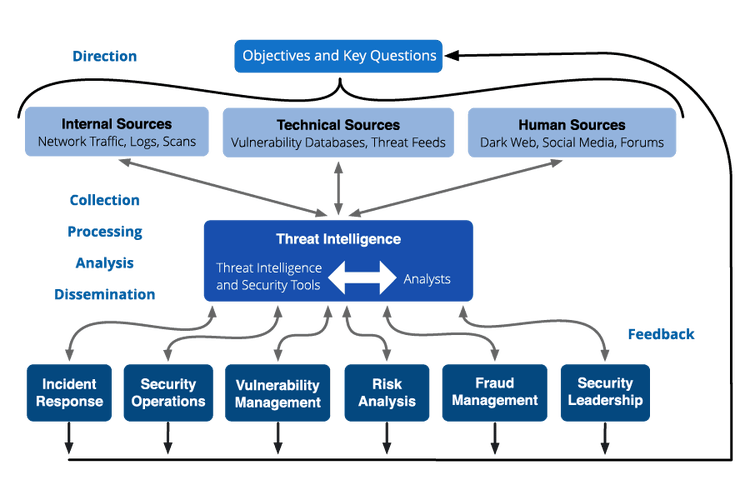
Threat intelligence and the six phases of the intelligence lifecycle.
1. Direction
The direction phase of the lifecycle is when you set goals for the threat intelligence program. This involves understanding and articulating:
- The information assets and business processes that need to be protected
- The potential impacts of losing those assets or interrupting those processes
- The types of threat intelligence that the security organization requires to protect assets and respond to emerging threats
- Priorities about what to protect
Once high-level intelligence needs are determined, an organization can formulate questions that channel the need for information into discrete requirements. For example, if a goal is to understand likely adversaries, one logical question would be, “Which threat actors on underground forums are actively soliciting data concerning our organization?”
2. Collection
Collection is the process of gathering information to address the most important intelligence requirements. Information gathering can occur organically through a variety of means, including:
- Pulling metadata and logs from internal networks and security devices
- Subscribing to threat data feeds from industry organizations and cybersecurity vendors
- Holding conversations and targeted interviews with knowledgeable sources
- Scanning open source news and blogs (a common OSINT practice)
- Scraping and harvesting websites and forums
- Infiltrating closed sources such as dark web forums
The data collected typically will be a combination of finished intelligence information, such as intelligence reports from cybersecurity experts and vendors, and raw data, like malware signatures or leaked credentials on a paste site.
3. Processing
Processing is the transformation of collected information into a format usable by the organization. Almost all raw data collected needs to be processed in some manner, whether by humans or machines. Different collection methods often require different means of processing. Human reports may need to be correlated and ranked, deconflicted, and checked.
An example might be extracting IP addresses from a security vendor’s report and adding them to a CSV file for importing to a security information and event management (SIEM) product. In a more technical area, processing might involve extracting indicators from an email, enriching them with other information, and then communicating with endpoint protection tools for automated blocking.
4. Analysis
Analysis is a human process that turns processed information into intelligence that can inform decisions. Depending on the circumstances, the decisions might involve whether to investigate potential emerging threats, what actions to take immediately to block an attack, how to strengthen security controls, or how much investment in additional security resources is justified.
The form in which the information is presented is especially important. It is useless and wasteful to collect and process information and then deliver it in a form that can’t be understood and used by the decision maker. For example, if you want to communicate with non-technical leaders, your report must:
- Be concise (a one-page memo or a handful of slides)
- Avoid confusing and overly technical terms and jargon
- Articulate the issues in business terms (such as direct and indirect costs and impact on reputation)
- Include a recommended course of action
Some intelligence may need to be delivered in a variety of formats for different audiences, say, by a live video feed or a PowerPoint presentation. Not all intelligence needs to be digested via a formal report. Successful cyber threat intelligence teams provide continual technical reporting to other security teams with external context around IOCs, malware, threat actors, vulnerabilities, and threat trends.
5. Dissemination
Dissemination involves getting the finished intelligence output to the places it needs to go. Most cybersecurity organizations have at least six teams that can benefit from threat intelligence.
For each of these audiences, you need to ask:
- What threat intelligence do they need, and how can external information support their activities?
- How should the intelligence be presented to make it easily understandable and actionable for that audience?
- How often should we provide updates and other information?
- Through what media should the intelligence be disseminated?
- How should we follow up if they have questions?
6. Feedback
We believe that it is critically important to understand your overall intelligence priorities and the requirements of the security teams that will be consuming the threat intelligence. Their needs guide all phases of the threat intelligence lifecycle and tell you:
- What types of data to collect
- How to process and enrich the data to turn it into useful information
- How to analyze the information and present it as actionable threat intelligence
- To whom each type of intelligence must be disseminated, how quickly it needs to be disseminated, and how fast to respond to questions
You need regular feedback to make sure you understand the requirements of each group, and to make adjustments as their requirements and priorities change.
Why is the Threat Intelligence Lifecycle So Important?
Provides Structure and Organization:
The threat intelligence lifecycle offers a defined framework with clear phases (Planning, Collection, Processing, Analysis, Dissemination, Feedback). This structure ensures that threat intelligence efforts are organized, systematic, and less prone to chaos or missed steps, especially when dealing with vast amounts of data.
Ensures Focused and Relevant Intelligence:
The "Planning" phase emphasizes defining requirements and objectives. This ensures that intelligence gathering efforts are targeted towards the organization's specific threats and needs, preventing wasted resources on irrelevant information and maximizing the value of the intelligence produced.
Transforms Data into Actionable Insights:
The threat intelligence lifecycle isn't just about collecting data; it's about transforming it. Through "Processing" and "Analysis," raw data is cleaned, enriched, contextualized, and analyzed to identify meaningful patterns, trends, and indicators of compromise. This transformation is essential for making the intelligence useful for security teams.
Enables Proactive Security Measures:
By understanding attacker motivations, tactics, and infrastructure (gained through the analysis phase), organizations can anticipate potential threats and implement proactive security measures to prevent attacks before they occur. This shifts the security posture from reactive to preventative.
Improves Threat Detection and Response:
Actionable threat intelligence enhances the ability of security tools and analysts to accurately detect threats and respond effectively during incidents. Contextualized intelligence reduces false positives and provides crucial information for faster containment, eradication, and recovery.
Facilitates Informed Decision-Making:
Threat intelligence provides valuable context for security leaders to make informed decisions about security investments, policy adjustments, resource allocation, and risk management based on the actual threat landscape.
Supports Continuous Improvement:
The "Feedback" phase is critical for learning from past intelligence efforts and security incidents. This feedback loop allows organizations to refine their processes, improve the quality of their intelligence, and adapt to the ever-evolving tactics of threat actors.
Enhances Collaboration and Information Sharing:
The structured nature of the threat intelligence lifecycle facilitates better communication and sharing of threat intelligence within the organization and with trusted external partners, leading to a more collective and effective defense.
In essence, the Threat Intelligence Lifecycle provides the roadmap for turning the overwhelming noise of cyber threats into clear, actionable intelligence that empowers organizations to better understand their adversaries, strengthen their defenses, and ultimately reduce their risk.
Get 'The Threat Intelligence Handbook'
There’s a lot more essential content in the full chapter of the book, including helpful diagrams, notes and tips on applying these explanations to your own effective threat intelligence program, and more detailed information on things like threat data.
To read the rest, download your full (and completely free) copy of “The Threat Intelligence Handbook” today.
FAQs
Why is the cyber threat intelligence cycle crucial for security teams?
The cyber threat intelligence cycle is pivotal for security teams as it provides a structured methodology to gather, analyze, and utilize threat intelligence. This cycle aids in understanding the threat landscape better, which in turn helps in preparing for and reacting to security threats efficiently. Through this cycle, actionable intelligence is generated which is instrumental in making informed decisions to bolster the organization's security posture against cyber attacks.
What are the main benefits of implementing a threat intelligence program?
Implementing a threat intelligence program empowers organizations with the capability to anticipate, prepare for, and mitigate potential security threats. This program is an integral part of the threat intelligence process, facilitating a deeper understanding of threat actors and their tactics. It thereby enables the threat intelligence team to deliver finished threat intelligence crucial for proactive defense measures. Moreover, a threat intelligence program enriches incident response strategies and fosters a culture of continuous learning and adaptation to the evolving threat landscape.
Which organizations benefit the most from the cyber threat intelligence cycle?
Organizations operating in sectors with high-value data such as finance, healthcare, and government are often prime targets for threat actors, hence they greatly benefit from the cyber threat intelligence cycle. This cycle, with its defined threat intelligence lifecycle stages, aids in intelligence collection and threat intelligence analysis, crucial for understanding and mitigating potential risks. Additionally, organizations with a significant online presence, businesses that focus heavily on uptime, or those subject to regulatory compliance also find the cyber threat intelligence cycle indispensable in navigating the complex security landscape.
What are the common challenges faced when implementing the cyber threat intelligence cycle?
The common challenges during implementation include the initial setup of a robust threat intelligence platform, ensuring continuous and relevant intelligence collection, and analyzing data accurately to generate actionable insights. The effectiveness of threat intelligence reports can be hindered by a lack of skilled personnel or inadequate resources. Furthermore, integrating the insights obtained from the threat intelligence analysis into the existing incident response procedures and ensuring a seamless flow of information can also pose significant challenges.
How does the threat intelligence lifecycle improve security?
The threat intelligence lifecycle enhances security by providing a structured process to transform raw data into actionable insights about threats. This enables organizations to proactively identify potential attacks, improve threat detection accuracy, enhance incident response effectiveness, strengthen defenses with targeted controls, inform strategic security decisions, optimize resource allocation, facilitate proactive threat hunting, improve information sharing, and continuously refine their security posture based on the evolving threat landscape through the crucial feedback loop.
How does automation and AI enhance the threat intelligence lifecycle?
Automation and Artificial Intelligence (AI) significantly enhance the threat intelligence lifecycle across multiple phases. 1 Collection benefits from AI's ability to automatically scan and process vast amounts of data from diverse sources, including unstructured text using Natural Language Processing (NLP), to identify relevant information and indicators. 2 In Processing and Analysis, AI and machine learning algorithms can automatically enrich, correlate, and prioritize data, identify patterns and anomalies that human analysts might miss, and even predict future threats. 3 Dissemination can be improved through AI-powered report generation and tailored intelligence delivery to specific audiences. 4 Finally, the Feedback phase can leverage AI to analyze the effectiveness of past intelligence and refine the entire lifecycle for continuous improvement, leading to faster, more accurate, and more actionable threat intelligence. 5
How does threat intelligence integrate with security operations?
Threat intelligence is integral to security operations, providing the crucial context and insights needed for proactive defense. By integrating threat intelligence feeds and platforms with SOC tools like SIEM and EDR, alerts are enriched with attacker details and tactics, enabling better prioritization and reduced false positives. During incident response, it offers vital information for effective containment and eradication, while also empowering proactive threat hunting for hidden threats. Furthermore, threat intelligence informs the configuration of security tools, prioritizes vulnerability patching, and even drives automation in response workflows, ultimately transforming security operations from reactive to anticipatory, enhancing their ability to understand and mitigate the evolving threat landscape.
This article was originally published Jan. 15, 2020, and last updated Feb. 5, 2024.