
Your Supply Chain Breach Is Someone Else's Payday
- TeamPCP exploited a single stolen credential to gain write access to trusted software repositories, inject credential-harvesting malware, and cascade across five ecosystems in five days.
- Stolen credentials can enable payroll redirection, freight rerouting, and extortion — active campaigns Insikt Group is tracking that show how a software supply chain breach can quickly become a business operations crisis.
- Learn why an inventory of your software components isn't enough when malicious code is injected after the source commit, and what a truly effective defense — combining third-party due diligence. cryptographic signing, and AI-driven anomaly detection — actually requires.
In March 2026, a group calling itself TeamPCP compromised LiteLLM (a Python package with roughly 97 million monthly downloads used by thousands of organizations to connect to AI services) and Checkmarx (one of the most widely used application security testing platforms on the planet). How they got in isn’t publicly confirmed. But the result was write access to a trusted software repository.
From there, they injected a credential-harvesting payload into the software and poisoned two Checkmarx GitHub Actions workflows. The malware ran silently on installation, vacuuming up access keys, cloud credentials, secrets, and (the cruelest irony) every AI API key that LiteLLM was specifically designed to manage. The stolen data was encrypted, then pushed to a lookalike domain.
And here is the part that should keep you up at night: this was one campaign, by one group, in one week. The downstream consequences are still unfolding.
Identity Is the Perimeter (and the Attack Surface)
The throughline in the TeamPCP campaign is identity. Start to finish.
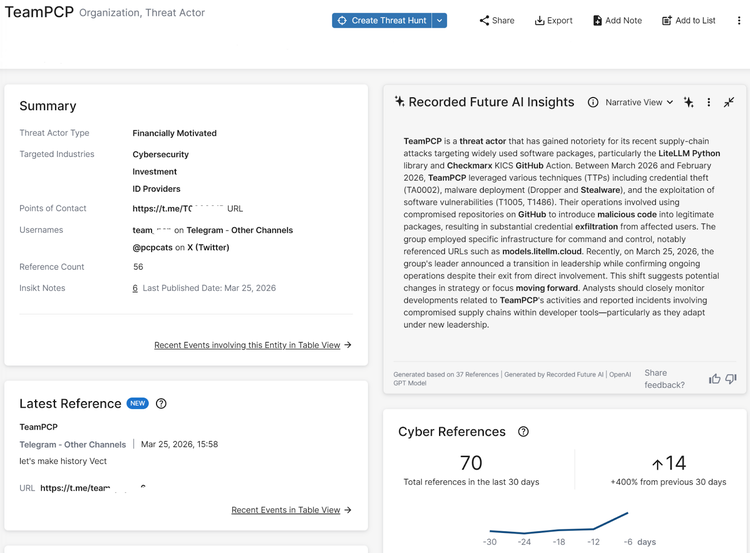
No one has publicly confirmed exactly how TeamPCP gained access to the LiteLLM maintainer’s repository, but the most likely vector is stolen credentials. Recorded Future’s identity intelligence contains almost 1 million compromised GitHub developer credentials harvested by infostealers and sold across dark web marketplaces. A single publishing token or access key, lifted from a prior infection and left unrotated, would have been sufficient. TeamPCPs’ earlier compromise of Aqua Security’s Trivy infrastructure in late February (where incomplete credential rotation left residual access open for weeks) demonstrates exactly this pattern: one stolen token, one missed rotation, and the door stays open.
Whatever the precise mechanism, TeamPCP used valid credentials to push malicious code into trusted repositories. No firewall to bypass. No endpoint to exploit. Just a valid login and the implicit trust that comes with it.
Then the payload itself was designed to steal more identities. Each compromised environment yielded credentials that unlocked the next target. Trivy led to GitHub Actions. GitHub Actions led to four additional software distribution ecosystems. One incomplete incident response created a cascading chain of supply chain compromises across five ecosystems in five days.
This is the identity and access management problem stated as plainly as possible: if the perimeter is identity, then every stolen credential is a breach in the wall. And unlike a firewall rule, a stolen credential doesn’t trigger an alert. It just works.
We previously wrote about how deserialization vulnerabilities have plagued enterprise software for over a decade. The pattern is always the same: trusting input that should not be trusted. Supply chain attacks are the organizational equivalent. We trust the packages we install. We trust the pipelines we build. We trust the security tools we deploy. TeamPCP exploited every layer of that trust, starting with a single compromised identity.
The Impact Is Not Just Ransomware
TeamPCPs’ Telegram channel references a ransomware victim’s site. The group appears to operate as a ransomware affiliate and has publicly discussed extorting companies by threatening to release over 300 GB of stolen data. Reports indicate a possible collaboration with the Lapsus$ extortion group. Ransomware is the obvious play.
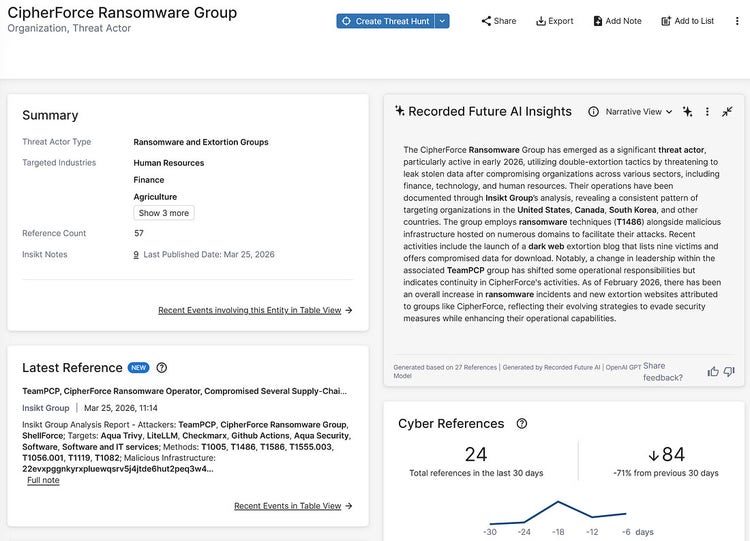
But ransomware is only the most visible impact. The more dangerous question is: what else can you do with over a million stolen cloud credentials, API keys, and service account tokens?
The answer, based on what Insikt Group is tracking across multiple unrelated campaigns, is far broader than encryption and extortion.
Redirect payroll. Late last year (2025) Insikt Group was monitoring activity around a campaign called “Swiper,” run by likely Russian-speaking actors who set up phishing infrastructure impersonating major financial institutions and payroll service providers. Stolen credentials were transmitted in real time, enabling the actors to alter direct deposit accounts and redirect payments before anyone noticed. The responsible actor was identified through a dispute on a criminal forum, and their cryptocurrency wallet has processed over 7,000 transactions. This was a credential theft operation that converted identity compromise directly into financial theft. Now imagine that same playbook amplified by a supply chain attack that harvests payroll platform credentials at scale.
Reroute shipments. Separately, Insikt Group has identified TAG-160, a threat group targeting the US logistics and transportation sector. TAG-160 impersonates logistics companies, sends fraudulent rate confirmations via phishing emails, and delivers remote access malware. But TAG-160 has also been caught running “double brokering scams,” where they pose as a legitimate carrier, obtain valid load details from a real broker, then re-advertise the load under the broker’s name to contract a different carrier. The legitimate carrier moves the freight. The threat actor collects the payment. The real carrier never gets paid. A second, unrelated threat cluster targets German logistics companies with a similar playbook.
These are not theoretical scenarios. They are active campaigns running in parallel with the TeamPCP supply chain compromises. And the common denominator across all of them is credential theft and identity abuse.
In the five risk impact categories we use as a framework for translating cyber threats into business risk, the TeamPCP compromise touches every single one: operational disruption (ransomware, system lockout), financial fraud (payroll redirection, double brokering fraud, extortion payments), competitive disadvantage (credentials, trade secrets, PII), brand impairment (customers learning their security tooling was the vector), and legal and compliance consequences (breach notification obligations, potential liability for downstream impacts).
The tendency is to categorize supply chain attacks as a “security tool problem” or a “developer problem.” It is neither. It is a business risk problem whose blast radius extends from IT operations to payroll to logistics to the boardroom.
Organizations should ask how they can use AI-driven analysis to continuously verify the integrity of every package and build artifact entering their production systems. This means comparing distributed packages against their source repositories to detect injected code. It means analyzing updates to flag anomalous changes in behavior. It means automated provenance verification that traces software from source to distribution, flagging breaks in the chain.
But the TeamPCP campaign exposed a truth the industry has been slow to internalize: the security tools themselves are targets. TeamPCP specifically chose a vulnerability scanner and an application security platform because those tools have the broadest access to credentials and infrastructure. Compromising the tool that checks your code is the ultimate fox-in-the-henhouse scenario.
The organizations that weather this era of supply chain risk will be those that treat code integrity verification as a continuous, automated, AI-augmented process rather than a periodic audit.
So What. Now What.
TeamPCP is not done. Their Telegram channel explicitly states the operation is still unfolding, and they claim to be working with new partners to monetize stolen data at scale.
For security leaders, the immediate actions are straightforward: if your organization uses LiteLLM, Trivy, or Checkmarx GitHub Actions, assume compromise and rotate every credential on affected systems. Audit your software pipelines for unauthorized changes. Pin software dependencies to verified, immutable versions.
But the longer-term lesson is more fundamental. Supply chain attacks convert the trust model of modern software development into an attack surface. The packages you install, the tools you run, the pipelines you build: these are not neutral infrastructure. They are vectors. And the credential stolen today from a compromised software package could show up tomorrow as a payroll redirect, a rerouted shipment, or a ransomware demand.
The keys to your kingdom are scattered across every package manager, every automation token, and every service account in your environment. Someone is collecting them. And your supply chain breach is already someone else’s payday.
How Recorded Future Helps
The TeamPCP campaign left signals at every stage. Three Recorded Future capabilities speak directly to this threat:
- Identity Intelligence — monitors infostealer logs, dark web markets, and credential dumps in real time, automatically detecting compromised employee credentials and triggering immediate response — including the nearly one million compromised GitHub developer credentials already in Recorded Future's dataset.
- Insikt Group — elite analysts with deep government, law enforcement, and intelligence agency experience who produced the TeamPCP, Swiper, TAG-160, and CipherForce research in this blog. Customers see threats as they develop, not after they've made headlines.
- Third-Party Risk — continuously monitors vendors for ransomware extortion activity, breach indicators, and credential leaks, replacing point-in-time questionnaires with real-time visibility across your supply chain.