
August 2026 CVE Landscape
In August 2026, Insikt Group® identified 73 high-impact vulnerabilities that should be prioritized for remediation, 43 of which had a Very Critical Recorded Future Risk Score. This represents a 14% decrease from last month. 31 of these vulnerabilities were surfaced through the US Cybersecurity and Infrastructure Security Agency (CISA)’s Known Exploited Vulnerabilities (KEV) catalog, 32 were reported in open sources and validated by Insikt Group, seven were sourced through security vendor telemetry, and three were exclusively surfaced through honeypot data.
The 73 vulnerabilities in this blog affected products from 45 vendors, with Microsoft accounting for approximately 11% of the vulnerabilities. The remaining exposure spanned remote monitoring and management, virtualization, application delivery, collaboration, artificial intelligence, developer, analytics, identity, operational technology, content management, network edge, video surveillance, and endpoint technologies.
In August, Insikt Group created Nuclei templates to detect CVE-2025-62593 (Ray), CVE-2026-72898 (Metabase), and CVE-2026-9198 (IBM Langflow). Each of these vulnerabilities is featured in this blog. Additionally, Insikt Group had previously created templates to detect CVE-2026-3395 (MaxSite CMS) and CVE-2026-59800 (decolua 9Router), but their exploitation was reported in July, so they are not listed in the August 2026 Vulnerability Table. Additionally, Insikt Group created a Nuclei template to detect GitHub Issue #4255 affecting Apache Log4j, a deserialization allowlist bypass that Apache classified as a hardening gap rather than a Log4j vulnerability; as such, it was not assigned a CVE. These Nuclei templates are available to customers via the Recorded Future Intelligence Platform.
Quick reference: August 2026 vulnerability table
All 70 vulnerabilities below were actively exploited or operationally weaponized in August 2026. This table does not include the three CVEs that were primarily surfaced through honeypot data, which are available to Recorded Future Intelligence Platform customers via the CVE Monthly report. The table below also provides examples of public PoCs identified by Insikt Group. These PoCs were not tested for accuracy or efficacy. Vulnerability management teams should exercise caution and verify the validity of PoCs before testing.
Score
Table 1: List of vulnerabilities that were actively exploited in August, 2026 based on Recorded Future data (excluding honeypot-sourced CVEs).
Key trends: August 2026
- August reporting showed two AI-assisted operations: UAT-10147 exploited Zimbra, AjaxPro, Nacos, and Telerik servers before using DeepAudit and PentestGPT after compromise, while a separate Chinese-speaking actor weaponized Hermes Agent and DeepSeek in failed attempts against Langflow and n8n.
- 34 of the 73 vulnerabilities enabled remote code execution (RCE). They affected Microsoft productivity, database, server, and endpoint software; network edge and application delivery appliances; webmail, collaboration, content management, and web server platforms; AI, analytics, developer, and CI/CD services; and operational technology, product lifecycle management, file transfer, videoconferencing, and enterprise integration software.
- We identified public proof-of-concept (PoC) exploits and scanners for 53 of the 73 vulnerabilities.
- The most common weakness classes were CWE-94 (Code Injection) and CWE-502 (Deserialization of Untrusted Data) with seven each, followed by CWE-287 (Improper Authentication) and CWE-306 (Missing Authentication for Critical Function) with six each.
- 17 vulnerabilities were at least five years old, and the oldest was approximately 16 years old.
Trend analysis: AI-assisted workflows scale exploitation and target selection
Insikt Group detailed how Chinese-speaking threat group, UAT-10147, combined conventional exploitation with agentic artificial intelligence (AI) during post-compromise operations against internet-facing Windows and Linux web servers. Cisco Talos observed the threat actor exploiting or weaponizing CVE-2019-18935 in Telerik UI for ASP.NET AJAX, CVE-2021-23758 in AjaxPro, CVE-2021-29441 and CVE-2021-29442 in Nacos, and CVE-2022-27925 in Zimbra for initial access. After compromise, UAT-10147 used CVE-2010-3904, CVE-2015-3246, CVE-2015-5287, CVE-2021-3156, CVE-2022-0847, and CVE-2022-0995 for local privilege escalation on Linux.
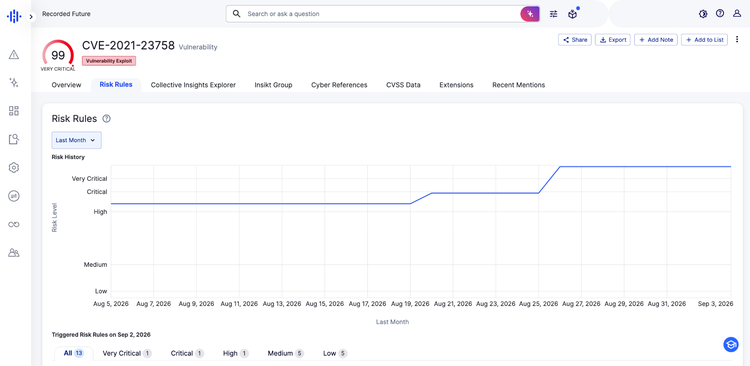
UAT-10147 used DeepAudit and PentestGPT to accelerate vulnerability discovery, PoC execution, payload generation, validation, and troubleshooting, but the operation remained semi-autonomous and required human involvement. Its Windows post-compromise activity included the use of EfsPotato, QuasarRAT, BadIIS, ASHX web shells, Defender exclusions for IIS directories, a Google Chrome Start scheduled task, and rogue privileged accounts. On Linux, the threat actor deployed NoodleRAT, SPECTRE, and Meterpreter after gaining root access. When assessed against Recorded Future’s AI Malware Maturity Model (AIM3), this activity falls at Level 4 (Transforming). UAT-10147 used agentic AI systems to orchestrate multi-step exploitation, reconnaissance, payload generation, validation, troubleshooting, and persistence workflows, but the operations remained semi-autonomous and required human involvement rather than running end-to-end without human oversight.
Insikt Group described a separate Chinese-speaking threat actor that used Hermes Agent with DeepSeek to automate target enumeration, public-exploit acquisition, exploit selection, and exploitation attempts. The agent attempted to exploit CVE-2026-33017 (Langflow) against 84 enumerated instances and chained CVE-2026-21858 with CVE-2025-68613 (n8n) while scanning more than 50 additional targets. The Langflow attempt failed because the discovered target lacked the required public-flow conditions, and the n8n attempts failed because the identified forms required authentication. The threat actor also cloned a placeholder repository for CVE-2026-0300 (PAN-OS), although Unit 42 found no evidence that the threat actor modified or executed it.
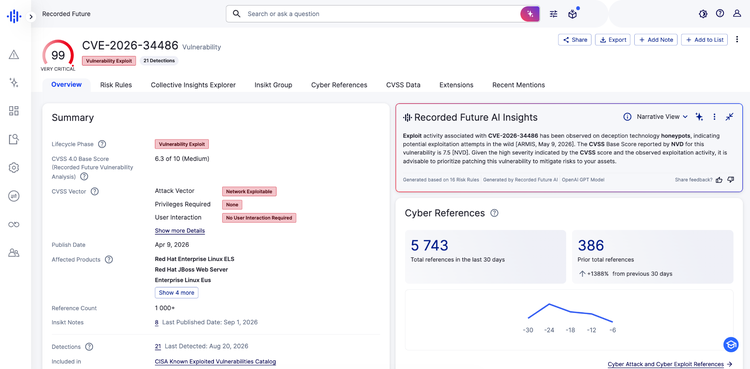
Additionally, the threat actor also exploited CVE-2026-3055 (NetScaler) to exfiltrate memory from three organizations and searched the output for authentication cookies. The threat actor also exploited CVE-2026-39987 (Marimo) to achieve command execution on 11 Marimo notebook deployments, attempted Java deserialization reverse shells against nine Apache Tomcat servers by leveraging CVE-2026-34486, and attempted reverse-shell callbacks against three Windows Internet Key Exchange virtual private network endpoints with CVE-2026-33824. Across both operations, the Chinese-speaking threat actors combined AI-assisted automation with conventional exploitation techniques.
Additional trends and analyses from July are available to Recorded Future customers.
Take action
Timely and relevant information on vulnerabilities in your environment and that of your vendors and suppliers is critical for reducing risk. Find out how Recorded Future can support your team by increasing visibility, improving efficiency, and enabling confident decisions.
Vulnerability Prioritization – Prioritize vulnerabilities based on the likelihood of exploitation – not just the severity. Easily understand the risk of exploitation alongside severity, and real-time contextualized intelligence to help you quickly make confident decisions, patch what matters, and prevent attacks.
Attack Surface Intelligence – Identify internet-facing assets vulnerable to a specific CVE. Attack Surface Intelligence provides an outside-in view of your organization to help you actively discover, prioritize, and respond to unknown, vulnerable, or misconfigured assets.
Third-Party Risk – Gain an external view of the security posture of your vendors and partners. Eliminate time-consuming research and vendor communication cycles with the ability to promptly assess vulnerabilities in their internet-facing systems.
Insikt Group® – Receive access to exclusive reports on new vulnerabilities and trends from Recorded Future’s team of experts, the Insikt Group®. Download Nuclei templates created by Insikt Group® for select CVEs to detect actively exploited vulnerabilities.
Recorded Future Professional Services – Work with our Professional Services team on a Vulnerability Analysis Engagement. Designed to equip your team with advanced strategies for identifying, prioritizing, and mitigating threats effectively, this program delves into technologies and operations essential for a successful vulnerability management program. (Learn more about how our Professional Services team can help elevate your team by watching our recent Vulnerability Prioritization Workshop)
About Insikt Group®
Recorded Future’s Insikt Group, the company’s threat research division, comprises analysts and security researchers with deep government, law enforcement, military, and intelligence agency experience. Their mission is to produce intelligence that reduces risk for customers, enables tangible outcomes, and prevents business disruption.
Related Resources
Explore expert insights, reports, and tools to strengthen your cybersecurity strategy.