
The Fraud Ecosystem Has Industrialized. That's Good News for Defenders Who Know Where to Look.
Payment fraud no longer operates as a collection of discrete schemes run by individual threat actors.
It is increasingly sustained by an industrial support ecosystem: purpose-built infrastructure, packaged toolkits, and professionalized services that allow threat actors to maximize fraud output while minimizing the skill and effort required to execute attacks.
According to Recorded Future's Annual Payment Fraud Intelligence Report: 2025, this industrialization was driven by technical advances and increasingly professionalized support services.
The Magecart e-skimmer supply chain is the clearest example. Full-stack e-skimmer kits and Malware-as-a-Service (MaaS) offerings have made large-scale compromise of ecommerce websites accessible to less technically capable threat actors.
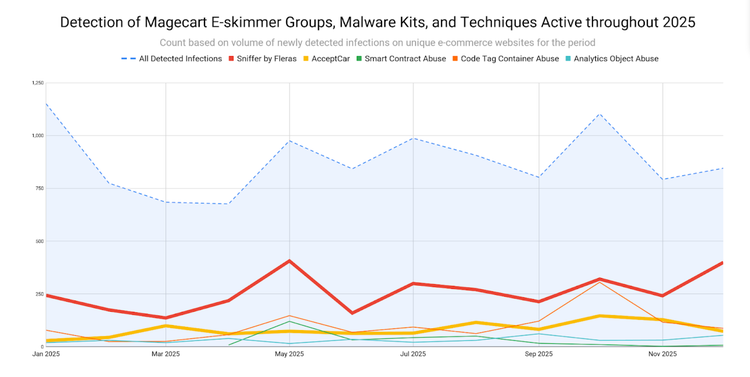
The "Sniffer by Fleras" kit, responsible for 26% of all e-skimmer infections observed in 2025, includes a web-based portal for generating malicious scripts and a management server for stolen data. The result was more than 10,500 unique Magecart infections active at some point during the year, likely compromising more than 23 million transactions.
Additionally, the "AcceptCar" e-skimmer, discovered in H2 2025, illustrates how far the service model has matured. Operators handle installation and operation on compromised e-commerce sites; in return, threat actors pay 50% of proceeds from card data sales or 70% of raw data intake. Using services like AcceptCar, fraud threat actors can participate in large-scale compromise operations without owning or managing any underlying infrastructure.
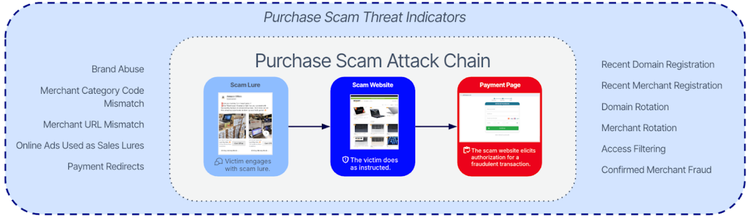
Purchase scam operations reflect a similar dynamic. Recorded Future Payment Fraud Intelligence identified more than 3,600 scam merchant accounts in 2025, up 2.5x from 2024, spanning at least 40 countries and 230 acquirers.
Recurring patterns in merchant registration data indicate that scam operators have standardized their merchant acquisition workflows, standing up fraudulent payment infrastructure at scale through repeatable, low-friction processes.
Card testing operates on the same service-economy logic. Telegram-based card testing services validated at least 27 million card records in 2025 through public-facing card generation and testing channels that any threat actor can access.
Among dark web checker services, over 1,350 legitimate merchant accounts were abused for card testing, with 94% not observed prior to 2025, suggesting systematic rotation to stay ahead of detection.
The Ecosystem Is Concentrated Upstream
Notably, each of these industrialized attack vectors sits upstream of the fraudulent transaction. E-skimmer infections and scam merchants compromise card data during online purchases. Card testing validates that stolen data before it’s monetized.
Fraud outcomes are visible, but the pathways that enable them are often not.
"Fraud outcomes are visible, but the pathways that enable them are often not."
This industrialized scale across these attack vectors requires standardization, and standardization produces detectable patterns.
When 26% of e-skimmer infections trace back to a single kit, when scam operators reuse merchant registration patterns across hundreds of acquirers, when card testers rotate through predictable BIN attack workflows, the convergence that makes fraud scalable also makes it mappable. As that standardization deepens, a single indicator of compromise reaches further across the threat landscape.
That standardization creates something concrete: a window.
Magecart infections are active and identifiable before stolen card data is harvested.
Scam merchants often display detectable signals, including recent domain registration, merchant rotation, and merchant category code mismatches.
Card testing activity reveals when a monetization attempt is likely to occur.
Each stage represents an opportunity to act before fraud registers as a financial loss.
Transaction Monitoring Looks at the Wrong End of the Lifecycle
Transaction monitoring and behavioral fraud models are built to detect anomalies at the point of payment, like unusual spend patterns, velocity, and geographic inconsistencies. They do what they were designed to, but provide no visibility into the increasingly industrialized, pre-monetization stages that were built to avoid detection by these traditional processes.
Purchase scams are explicitly designed to circumvent transaction-based controls by manipulating cardholders into authorizing the fraudulent transaction themselves, making the payment appear legitimate by design.
Card testers cycle through new merchants specifically because historical tester merchants get flagged (94% of tester merchants identified in 2025 were not previously observed). A detection approach built around transaction signals will always be working with information that arrives after the upstream infrastructure has already done its job.
As the upstream ecosystem industrializes, the volume of activity that transaction monitoring cannot see has grown. With purchase scam detections more than quadrupling year-over-year and Magecart infections having likely compromised more than 23 million transactions in 2025 alone, the cost of that blind spot compounds.
Maintaining an effective fraud posture will increasingly require financial institutions to complement reactive account monitoring with proactive, intelligence-informed defenses.
How Recorded Future Payment Fraud Intelligence Addresses This
Recorded Future Payment Fraud Intelligence monitors each of the upstream stages discussed in this post.
With daily monitoring of Magecart-infected sites and enriched merchant data that integrates with transaction monitoring, Payment Fraud Intelligence can enable detection of high-risk merchants months before stolen card data appears for sale.
Additionally, the Scam Merchants dataset can identify fraudulent merchant accounts and their associated domains before customers are defrauded and before downstream card data reaches criminal markets.
Tester merchant monitoring surfaces card testing activity as an early signal of which portfolios are being targeted ahead of any monetization attempt.
Because Payment Fraud Intelligence monitors the sources, kits, and infrastructure that threat actors have increasingly standardized around, a single identified indicator can surface exposure across a portfolio at scale.
According to Recorded Future data, 75% of compromised cards are identified before fraud occurs, and 90% of compromised card assets are identified within hours of a breach.
The pre-monetization window will not narrow as the fraud ecosystem matures — if anything, the report's data suggests it will widen as standardization deepens. Financial institutions with visibility into that window can act before losses occur. Those without it will continue to respond after the fact.
Read the full Annual Payment Fraud Intelligence Report: 2025 to explore this year's findings in depth.