
Getting Ahead of Payment Fraud: The Early Detection Window You're Missing
According to research from Recorded Future, in June 2025 criminals posted 10.5 million payment cards for sale on dark web marketplaces, resulting in $83 million in potential fraud losses from a single month. The worst part? Most fraud teams won't discover these compromised cards until fraudulent charges start appearing weeks or months later.
This highlights the fundamental flaw in modern fraud prevention: while teams excel at analyzing suspicious transactions, they remain blind to the criminal ecosystem where cards and personal information are stolen, bought, and sold, long before that first fraudulent charge appears. Traditional detection only kicks in after criminals have already struck. To break this cycle, fraud teams need visibility into the types of marketplaces where fraudsters purchase their tools and information.
The Dark Web and Beyond: Where Modern Card Fraud Lives
Dark web marketplaces serve as the critical distribution channel powering the fraud ecosystem. The numbers prove it: 269 million card records posted in 2024 (Recorded Future Annual Payment Fraud Intelligence Report: 2024), and 37 million from the US and Canada in Q1 2025 alone. Visibility into this space is needed to prevent card fraud from occurring, but focusing only on these marketplaces misses critical earlier stages in the fraud lifecycle.
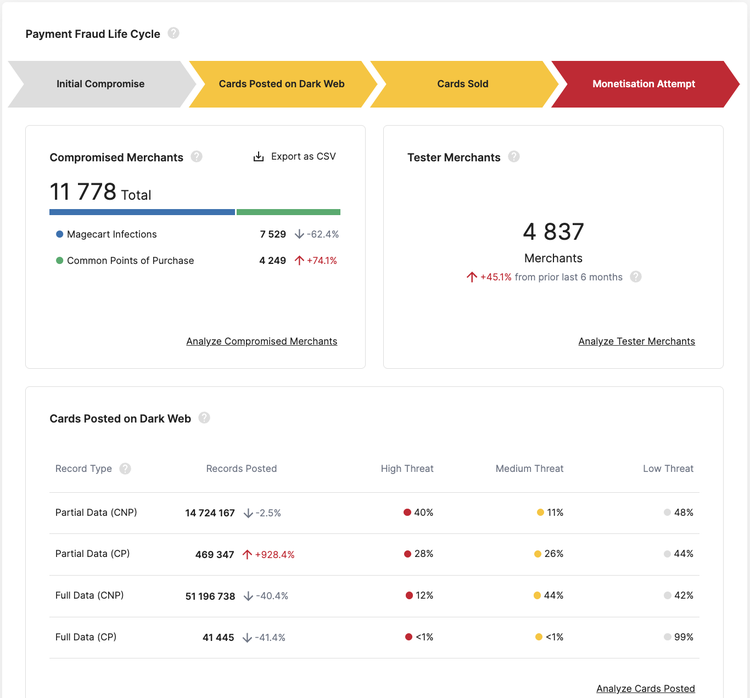
Before cards ever reach criminal markets, they're stolen through increasingly sophisticated methods. Magecart e-skimmers silently harvest payment data from compromised e-commerce sites. Recorded Future identified 2,951 domains infected with Magecart e-skimmers in June 2025, with that number rising to 3,341 in July. Each infected site steals payment data from unsuspecting customers at checkout.
Meanwhile, scam merchants harness increasingly sophisticated tactics, techniques, and procedures (TTPs) to pose as legitimate businesses, process payments, and steal card information directly. The biggest category by far in July 2025 was digital goods sellers, advertising online movies, books, and software that never get delivered. These fake merchants collect payments from unsuspecting customers, then vanish with both the money and card details.
Transaction analysis can reveal common points of purchase (CPPs) after the fact, showing patterns that indicate where cards were likely compromised through either e-skimmer infections or scam merchant operations.
This is the complete fraud kill chain most teams never see. E-skimmers and scam merchants steal the cards. Dark web marketplaces distribute them to buyers worldwide. Tester services validate which cards are still active. Months of planning and preparation happen between theft and use. Traditional fraud teams only witness the final act, the fraudulent transaction, when all opportunity for prevention has passed.
Modern Attack Methods Bypassing Traditional Controls
Criminals have evolved beyond what traditional fraud controls can handle. Consider their timeline advantage: stolen card details can go unused and undetected for long periods of time, retaining value throughout. This gives fraudsters the luxury of patience to develop back-up plans that can obfuscate the various detection & prevention measures employed by card-issuing banks. With most stolen card records being sold with the cardholder’s personal information, there are many options for victim manipulation.
Unsuccessful attempts at fraud are often followed by efforts that exploit personally identifiable information (PII), such as spearfishing and account takeover attacks. This means card records accompanied by PII are associated with higher risk to the cardholder and issuing bank, as well as greater value to criminals. Predictably, fraudsters work very hard for those records and the scale of these operations can be staggering.
In June 2025, a single UK-based phishing campaign deployed 207 domains in just 12 days to harvest victims' personal data and card details. The phishing infrastructure impersonated official web resources of the UK government, manipulating victims into providing a one-time password (OTP) and accepting device checks so the fraudsters could carry out downstream mobile wallet fraud, showing the lengths fraudsters will go to exploit PII-enriched card records. Criminals control when and how to strike. Fraud teams can only react to the aftermath.
These sophisticated techniques operate entirely outside traditional fraud controls' field of vision. While fraud teams analyze yesterday's transactions, criminals are already planning alternative ways to get returns on card records bought in marketplaces fraud teams will never see, or stolen through methods they struggle to detect.
Two recent cases expose the fatal flaw in reactive fraud prevention: by the time you detect fraud, it can already be too late.
Case 1: You Can Never React Fast Enough
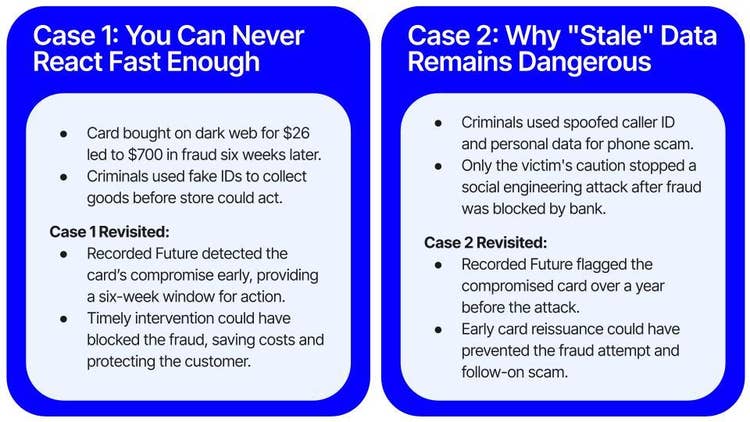
A cardholder spotted a $700 charge at a home improvement store that he never made. He called immediately, hoping to stop the criminals before they collected the order. But speed wasn't enough. By the time the merchant's fraud team got a hold of the store, the goods were gone, picked up with fake IDs by criminals who vanished without a trace.
Recorded Future had identified this compromised card in our datasets on April 14. The fraudulent transaction occurred on May 28: six weeks later. During those six weeks, the card sat on criminal marketplaces, waiting. The fraudsters paid just $26 for the card details and walked away with $700 in merchandise.
Case 2: Why "Stale" Data Remains Dangerous
When a bank successfully blocked a fraudulent transaction, they thought they'd won. Minutes later, the victim's phone rang. The caller claimed to be from the bank's fraud department, complete with the correct caller ID. The caller verified the cardholder's address and informed them that a courier would arrive shortly to collect the compromised card and deliver a replacement. The criminals had everything: full name, address, phone number, email. Only the victim's suspicion prevented disaster.
This card had been in criminal hands for over a year, giving fraudsters ample time to plan their attack and prepare for any fraud prevention response. When the bank blocked their first attempt, they were ready to immediately switch tactics. When the moment came, they leveraged the victim’s personal information to deploy sophisticated social engineering that nearly succeeded despite the bank's initial fraud detection.
The lesson is clear: criminals warehouse data, enrich it methodically, and strike when they find a weakness.
The Critical Gap in Traditional Fraud Prevention
Both cases reveal an uncomfortable truth: even when fraud prevention works exactly as designed, it may not be enough. In Case 1, immediate detection and response still resulted in $700 in losses. In Case 2, successfully blocking a fraudulent transaction merely triggered a sophisticated social engineering attack within minutes. These aren't isolated failures. They're symptoms of a timing problem that plagues traditional fraud detection. Teams analyze transaction patterns, risk scores, and behavioral anomalies. This is valuable data, but it's generated only after criminal activity has already begun. It shows where fraudsters have been, but not where they're headed. Even with enhanced industry collaboration and sophisticated risk-scoring algorithms from card networks, these tools remain retrospective by design.
Getting “Left of Boom”
Cybersecurity professionals use the term "left of boom" to describe preventing attacks before impact. They’ve learned that waiting for attacks means data is already stolen, systems compromised, and millions lost. To prevent breaches before impact, they hunt for early indicators, like suspicious traffic, malware signatures, and threat actor chatter. Fraud teams need the same early warning system empowered by a more comprehensive view of their adversaries.
The gap is visibility, not capability. When e-skimmers infect trusted merchants or cards surface on criminal forums, these signals offer the same opportunity as pre-attack indicators in cybersecurity. Teams with this visibility can reissue cards, tighten monitoring, and avoid the development of creative back-up plans. Without it, they're condemned to investigate losses instead of preventing them. The entire game changes when you can see the whole kill chain, not just the explosion at the end.
The Power of Proactive Intelligence
Recorded Future Payment Fraud Intelligence provides what traditional fraud systems lack: comprehensive visibility across the entire fraud lifecycle. By indexing intelligence directly from criminal marketplaces, messaging applications and compromised e-commerce sites, Payment Fraud Intelligence can identify stolen payment data before fraud occurs, enabling financial institutions to take preventative action.
The Platform delivers precision intelligence at every stage:
- Pre-compromise detection through daily Magecart monitoring catches e-skimmer infections as they happen on merchant sites.
- Transaction analysis reveals CPPs, which can expose breached or scam merchants before their stolen inventory hits criminal markets.
- Dark web monitoring tracks cards from the moment they're listed through enrichment and sale.
- Tester merchant detection uncovers merchants that criminals use to test the validity of stolen payment cards.
This real-time processing transforms scattered data points into actionable intelligence, enabling teams to see threats first and act before impact.
By shifting from reactive detection to proactive prevention, fraud teams can finally gain the advantage. They know what matters most and can act when it matters most.
Case 1 Revisited: The 6-Week Window
Recorded Future identified the compromised card on April 14, six weeks before the fraudulent transaction on May 28. With this early warning, the card-issuing bank could have taken decisive action. Card reissuance or enhanced monitoring could have prevented the $700 loss, preserved customer trust, and eliminated refund costs. Instead of investigating fraud after the fact, the bank could have stopped it cold.
Case 2 Revisited: The Year-Long Vulnerability
The stolen card appeared in our dataset over a year before criminals attempted to use it. This extended timeline reveals the true power of early detection. When fraudsters have a year to work with, they often don't just try once and give up. A blocked transaction can become a social engineering attempt. A failed phone scam can become an account takeover. They keep coming back with new angles until something works. Immediate card reissuance could have shut down this cycle before it even started.
From Reactive to Proactive
Traditional fraud prevention follows a predictable pattern: analyze yesterday's fraud, react with new rules, update systems, and wait for the next attack. This cycle guarantees you'll often be one step behind.
Intelligence-driven prevention flips the script. Monitor criminal marketplaces continuously. Identify compromised cards the moment they appear. Prevent fraud before criminals even attempt it. This isn't incremental improvement. It's a fundamental shift from playing defense on the criminals' timeline to controlling the game yourself. When you see threats first, you can act first. That changes everything.
Learn more about how Payment Fraud Intelligence helps teams get ahead of fraud.