2026 State of Security
Explore the intelligence from Recorded Future's Insikt Group annual threat landscape analysis: the definitive report on how geopolitical fragmentation, state-sponsored operations, and criminal ecosystem evolution are reshaping global risk.
Fragmentation is the new normal
The global threat landscape didn't simplify in 2025—it shattered. Geopolitical alliances strained. Criminal enterprises splintered and regrouped. State-sponsored actors shifted from dramatic disruptions to quiet pre-positioning. And as long-established norms unwound, convergence across once-distinct domains created unprecedented uncertainty.
The 2026 State of Security report delivers Insikt Group's most comprehensive annual analysis of the forces shaping global security—helping leaders reduce surprise, prioritize effectively, and act with confidence.
2025: A year of fragmentation
Geopolitical tensions dominate
- Russia-Ukraine War Enters Fourth Year | Geopolitical
- India-Pakistan Ballistic Missile Exchanges | Geopolitical
- US-Brokered Ceasefire Prevents Escalation | Geopolitical
State-sponsored attacks
- Israel-Iran Twelve-Day Conflict | Geopolitical
- RedMike Campaign Targets Telecom Infrastructure | State-Sponsored
- Chinese Actors Exploit Unpatched Cisco Devices Across 100+ Countries | State-Sponsored
Geopolitical threats and deepfakes
- Thailand-Cambodia Border Clashes | Geopolitical
- Russian GRU Operations Intensify Against NATO Infrastructure | State-Sponsored
- Deepfake-Enabled Fraud Increases 10x Since 2024 | Emerging Technology
Cybercrime leads
- 289 New Ransomware Variants Identified (33% YoY Increase) | Cybercrime
- Synthetic Identity Fraud Up 300% | Emerging Technology
- Law Enforcement Disruptions Fragment Criminal Ecosystems | Cybercrime
The converging threat landscape
State-sponsored operations
Risk moves to the edges
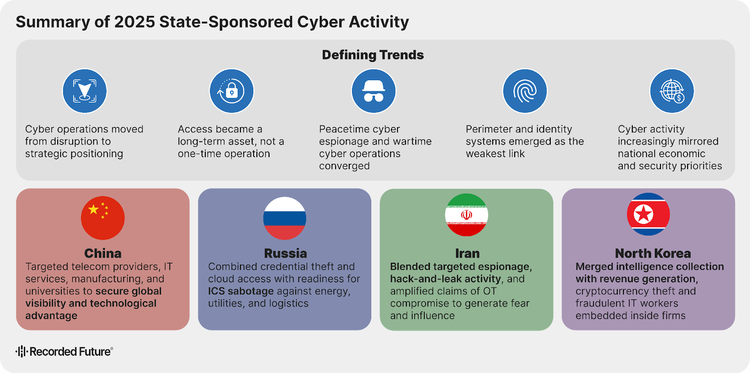
China, Russia, Iran, and North Korea focused not on dramatic attacks but on covert accumulation of access—targeting identity systems, cloud environments, and edge infrastructure where oversight is weakest. The primary risk is no longer a single large-scale incident. It's sustained pre-positioning that enables persistent espionage and creates latent capacity for disruption.
Key Insight: Warning timelines are compressing. The adversaries are already inside.
Hacktivism & influence operations
Convergence across domains
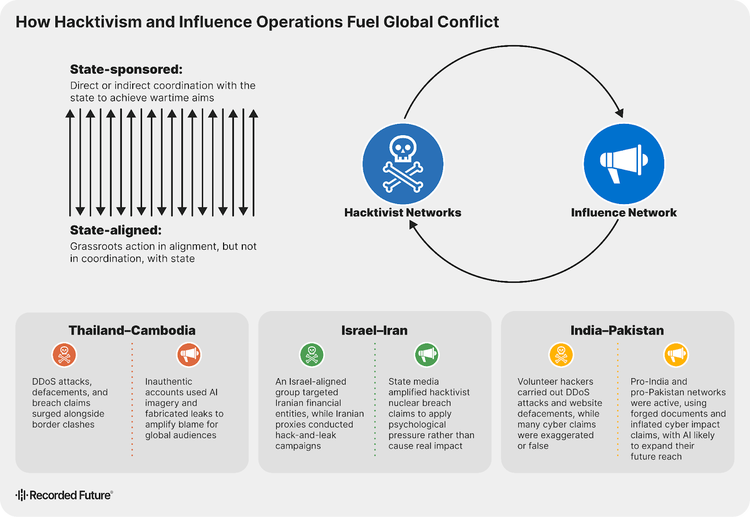
Every major conflict in 2025 had a digital front—and the combatants weren't always who they claimed to be. Genuine intrusions, exaggerated claims, and disinformation reinforced one another across Israel-Iran, India-Pakistan, Thailand-Cambodia, and Russia-Ukraine conflicts.
Key Insight: Perception is now contested terrain. Even low-sophistication attacks generate outsized impact when amplified through coordinated information operations.
Cybercrime evolution
Fragmented, modular, resilient
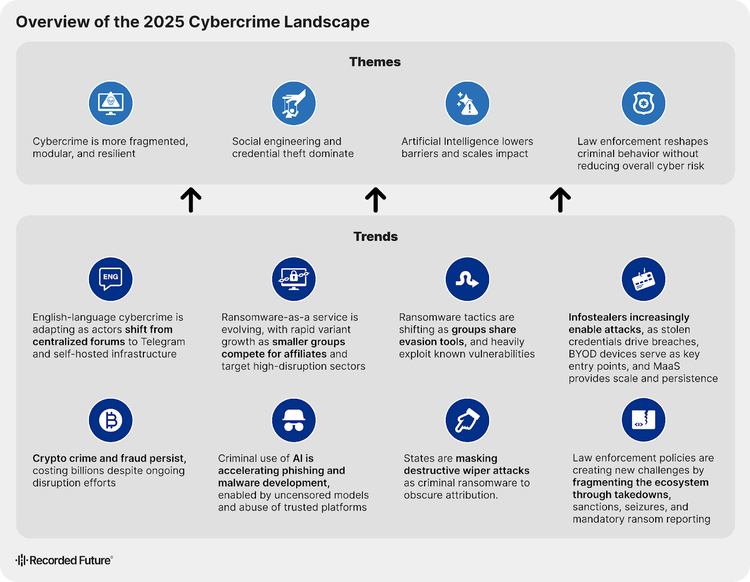
Law enforcement achieved significant wins in 2025. But the criminal ecosystem adapted. Sustained pressure fractured large enterprises into smaller, decentralized operations. Groups adopted subscription models, outsourced operations, and relied on specialized services—creating a distributed criminal supply chain that's resilient and difficult to track.
Key Insight: Threat actors are adapting faster than defenses. Modular ecosystems mean even disrupted operations reconstitute rapidly.
Emerging technology risk
Verification failure at scale
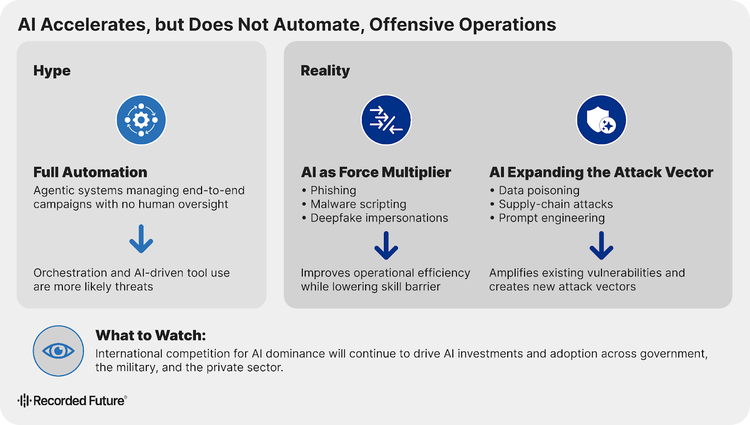
2025 was not a breakout year for AI-driven cyber operations. But the immediate risk isn't autonomous attacks—it's verification failure at scale, where deception becomes faster, cheaper, and more convincing. As AI becomes empowered to take real-world actions through autonomous agents, the attack surface for fraud and manipulation will expand dramatically.
Key Insight: Organizations that act now to establish AI governance and prepare for post-quantum migration will hold significant advantages.
What 2025 teaches us about 2026
The patterns of 2025 point toward a threat environment defined by sustained uncertainty. Security leaders should prepare for:
Download the full report
The 2026 State of Security report provides comprehensive analysis of each threat domain, threat actor profiles, regional risk assessments, and actionable recommendations for building organizational resilience.
Intelligence doesn't eliminate uncertainty—it makes uncertainty manageable. Get the insights you need to reduce surprise, prioritize effectively, and act with confidence.
The 2026 State of Security report was produced by Recorded Future's Insikt Group, comprising analysts and security researchers with deep government, law enforcement, military, and intelligence agency experience.