
Why Executive Accounts Are the Hardest Identity Problem to Solve
There's a category of employee credentials where standard monitoring often falls short: executives, finance leaders, IT administrators, and those with privileged access have a large target on their back.
VIP Credential Monitoring in Recorded Future is built to solve this problem. It continuously monitors for credential exposures tied to your most sensitive individuals across both work and personal accounts, and alerts your team fast enough to act before an account takeover occurs.
The Challenge with Protecting Your Most Targeted People
According to Verizon's 2025 Data Breach Investigations Report, credential abuse was the most prominent initial access vector observed across breaches. Attackers don't need to find a technical vulnerability to get inside your organization. Stolen credentials are widely available across criminal forums and dark web marketplaces, and buying access is often faster and cheaper than building an exploit.
What makes this particularly calculated is how threat actors decide which credentials to buy. Infostealer malware logs don't just capture usernames and passwords — they capture the authorization URLs where those credentials were entered. According to Recorded Future’s 2025 Identity Threat Landscape Report, 7 million credentials were indexed with identifiable authorization URLs, with 63.2% of those having been linked to authentication systems.
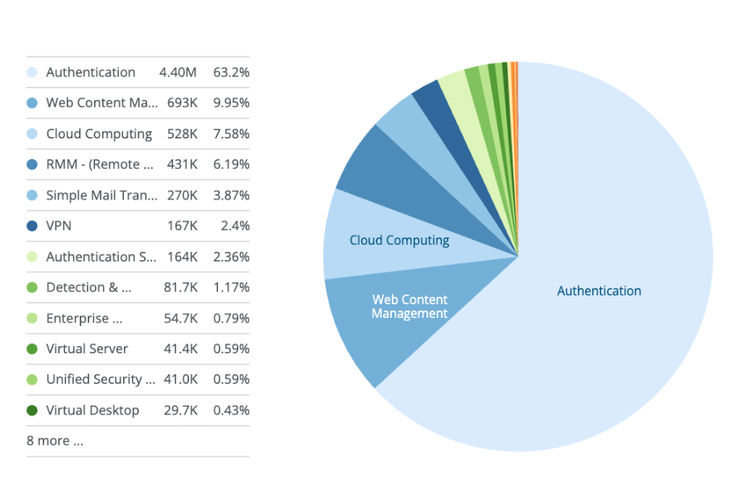
That means attackers can usually identify the access endpoints credentials unlock and they will prioritize accordingly. Executives and anyone with broad access to systems and data sit at the top of that list.
The 2025 cyber attack on University of Pennsylvania illustrates exactly how this plays out. A threat actor compromised a single employee's SSO credential and used it to move laterally across corporate systems, ultimately exposing data on approximately 1.2 million donors, alumni, and students. One credential, one login, and an organizational crisis.
The threat doesn't stop at corporate accounts. When attackers can't get hold of an executive's work credentials, they target personal accounts for these high-value targets. A personal email or social account can expose sensitive communications, private information, or material an attacker can use for extortion.
Corporate security controls don't extend to personal accounts. When those credentials are stolen, most security teams have no line of sight.
That gap between exposure and discovery is where the risk lives. Credentials stolen by infostealer malware are often purchased and weaponized within 48 hours of the compromise, potentially days or weeks before a security team has any indication something is wrong. For standard employee accounts, that window is serious. For your CEO or Head of Engineering, it's critical.
Monitoring Built for High-Value Targets
VIP Credential Monitoring provides continuous monitoring and alerting on compromised credentials for your high-value targets. Security teams can add personal or work email addresses for their executives and others with widespread access.
From that point forward, Recorded Future continuously monitors for those accounts across its full source coverage: infostealer malware logs from 30+ malware families, dark web forums, criminal marketplaces, paste sites, and breach dumps. When a VIP credential surfaces in that data, the team receives an alert with full contextual detail (malware family, authorization URL, compromised host information, etc.) so they can act with confidence.
Many executive monitoring solutions surface credential data that is days or weeks old by the time it reaches an analyst. By then, the window to get ahead of an attacker has often closed. For all stolen credentials indexed in 2025, Recorded future detected 36.4% within 24 hours of exfiltration, and 52.9% within one week.
The gap between when credentials are stolen and when a security team finds out is where breaches happen. Recorded Future closes that gap.
When a VIP credential appears in exposure data, teams can initiate a password reset, review active sessions, or reach out directly to the individual — all before the credential is exploited. For identities that carry this level of organizational risk, getting ahead of the exposure isn't just operationally valuable; it can be the difference between a resolved alert and a significant incident.
A Complete Picture of Identity Exposure
VIP Credential Monitoring is built on the same intelligence infrastructure that powers Recorded Future Identity Intelligence broadly: the same source coverage, the same detection engine, the same alert and triage workflow. It applies that capability to a category of identities that warrant closer attention, without requiring a separate tool, process, or integration. That's the logic behind Identity Intelligence as a whole: a unified view of credential exposure across every category of identity your organization needs to protect, covering employees, customers, and your highest-risk individuals.
For teams already using Identity Intelligence to monitor employee and customer credentials, VIP Monitoring is a targeted extension of coverage that fits into what they've already built. Any VIP credentials identified will benefit from the same core features of Identity Intelligence.
This includes Incident Reports, which surfaces any other credentials that may have been compromised from the same machine, and Customizable Alerting, which streamlines prioritization of these detections and can trigger response workflows through existing integrations with Okta, Microsoft Entra ID, XSOAR, Splunk, and others.
Attackers don't limit their targets to one type of account, and your monitoring shouldn't either. To see where you stand today, request a free Identity Exposure Assessment Report and get a concrete, evidence-based picture of your organization's credential exposure over the past year. Contact us to learn more about how Recorded Future can help your organization protect its identities and to see a demo of the platform in action.