
Making Cyber Threat Intelligence Operational: From Alerts to Actionable Insights
Key Takeaways
- The average organization today relies on multiple platforms and tools delivering round-the-clock feeds of security information and alerts. Under this deluge of data, many organizations find themselves struggling to actually make sense of, let alone use of, all this information.
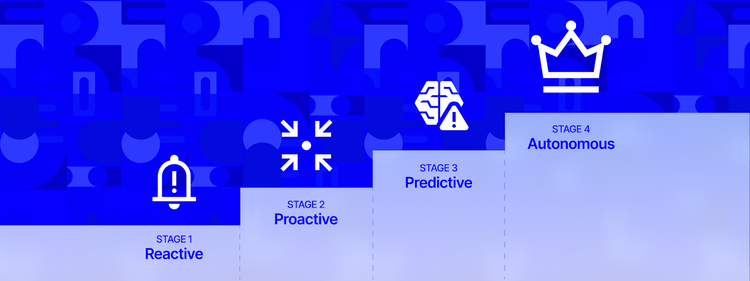
- Recorded Future offers a concrete threat intelligence maturity journey organizations can follow in order to evolve from this reactive state of intelligence overload, to a more value-added state. The four stages of this journey include: Reactive, Proactive, Predictive, and Autonomous.
- Along the course of this journey, organizations will take clear steps to go from responding to threats after detection, to preventing known threats, all the way to using automation to self-direct threat responses with minimal human intervention
- Platforms like Recorded Future provide the data, context, and automation to accelerate your journey toward operational cyber threat intelligence maturity.
The Information Overload Problem: Why More isn’t Always Better
Your security operations center (SOC) runs multiple threat intelligence feeds around the clock. Hundreds of alerts pour in daily—indicators of compromise (IOCs), suspicious IP addresses, emerging vulnerabilities, and more. Yet despite all this data, the team still spends much of its day reacting to alerts, rather than staying ahead of threats. Valuable data is stored, analyzed, and even given high visibility, but rarely acted upon in time to make a difference.
This is the information overload problem, and it’s widening the gap between information and action. Organizations collect and subscribe to vast quantities of threat data from multiple sources, but few have the threat intelligence capabilities—the processes, integrations, and automation—required to add context to all that data and transform it into measurable security outcomes.
The problem isn’t the data itself. It’s the operationalization of it. That is to say, the ability to use threat data efficiently, contextually, and predictively across the security ecosystem. As Recorded Future highlights in its Threat Intelligence Maturity Assessment, most organizations are somewhere along a journey toward maturity, moving from purely reactive intelligence to fully autonomous operations.
This post explores that path, offering a practical roadmap for transforming raw alerts into operational cyber threat intelligence. Using the four stages of maturity (i.e. Reactive, Proactive, Predictive, and Autonomous) we’ll show how organizations can evolve their security programs from putting out fires to acting with foresight.
The Threat Intelligence Maturity Model: From Reactive to Autonomous
Threat intelligence isn’t a binary capability. It exists on a continuum. As organizations gain visibility, automation, and analytical depth, their approach to threat intelligence evolves. Recorded Future’s Threat Intelligence Maturity Model defines this journey in four stages:
- Reactive: Responding to threats after detection.
- Proactive: Preventing known threats before impact.
- Predictive: Anticipating threats before they materialize.
- Autonomous: Enabling self-directing, intelligence-led defense at machine speed.
Each stage represents a significant leap in capability, mindset, and operational efficiency. Progress along this path requires more than just technology. It depends equally on people, processes, and the integration of intelligence into everyday decision-making.
In the sections that follow, we’ll explore what defines each stage, common challenges, measurable KPIs, and key actions to help organizations advance their threat intelligence operations.
Stage 1: Reactive—Responding to What’s Already Happened

In the Reactive stage, organizations are still fighting fires. Various forms of intelligence are consumed, but rarely operationalized. Analysts manually investigate alerts, cross reference indicators, and often rely on intuition or Google searches to make sense of raw data.
This stage is typical for teams suffering from alert fatigue or lacking dedicated threat intelligence personnel. Intelligence feeds may be connected to security tools, but without clear processes, much of that data sits unutilized.
Characteristics of a Reactive Organization
- Focused on detection and containment.
- Success means closing incidents, not necessarily preventing them.
- However, this stage is where the foundation for maturity is built.
Pain Points and Challenges
- Overload without insight: Teams receive too many alerts to analyze effectively.
- Siloed tools and workflows: Intelligence isn’t integrated across the stack.
- Limited automation: Manual lookups and enrichment dominate response time.
- High dwell time: Threats are detected after the fact, often too late for meaningful containment.
Steps to Advance
- Centralize intelligence feeds into a single operational view.
- Automate enrichment of alerts with high-confidence threat indicators.
- Establish workflows for classifying, triaging, and escalating alerts based on context.
- Begin correlating IOCs with known campaigns or adversary tactics.
Success Indicators and KPIs
Across the industry, certain standards, KPIs and other measures have emerged to help orient and assess one’s progress through each stage of the maturity journey. For the Reactive stage, these include:
- Reduction in duplicate or “known bad” alerts.
- Decrease in manual investigations per analyst.
- Improved Mean Time to Triage (MTTT): faster analysis of known threats.
- Greater integration between intelligence feeds and alert management.
The Reactive stage is about laying the groundwork for operationalized intelligence, consolidating data and reducing noise so analysts can focus on meaningful threats. Once teams can respond consistently and efficiently, they’re ready to evolve toward a proactive posture.
Stage 2: Proactive—Preventing Known Threats

The Proactive stage marks a crucial transition from reacting to known events to actively preventing them. Here, organizations begin to enrich alerts with context, prioritize risk, and use intelligence to inform vulnerability management and threat hunting.
Teams at this stage have moved beyond basic detection. They use intelligence to drive decision-making, asking “What matters most to us?” instead of simply responding to what the feeds say.
Characteristics of a Proactive Organization
- Security teams conduct regular threat hunting exercises to identify indicators of compromise before alerts fire.
- Vulnerability management programs are intelligence-led, prioritizing patches based on real-world exploitation trends.
- Analysts can articulate threat actor behaviors and motivations, not just indicators.
- Intelligence is beginning to inform executive-level reporting and risk assessments.
Pain Points and Challenges
- Context overload: Adding intelligence without prioritization can still create noise.
- Scaling analysis: Manual research can’t keep up with threat volume.
- Communication gaps: Intelligence insights may not reach decision-makers fast enough.
Steps to Advance
- Integrate enrichment and context directly into alert workflows.
- Use intelligence to prioritize vulnerabilities being actively exploited in the wild.
- Establish a repeatable threat hunting process tied to known tactics, techniques and procedures (TTPs).
- Create basic reporting dashboards to show intelligence-driven outcomes to leadership.
Success Indicators and KPIs
As outlined above, industry best practices and our own internal expertise has helped to inform clear indicators of success and measurable KPIs to help you traverse this stage:
- Further reduction in Mean Time to Respond (MTTR) and faster full-cycle incident resolution.
- Increase in incidents identified through proactive hunting.
- Decrease in unpatched, high-risk vulnerabilities.
- More consistent cross-departmental sharing of intelligence insights.
Proactive organizations are no longer purely reactive responders; they are early detectors. They use operational cyber threat intelligence to stop known attacks before they strike, ridging the gap between detection and prevention.
Stage 3: Predictive—Anticipating What’s Next

At the Predictive stage, organizations transform from defenders into forecasters. Intelligence isn’t just about identifying active threats. It’s about anticipating what adversaries will do next.
Predictive intelligence uses advanced analytics, automation, and pattern recognition to reveal emerging campaigns, shifting tactics, and vulnerabilities before they’re exploited. At this stage, intelligence becomes strategic, influencing not just SOC operations but enterprise-wide risk management and planning.
Characteristics of a Predictive Organization
- Security and risk teams share a unified intelligence strategy.
- Machine learning and AI tools help identify evolving threat trends.
- Insights extend beyond cyber to supply chain, digital risk, and geopolitical factors.
- The organization uses predictive intelligence to guide security investment decisions.
Pain Points and Challenges
- Data interpretation: Turning predictive signals into actionable decisions.
- Cross-functional alignment: Intelligence must inform departments beyond security (legal, procurement, communications).
- Maintaining analyst trust in automation, ensuring predictive systems remain transparent and explainable.
Steps to Advance
- Combine internal telemetry with external intelligence for a 360° threat view.
- Monitor emerging TTPs and map them to organizational exposures.
- Develop scenario-based playbooks informed by predictive analysis.
- Use predictive insights to shape security budgets and executive strategy.
Success Indicators and KPIs
- Significant reduction in average dwell time (threats neutralized before causing damage).
- Overall percentage of threats mitigated before exploitation.
- Increased accuracy of threat forecasting.
- Improved strategic alignment between security and business objectives.
The Predictive stage represents the maturation of threat intelligence operations. Security becomes a forward-looking function—one that can anticipate risk and shape outcomes, rather than merely react and respond to them.
Stage 4: Autonomous—Intelligence at Machine Speed

The Autonomous stage represents the pinnacle of operational cyber threat intelligence maturity. At this point, intelligence systems and AI-driven automation operate continuously: detecting, analyzing, and responding to threats with minimal human intervention.
Here, human analysts focus on strategic research, oversight, and long-term planning while machines handle routine detection and response. Intelligence is fully operationalized, driving every aspect of the security ecosystem in real time.
Characteristics of an Autonomous Organization
- Threat intelligence is deeply integrated across all systems and workflows.
- AI and automation enable continuous detection and response without manual triggers.
- The organization has global visibility into digital, third-party, and geopolitical risks.
- Threat intelligence is recognized as a strategic business differentiator.
Pain Points and Challenges
- Governance and oversight: Ensuring automated decisions remain transparent and aligned with policy.
- Cultural adaptation: Building trust in autonomous operations among leadership and analysts.
- Optimization: Continuously tuning models and workflows for performance and precision.
Steps to Advance
- Expand autonomous intelligence integration across the full security stack.
- Enable continuous enrichment of intelligence data for context-aware decision-making.
- Automate rule creation and response playbooks based on live threat insights.
- Use AI to generate executive-level summaries and automated intelligence reporting.
Success Indicators and KPIs
- High rate of automated response actions.
- Continuous reduction in dwell time.
- Consistent threat mitigation without human escalation.
- Cross-functional visibility and reporting of intelligence outcomes.
In the Autonomous stage, the line between intelligence and action disappears. Security operations are intelligence-led and self-improving, creating a closed-loop system that operates at the same speed as the adversaries it defends against.
Fueling the Engine: How Intelligence Powers Every Stage
Progression through these maturity stages depends on the quality, breadth, and automation of the underlying intelligence platform. Recorded Future’s ecosystem exemplifies this principle—providing comprehensive data, contextual insights, and machine-speed automation to advance organizations along the maturity curve.
Stage
Primary Intelligence Focus
Outcome
At every stage, operational cyber threat intelligence is both the fuel and the framework for progress. It informs decisions, shapes response playbooks, and empowers organizations to act faster, smarter, and with greater confidence.
Your Next Move on the Journey to Operational Intelligence Maturity
Operationalizing threat intelligence is not a single milestone, it’s a journey. Each stage builds upon the last, requiring time, structure, and deliberate investment in people, process, and intelligence integration. Just like a human learning to crawl, walk, run, and sprint, the journey towards maturity is rich with both challenges and rewards.
The key is honest assessment:
- Are you still chasing alerts in a reactive, ad hoc fashion?
- Have you begun to anticipate known threats through proactive hunting and prioritization?
- Are you using predictive analytics to anticipate emerging risks?
- Or have you reached autonomous operations, where intelligence drives decisions at machine speed?
Wherever you are today, your next move determines how effectively your organization can predict, prevent, and protect against tomorrow’s threats.
Whether you’re integrating your first intelligence feed or orchestrating fully autonomous threat response, Recorded Future provides the data, context, and automation to accelerate your journey toward operational cyber threat intelligence maturity.
See how Recorded Future’s Threat Intelligence Platform can empower your organization to move from reactive defense to autonomous, intelligence-led operations.
Frequently Asked Questions
What does it mean to "operationalize" threat intelligence?
Operationalizing threat intelligence means moving it from a passive, informational role to an active, integrated part of your daily security operations. It's the process of embedding timely, relevant, and contextualized intelligence directly into your security tools (like SIEMs, SOAR platforms, and firewalls) and workflows to enable automated, proactive, and faster defense.
What's the difference between strategic, tactical, and operational intelligence?
Strategic intelligence is high-level information for executive leadership about the threat landscape and business risk. Tactical intelligence focuses on the specific tactics, techniques, and procedures (TTPs) of threat actors for a more technical audience. Operational intelligence is the real-time application of tactical intelligence to daily security tasks, such as identifying active threats in your network or prioritizing vulnerabilities for patching.
What is a common mistake when starting a cyber threat intelligence program?
A common mistake is focusing solely on acquiring data feeds without a clear plan for how the data will be processed, analyzed, and used. This leads to overwhelming security teams with low-fidelity alerts and noise, a problem often called "death by data." An effective program prioritizes the operational process over the simple collection of data.
How does Recorded Future help operationalize threat intelligence?
Recorded Future's Threat Intelligence Platform is designed specifically for operationalization. It automates the collection and analysis of a massive amount of data, enriches it with context, and assigns risk scores to make it actionable. Crucially, its extensive library of integrations allows security teams to feed this high-fidelity intelligence directly into their existing security tools, empowering everything from SOC alerting and vulnerability prioritization to incident response.
What is a key metric for a successful threat intelligence operation?
A powerful metric is "Mean Time to Detect" (MTTD) or "Mean Time to Respond" (MTTR). A successful operational CTI program will demonstrably reduce these times by providing analysts with the context they need to identify real threats faster and providing automated systems with the high-confidence data needed to block threats proactively.