Beyond Acceleration and Automation: How AI + Intelligence Changes Cyber Defense
Executive Summary
Artificial intelligence is often discussed as a tool for automating and accelerating existing cybersecurity workflows. While that framing is accurate, it is incomplete. The most consequential shift occurs when AI is combined with threat intelligence — both intelligence about attacker capabilities and TTPs, and intelligence about our own defensive weaknesses and exposure. This combination produces qualitatively new defensive capabilities that may, for the first time, begin to structurally narrow the long-standing asymmetry between attackers and defenders.
This memo examines what is genuinely new about AI-enabled defense, with particular emphasis on how the fusion of threat intelligence and AI reasoning changes the strategic calculus. It also argues that in the end, it is a question of who can most efficiently use scarce resources (compute and energy) to get the upper hand. Intelligence guides defenders in how to best use these resources to defend, thereby changing the balance of power against adversaries.
The Traditional Defender’s Dilemma
The core asymmetry in cybersecurity is well understood: defenders must protect every possible attack surface, while attackers only need to find one exploitable weakness. Defenders operate under constraints — budgets, compliance mandates, uptime requirements — while attackers can be patient, selective, and asymmetric.
Traditionally, threat intelligence has been consumed by defenders as a feed: indicators of compromise, malware signatures, and published advisories. This intelligence was valuable but largely reactive and disconnected from the defender’s own environment. Knowing that a threat group uses a particular technique is only useful if you can rapidly assess whether that technique works against your infrastructure. That assessment has historically required scarce human expertise, time, and tooling — precisely the resources defenders lack.
The Automation Layer: Real But Evolutionary
A significant portion of AI’s current impact on defense is best described as automation of existing processes: faster alert triage, automated enrichment, accelerated patch prioritisation, and AI-assisted Tier 1 SOC analysis. These improvements are valuable — they compress response times, reduce analyst fatigue, and address chronic staffing shortages — but they are conceptually extensions of workflows that already existed.
Similarly, AI can automate the ingestion and normalisation of threat intelligence feeds, reducing the manual work of parsing reports and extracting indicators. This is useful, but it does not change what defenders can fundamentally do with that intelligence. The real transformation lies elsewhere.
The Convergence: Where Threat Intelligence Meets AI Reasoning
The most significant shift is not AI applied to defense in isolation, nor threat intelligence consumed as a feed. It is the convergence of the two: AI systems that can reason simultaneously over what attackers are doing and what defenders are exposed to, in real time, at scale. This convergence produces capabilities that did not previously exist.
1. Connecting Attacker TTPs to Your Actual Exposure
Traditionally, a threat intelligence report might tell you that a particular adversary group is exploiting a vulnerability in a specific product, or is targeting your sector using a known technique chain. Acting on that information used to require an analyst to manually map those TTPs against your environment: do we run that product? Is the vulnerable version deployed? Are the relevant network paths open? Are our detection rules adequate for that technique?
AI can perform this mapping continuously and at scale. When a new threat report lands, an AI system can immediately cross-reference the described TTPs against a live model of your infrastructure, your patching state, your detection coverage, and your segmentation — and surface a prioritised assessment of actual risk, not theoretical risk. This transforms threat intelligence from awareness into actionable, environment-specific defense guidance.
2. Fusing Offensive Intelligence With Defensive Weakness Data
Defenders have long maintained two separate bodies of knowledge: external threat intelligence (what adversaries are capable of and likely to do) and internal vulnerability and exposure data (what weaknesses exist in our own environment). These have typically lived in different systems, managed by different teams, and reconciled manually and infrequently.
AI enables continuous fusion of these two streams. A model can hold both the attacker’s perspective — known TTPs, targeting patterns, tooling, and objectives — and the defender’s perspective — unpatched systems, misconfigured controls, overprivileged accounts, and detection gaps — and reason about the intersection. The result is not a vulnerability list or a threat report, but an integrated picture of where the attacker’s capabilities meet our specific weaknesses. This is the analysis that the best red teams produce during an engagement, except it can now run continuously rather than quarterly.
3. Predictive Prioritisation Based on Adversary Behaviour
Patch prioritisation has traditionally been driven by CVSS scores — a measure of theoretical severity that ignores both attacker intent and environmental context. AI models trained on threat intelligence can reorder priorities based on which vulnerabilities are actually being exploited in the wild, by which adversary groups, against which sectors, using which delivery mechanisms. Combined with internal exposure data, this enables prioritisation that better reflects real-world risk rather than abstract severity.
The same logic applies to detection engineering. Rather than building detections for every possible technique, AI can identify the techniques most likely to be used against your specific environment — based on who is targeting your sector, what tools they use, and where your coverage gaps are — and focus engineering effort where it matters most. In fact, in most cases AI will be able to build those detectors for you!
4. Reasoning Over Context at Scale
Traditional detection systems correlate events against rules. AI models can reason about events holistically, synthesising partial logs, ambiguous telemetry, and unusual configuration changes into a judgment that approximates what a senior analyst would conclude. Crucially, this reasoning can be informed by threat intelligence: not just “is this anomalous?” but “is this consistent with the tradecraft of groups known to target us?” That contextual layer makes detection both more accurate and more relevant.
5. Continuous Attack-Path Modelling
Historically, understanding one’s own exposure was a periodic exercise: run a penetration test, receive a report, remediate, repeat. AI enables a living model of the environment that continuously re-evaluates exploitable paths to critical assets as conditions change. When this model is enriched with threat intelligence — particularly information about which attack paths adversaries actually favour, and which tools they use to traverse them — the result is a dynamic, threat-informed view of exposure that stays up to date automatically, not only when your manual pen testers or red team have time to update it.
6. Adversarial Prediction During Active Incidents
During an active incident, experienced responders draw on their knowledge of attacker behaviour to anticipate likely next moves. AI models trained on threat intelligence and historical incident data can encode this reasoning and make it available to any response team. If the model recognises that the observed initial access technique and lateral movement pattern are consistent with a known adversary group, it can predict likely next steps — which credentials they will target, which persistence mechanisms they prefer, which data they are likely to exfiltrate — and help defenders get ahead of the intrusion rather than simply reacting to each new indicator.
Turning the Tables: AI-Enabled Deception
The capabilities described above are fundamentally defensive: detecting, predicting, and prioritising. But the convergence of AI and threat intelligence also opens a qualitatively different category of action — using intelligence about the attacker to actively mislead them.
From Static Honeypots to Adaptive Deception
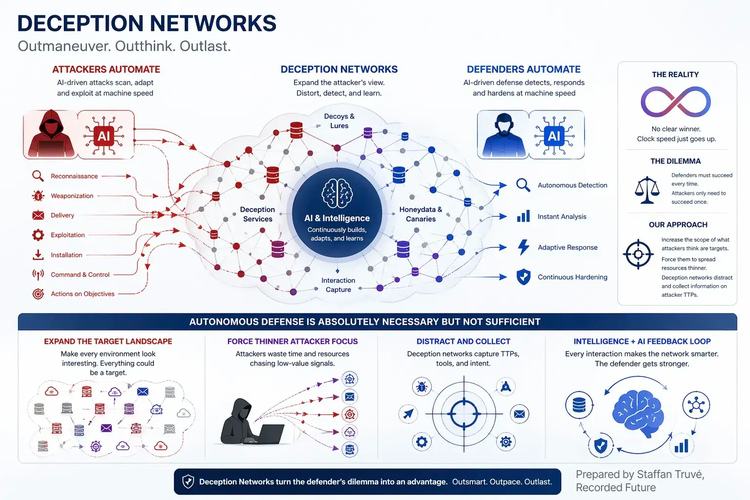
Deception technologies such as honeypots and honeytokens have existed for decades, but they have always been constrained by how static and labour-intensive they are to deploy convincingly. A skilled attacker can often identify a honeypot by its lack of realistic activity, stale data, or inconsistencies with the surrounding environment. AI removes these constraints. AI-generated deception environments can include realistic-looking decoy infrastructure — fake services, plausible file shares, synthetic credentials, even simulated user activity patterns — that adapts dynamically in response to attacker behaviour. Rather than a static trap that a competent adversary recognises and avoids, the defender can maintain a deception layer that evolves to stay convincing.
Intelligence-Informed Decoy Placement
This capability ties directly into the threat intelligence fusion described above. If you know which TTPs a likely adversary uses, which attack paths they favour, and where your real weaknesses are, AI can place decoys precisely along the routes those adversaries are most likely to take. The deception is no longer generic; it is tailored to the specific threat. A decoy credential can mimic the type of service account the adversary’s tooling is known to target. A fake file share can contain documents plausible enough to absorb attacker time and attention, and simultaneously provide new intelligence about the adversary. The threat intelligence that informs your defensive posture simultaneously informs your deception strategy. This is “Machine Counter Intelligence”!
Imposing Costs and Eroding Attacker Confidence
AI-generated deception at scale inverts a piece of the traditional asymmetry. Attackers who encounter a pervasive deception layer must spend significant time and effort distinguishing real assets from fake ones. Every interaction with a decoy wastes their resources, degrades their confidence in the intelligence they have gathered, and increases the risk that they will trigger an alert. In effect, the attacker now faces a version of the defender’s dilemma: they must verify everything, while the defender only needs one decoy to succeed.
Active Intelligence Collection Through Engagement
Perhaps most significantly, AI can interact with attackers inside deception environments in ways that feel plausible, drawing out more of their tooling, techniques, and objectives. This turns deception from a passive tripwire into an active intelligence-gathering operation. The tradecraft revealed through these engagements feeds back into the threat intelligence cycle, improving the defender’s understanding of the adversary and refining future defensive and deceptive measures. The result is a virtuous loop: intelligence informs deception, deception generates new intelligence.
There is an inherent tension in active deception engagement: traditional incident response doctrine prioritises minimising dwell time, while deception-based intelligence collection deliberately extends it. The risks are real — containment failure if the deception boundary isn't airtight, resource cost of sustained monitoring, potential legal and regulatory questions about why an attacker was permitted to remain active, and the possibility that a sophisticated adversary recognises the deception and feeds false signals back to poison your intelligence. These risks do not invalidate the approach, but they define the conditions under which it works. Active engagement requires genuinely isolated deception infrastructure, and clear decision frameworks for when to engage.
Democratising Access to Intelligence-Driven Defense
A less obvious but structurally significant change is that AI lowers the barrier to performing intelligence-driven defense. When an analyst can query in plain language — “which of our externally-facing systems are vulnerable to techniques used by a certain threat group in the last 90 days?” — and receive an accurate, contextualised answer, the skill requirement for effective threat-informed defense drops substantially. This is not doing an old thing faster; it is enabling a different operating model in which threat intelligence becomes a working tool for the entire security team, not just the analysts who specialise in it.
Strategic Implications
The most profound implication is that defenders have historically been reactive because they lacked the cognitive bandwidth to continuously fuse offensive intelligence with their own exposure data. AI makes this fusion not only possible but economically viable for organisations that could never previously afford dedicated threat intelligence teams, red teams, and continuous assessment programmes.
This changes the nature of the defender’s dilemma. The traditional framing — “defenders must protect everything; attackers only need one way in” — assumed that defenders could not know, in real time, which parts of their attack surface are most likely to be targeted. AI-enabled threat intelligence fusion challenges that assumption. If defenders can continuously identify the most probable attack paths based on current adversary behaviour and their own specific weaknesses, they can concentrate resources where they matter most. The dilemma does not disappear, but the defender is no longer operating blindly, but can take control.
The key asymmetry is therefore shifting from “attacker versus defender” to “AI-augmented versus non-augmented.” Organisations that integrate AI with robust threat intelligence programmes may find themselves closer to parity with attackers than at any point in the history of the field. Those that do not will face an even steeper version of the traditional dilemma, as AI-empowered adversaries exploit the widening gap.
Final Words
The emergence of fully autonomous AI agents on both sides raises unresolved questions. If attackers deploy autonomous offensive agents that can chain exploits and adapt to defenses without human guidance, defenders will need equally autonomous systems — systems that consume threat intelligence, assess exposure, and act on the results without waiting for human approval. The governance, trust, and control challenges this creates are substantial, but the journey towards this goal must begin now.
There is also a risk that the intelligence-AI feedback loop becomes adversarial in new ways. Sophisticated attackers who understand that defenders are using AI to map TTPs against exposure may deliberately vary their tradecraft to evade predictive models, or generate false signals to misdirect AI-driven defense. The quality and provenance of threat intelligence will become even more critical as AI amplifies both its value and the consequences of acting on flawed data — we need automation-grade intelligence!
We have not changed the basic equation: defenders must still know and mitigate every weakness, while the attacker needs only one. AI does not abolish that asymmetry, and claiming otherwise would be dishonest. What AI fused with threat intelligence does is change the terms of the contest. Instead of defending blind — treating every weakness as equally likely to be exploited — defenders can now continuously map attacker capabilities against their own specific exposure, concentrate resources on the paths adversaries actually use, and impose real friction through deception that degrades the attacker's speed advantage. The attacker still only needs one weakness, but they are now searching for it in an environment that fights back: one that predicts where they will look, places convincing traps along those paths, and learns from every encounter.
The defender may never achieve dominance, but the era of structural helplessness — of knowing that the asymmetry is permanent and unmanageable — is ending for organisations willing to invest in these capabilities. Parity in an adversarial contest is not a consolation prize; it is the condition under which skill, preparation, and operational discipline start to matter more than structural advantage.