Risk Scenarios for the US’s Strategic Pivot
Summary
The United States (US) is shifting toward a more force-driven security strategy primarily relying on military operations and economic pressure to counter transnational criminal organizations and limit Chinese, Russian, and Iranian influence in the Western Hemisphere.
Regional outcomes diverge across three core scenarios:
- US-aligned authoritarian cooperation with fragile stability
- Political fragmentation enabling criminal expansion and governance breakdown
- A strategic realignment toward BRICS that reduces US influence and increases great power competition
Each scenario increases the risks of political instability, regulatory fragmentation, and cyber threats, including increased surveillance, cybercrime, and targeting of critical infrastructure and multinational businesses.
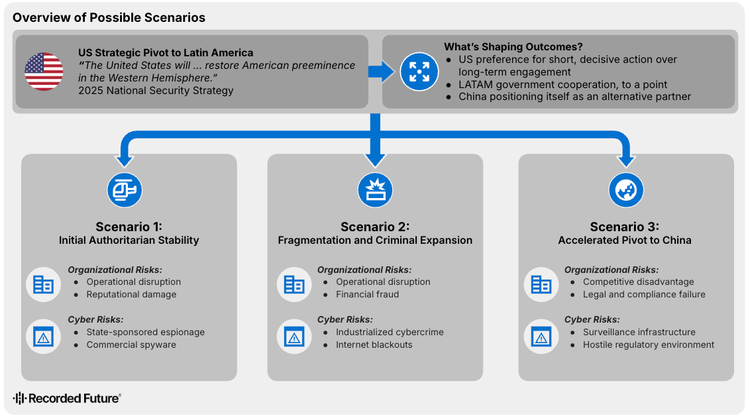
Figure 1: Overview of possible scenarios resulting from the US’s strategic pivot to Western Hemisphere security
(Source: Recorded Future)
Analysis
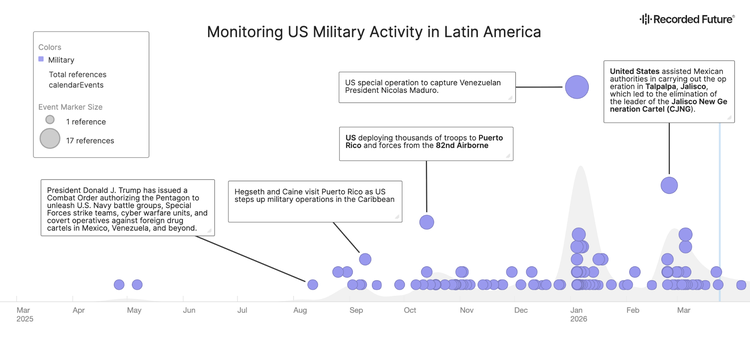
The US 2025 National Security Strategy formalized a shift toward hemispheric priorities and narrower strategic objectives. This shift had been building throughout President Donald Trump’s first term:
- January 2025: An executive order formally designates cartels as foreign terrorist organizations.
- August 2025: The president signed a classified order directing military action against cartels beyond traditional law-enforcement frameworks.
- September 2025: US forces carried out the first strike on alleged drug-trafficking vessels. Since then, more than two dozen kinetic strikes in the Caribbean and Eastern Pacific have resulted in over 100 fatalities.
- December 2025: The US begins seizing oil tankers accused of sanctions evasion.
- January 2026: The US launches a special operation to capture and extract Venezuelan President Nicolás Maduro to face drug trafficking charges in court.
- March 2026: The US launches the “Shield of the Americas” initiative, intended to counter drug trafficking, transnational criminal networks, and illegal migration in the Western Hemisphere. In an address to Congress two weeks later, the commander of US Southern Command reinforced a greater military role in countering foreign terrorist organizations (FTOs) and managing other security priorities in the region.
Taken together, these moves suggest a shift from a law-enforcement-led regional security model toward more overt coercion driven by military intervention.
At a strategic level, US objectives remain centered on limiting transnational criminal activity and countering external competitors. Transnational criminal organizations are framed as a primary threat vector due to their role in narcotics trafficking and financial crime. China’s growing economic presence, anchored in trade and Belt and Road Initiative (BRI) infrastructure, is also seen as a threat to US interests. Russia and Iran maintain more targeted but persistent footholds, particularly through surveillance coordination in Nicaragua, Cuba, and Venezuela. US policy is oriented toward constraining adversary influence while reinforcing its own economic and security partnerships. The US is pursuing these objectives through a combination of expanded military operations, law enforcement activity, and coercive economic measures, including tariffs and sanctions tied to political alignment.

Scenarios
The shift toward prioritizing US influence in the Western Hemisphere over other national security objectives will likely reshape the regional risk landscape. To assess the potential medium-term outcomes, Recorded Future identified key drivers and established baseline assumptions that underpin scenario development.
Drivers
Assumptions
● Increased US military interventions against alleged transnational criminal organizations TCOs and enablers
● Expanding role of TCOs and armed groups in regional instability
● Existing security cooperation between the US and Latin America LATAM governments
● Growing Chinese economic and infrastructure investment in LATAM
● Historical and ongoing relationships between Russia, Iran, and LATAM (notably Venezuela, Cuba, and Nicaragua)
● Increased adoption of commercial spyware and surveillance tools by LATAM governments
● US policy will prioritize countering malign influence and security threats within the Western Hemisphere over other regions
● Policy direction will remain sensitive to domestic political cycles in both the US and Latin America, creating potential for shifts following elections
● The US will favor limited-duration, high-impact interventions over prolonged military or large-scale nation-building efforts
● China will continue to expand its economic and diplomatic engagement in Latin America, positioning itself as an alternative partner (instead of the US
● Russia and Iran will seek to exploit opportunities to challenge US influence in the region, particularly through relationships with anti-US governments
● Regional governments will continue to leverage emerging surveillance and cyber capabilities to address internal security challenges
The following scenarios explore potential outcomes as the US reorients its security strategy toward the Western Hemisphere:
Scenario 1: Initial Authoritarian Stability
In this scenario, the US successfully asserts influence over historically adversarial authoritarian regimes, notably Venezuela and Cuba. These governments pivot toward cooperation with the US on trade, energy, and security, while maintaining repressive political systems domestically. US intervention has already reshaped Venezuela’s leadership and opened pathways for Western energy investment, while Cuba has responded to continued pressure by showing openness to economic reforms. Meanwhile, democracies like Colombia and Ecuador may adopt more coercive internal security postures, particularly in states facing cartel violence, in response to US pressure.
The US takes more aggressive measures to deter and counter non-Western infrastructure investments, leading to a relative diminishment in the influence of China and Russia as US engagement deepens. However, both powers will likely retain significant hemispheric influence and may pursue limited, asymmetric responses rather than direct confrontation.

Organizational Risks
Cyber Risks
● Operational disruption: This outcome may appear stable in the short term but is likely structurally fragile, as it depends on sustained coercive pressure and political alignment. Electoral changes will almost certainly bring in a new set of priorities and approaches to the region. This will create an operating environment at high risk of disruption.
● Reputational damage: Companies seen as being too close to one political bloc or regime may face reputational damage as policies reverse.
● Chinese and Russian state-sponsored actors will likely increase cyber operations against expanding US assets in the region, particularly in telecommunications and energy, to gather information or conduct strategic, limited disruption.
● Surveillance, including the use of commercial spyware, will almost certainly increase as states escalate law enforcement operations against cartels and non-state armed groups.
Scenario 2: Fragmentation and Criminal Expansion
US intervention produces a political backlash, weakening democracies and fueling the collapse of transitional regimes. Inconsistent or heavy-handed military actions against alleged criminals increase public outrage, leading to electoral turnover and instability. As governments escalate repression to maintain control, resistance movements and localized violence intensify, further eroding state authority. This dynamic creates governance vacuums that strengthen TCOs, particularly in border regions. In this environment, cartels and armed groups re-emerge as dominant power brokers, reversing gains in regional security and leading to a resurgence in criminal activity and violence.
Organizational Risks
Cyber Risks
● Operational disruption: Violence and corruption will likely increase instability. Further, regime collapse in Cuba or Venezuela would provide a haven for criminal groups.
● Financial fraud: Expanding criminal influence increases the likelihood of cyber or violent crimes, such as fraud or extortion.
● Industrial-scale cybercrime operations, similar to the scam call centers in under-governed regions of Myanmar, may increase under cartel control. This would scale up fraud, cryptocurrency theft, and money laundering operations, likely targeting Spanish-, Portuguese-, and English-speaking populations.
● Internet blackouts are used as a weapon by governments struggling to maintain control, causing instability in communications and other infrastructure.
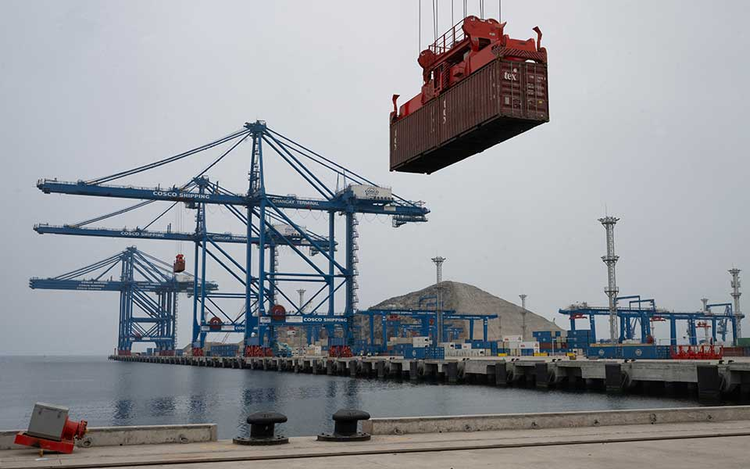
Figure 5: Chancay “megaport” in Chancay, Peru, is funded under China’s Belt and Road Initiative
(Image source: China’s Global South Project)
Scenario 3: Accelerated Pivot to China
The US’s overreliance on military solutions at the expense of soft power enables China to position itself as an appealing alternative partner by offering positive incentives and stable, long-term policy-making. As a result, LATAM governments across the ideological spectrum quietly accelerate their pivot toward China, building on existing trade and investment ties. As this trend continues, LATAM governments feel emboldened to adopt more overt mechanisms to resist US influence, including legal challenges to military operations and regulations targeting US companies. Both China and Russia are able to increase their economic footprint and political influence in the region, especially if the US becomes less willing to maintain a consistent security presence.
Organizational Risks
Cyber Risks
● Competitive disadvantage: Expanding Chinese and Russian economic influence may displace US companies in key sectors such as energy, agriculture, telecommunications, and infrastructure, reducing market access and long-term competitiveness
● Legal and compliance failure: A more hostile regulatory environment could limit operations or force costly restructuring
● China and Russia gain a greater surveillance foothold, taking advantage of LATAM countriesʼ construction of telecommunications and “Smart Citiesˮ infrastructure using companies like Huawei, as well as the use of Russian digital surveillance technology, to ensure visibility.
● Increased data sovereignty and related technology regulations can disrupt regional and global business operations, particularly for cloud services, financial systems, and multinational supply chains.
Outlook
The scenarios are not mutually exclusive: multiple outcomes can play out in different countries or regions across Latin America. Below are key indicators to monitor to anticipate which outcome is more likely to emerge:
- Election Outcomes: Colombia, Peru, and Brazil all have elections in the next year; a change in leadership may reflect popular dissatisfaction with the current government’s foreign policy, precipitating a policy shift. Furthermore, a decisive Republican defeat in the US midterms may reduce appetite for foreign intervention, leading to inconsistent policy.
- US Intervention in Cuba: The US government is strongly signaling its intention to replace or significantly reform Cuba’s long-standing Communist regime. The success of the operation and the willingness of the US to back a transitional or reform government will determine which scenario described above plays out.
- LATAM Security Cooperations: Criminal groups and militias thrive in contested or under-governed regions, such as along borders. Look for signed agreements and joint operations as signs of cooperation — or the lack thereof signalling potential breakdown in security coordination and a greater likelihood of criminal expansion.
- The China Alternative: While China is likely to want to avoid direct confrontation over influence in the Western Hemisphere, the CCP may seek to offer more positive incentives to increase its economic footprint in the region, such as continued investments in ports, telecommunications, and other critical infrastructure.
- The War in Iran: Even though it’s happening on the other side of the world, the Iran war is likely to shape how the US pursues military operations in the Western Hemisphere. Battlefield setbacks could decrease appetite for military intervention, or energy security pressures could increase the imperative to ensure influence.
Mitigations
- Strengthen cyber resilience and third-party risk management: Enhance monitoring and defenses for critical infrastructure, telecommunications, and cloud environments. Use Recorded Future’s Geopolitical Intelligence module to understand the surveillance risk in countries where you operate. Conduct regular assessments of vendors and partners to reduce exposure to espionage, surveillance, and cybercrime.
- Prepare for regulatory fragmentation and data localization requirements: Develop flexible compliance frameworks that can adapt to diverging data sovereignty laws, sanctions regimes, and trade restrictions. This includes establishing localized data storage where necessary and maintaining legal contingency plans for rapid policy changes.
- Enhance crisis response and continuity planning: Build scenario-based contingency plans for political instability, violence, or infrastructure disruption (such as internet outages or supply-chain interruptions), which are routinely monitored in the Geopolitical Intelligence module. Contingency planning should include evacuation preparation, alternative logistics routes, and redundant communications systems to ensure operational continuity across volatile environments.