Russia’s Defense-Based Economy Risks Forcing Putin to Fight Wars
Executive Summary
Since Russia’s full-scale invasion of Ukraine in February 2022, and the subsequent increase in Western sanctions on Russian individuals and firms, Russia’s economy has become increasingly skewed toward the defense sector. This has very likely led Russian political elites to increasingly draw patronage flows from defense-related expenditures. The wide range of sanctions has likely made it difficult for elites to diversify the sources of their graft, leaving them increasingly dependent on defense contracts for illicit funds.
As Russian President Vladimir Putin uses the distribution and withdrawal of patronage flows as a key way to maintain elite loyalty, a steady stream of defense expenditures has likely become an increasingly important cornerstone for Putin’s ability to maintain domestic political stability. Since maintaining domestic political stability is critical to Putin’s political survival, he very likely sees maintaining current defense expenditures as not only a foreign policy priority, but also a domestic political imperative. A decrease in defense expenditures would likely result in a decline in patronage flows to elites, thereby raising the prospect of elite discontent and greater difficulty in maintaining political stability.
Insikt Group therefore assesses that Putin is likely incentivized to engage in conflict abroad, not only for geopolitical purposes, but also to maintain high levels of defense spending. Should the war in Ukraine end without sanctions abatement –– and thus without providing a pathway for economic and patronage flow diversification –– Putin would likely seek alternative venues for mobilization to ensure defense-related patronage flows continue. Likely target states include non-NATO states close to Russia, including Moldova.
Public- and private-sector entities based in Europe and those with investment in Russia or users there are therefore likely to face a high-risk, unpredictable Russia-nexus cyber, physical, and economic threat environment, as long as sanctions preclude diversification of patronage flows beyond the defense sector.
As such, political settlement in Ukraine, coupled with sanctions rollbacks and security guarantees for Ukraine and other non-NATO states close to Russia, such as Moldova, likely would raise the cost of starting a conflict elsewhere while providing Putin with a pathway to diversify his elites’ patronage flows, thereby reducing his incentive to fund Russia’s patronage networks via mobilization.
Key Findings
- Since the 2022 invasion of Ukraine, Russia’s economy has become increasingly dependent on military spending, with defense expenditures reaching an estimated 7.2% of GDP and 32% of the federal budget by 2025.
- The military-industrial complex now employs approximately 3.5 million Russians, accounting for roughly 5% of the total labor force, while the production of civilian goods, such as cars and home appliances, has stagnated or declined.
- Systematic Western sanctions have limited the avenues Russian elites have to accumulate illicit wealth, forcing Russian political and business elites to rely increasingly on defense contracts for patronage and graft.
- As a decrease in defense spending would likely reduce the patronage flows necessary to maintain elite loyalty and domestic stability, Putin is likely incentivized to maintain high levels of military mobilization, even if the war in Ukraine were to end.
- Putin’s likely domestic political motivation to maintain military mobilization –– whether in Ukraine or elsewhere –– means that dissuading Putin from pursuing further interventions abroad likely would require not only negotiating a peace in Ukraine and providing security guarantees for Kyiv, but also alleviating sanctions on Russia, thereby providing Putin a pathway to diversify the sources of elite patronage
Russia’s Military-Industrial Complex Has Grown Since 2022
Since Russia’s full-scale invasion of Ukraine in February 2022, Russia’s economy has become much more dependent on defense-driven state demand. Following Russia’s annexation of Crimea in 2014, United States (US) and European Union (EU) sanctions forced Russia toward import substitution and greater state involvement in the economy; however, Russia’s economic reliance on defense to generate GDP revenue accelerated after the full-scale invasion. This increasing dependence is apparent in three main areas: budgetary allocations for defense spending, the percentage of industrial output tied to military production, and the fact that macroeconomic indicators showing growth, employment, and inflation are increasingly tied to war spending.
Increasing Share of GDP and Budget Devoted to Defense Spending
Russia’s military expenditures have occupied an increasing share of GDP since 2014, particularly since 2021, when defense spending began taking up a larger percentage of GDP. As of 2025, Russia’s defense spending is comparable to estimates from the 1980s, when the Soviet Union was fighting in Afghanistan and maintaining a large nuclear arsenal to counter the US.
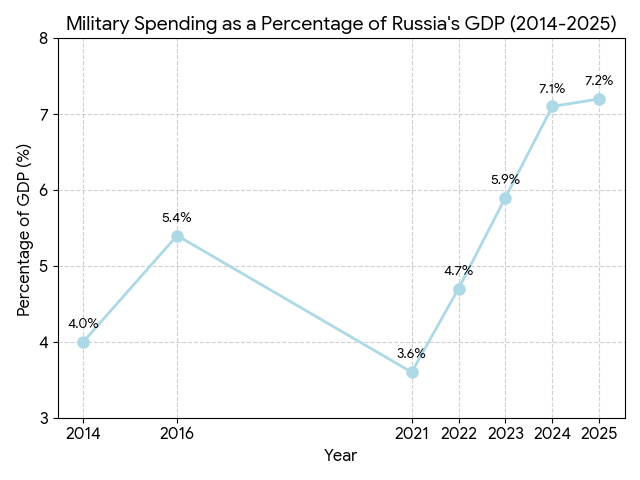
Russia’s military spending has also increased as a share of its state budget. Military spending accounted for 16% and 19% of total government spending in 2023 and 2024, respectively. In 2025, the “defense spending and national defense” category of the budget accounted for an estimated 32% of total federal spending.
Real military spending has increased significantly since the beginning of Russia’s full-scale invasion. In 2021, Russia spent an estimated 4.9 trillion rubles on the military; that figure increased to 14 trillion rubles in 2024 and 15.5 trillion rubles in 2025.
Military Production Comprises an Increasing Portion of Industrial Output
Military production as a share of Russian manufacturing has risen in recent years, according to official data from Rosstat, Russia’s government statistical service.
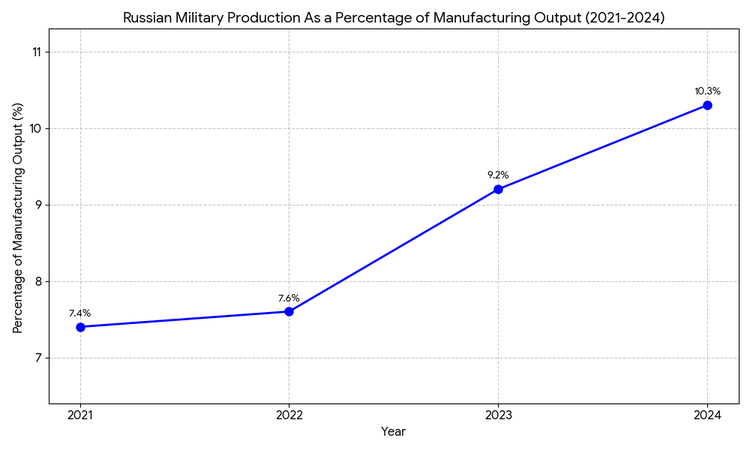
Military machine building has increased as a share of overall machinery and engineering output, from 30.6% in 2021 to 33.6% in 2022, 34.7% in 2023, and 36.5% in 2024. The total volume of military production increased to more than 7.2 trillion rubles in 2024, almost twice the pre-invasion level in 2021. Finally, the World Bank reported that, while Russia’s economy grew by 3.6% in 2023, manufacturing increased by 7%, reflecting a large increase in military-related activity and import substitution amid sanctions that isolated Russia’s economy.
Russia’s largest military manufacturing firms include Rostec (Russian Technologies), which is the world’s largest tank manufacturer; Almaz-Antey, the primary developer of Russia's surface-to-air missiles, such as the S-300, S-400, and S-500; United Engine Corporation, which manufactures engines for Russia’s fighter jets and cruise missiles; and United Shipbuilding Corporation (USC), which is responsible for Russia’s naval manufacturing.
As military production has occupied a greater percentage of Russia’s industrial output, production of civilian goods has decreased. For example, production of civilian cars in Russia remained roughly at 2021 levels in 2026; output of cement and bricks fell by 10–25% in early 2026, in part due to the diversion of steel to tank manufacturing; and manufacturing of home appliances such as refrigerators and washing machines has stagnated, as components have been diverted to military electronics.
Macroeconomic Indicators Increasingly Tied to Defense Spending
Key macroeconomic indicators –– including employment rate, size of the workforce, and inflation –– are very likely increasingly tied to defense spending. Defense industry employment has increased by an estimated 520,000 jobs since 2022; 3.5 million Russians are now employed in sectors supporting the military-industrial complex. As defense industry employment has risen, the civilian workforce has shrunk because Russia’s overall labor force has remained roughly steady at 76 million individuals. Between 2021 and 2026, the percentage of the Russian labor force employed by the defense industry rose from 3.9% to an estimated 5.1%.
In addition, the unemployment rate in 2025 was under 3%; economists consider this above “full employment,” and it is an indication that Russia may face a labor shortage driven by overinvestment in defense. Inflation has increased from 7.3% in 2023 to 9.5% in 2024 before dropping to 5.6% in 2025, driven by a combination of government defense spending, labor shortages, and supply constraints due to sanctions.
Russian Elites Increasingly Draw on Defense Sector for Graft
Corruption in Russia has long been at systemic levels that are higher than in the vast majority of countries. Transparency International –– a highly respected think tank that measures corruption worldwide –– ranked Russia 157th out of 182 countries in 2025, in terms of level of corruption, with a score of 22/100. Large-scale academic and think tank studies demonstrate the extent of corruption in Russia. For example, a 2013 Credit Suisse report showed that 110 individuals control about 35% of Russia’s total wealth, and an estimated $17 billion in assets is tied to 35 individuals close to President Putin. Putin himself has used state funds to amass wealth; for example, an investigation found that he owns a $1.3 billion palace financed via corruption schemes involving state-linked companies. Corruption in Russia extends beyond elites; an estimated one-quarter of Russian government officials regularly take bribes.
Putin very likely uses the distribution of government contracts and funds as one way to keep elites wealthy and therefore loyal. A 2022 study by the Organized Crime and Corruption Reporting Project (OCCRP) documented over $19.8 billion in state assets owned by individuals in politically influential positions in the Russian political system. Some of these individuals have official roles in the Russian government; others have long acted as influential advisors without formal positions. For example, Alisher Usmanov –– who allegedly has financial ties to Putin and former Russian President Dmitriy Medvedev –– has enriched himself by siphoning from telecommunications, media, and mining entities and has an estimated net worth of $3.5 billion. Gennady Timchenko –– one of Putin’s longtime confidants –– co-founded crude oil trader Gunvor, which very likely helped fuel his $70.5 billion net worth, as well as Putin’s wealth. Igor Sechin –– CEO of state oil company Rosneft, former deputy prime minister, and longtime Putin advisor –– very likely extracts money from Rosneft to build up his personal net wealth, which is estimated at roughly $800 million.
As the Russian economy has become increasingly dependent on defense spending for GDP and industrial output, Russian elites have likely drawn a greater share of their graft from defense-sector entities. Analysts estimate that about 40% of defense spending goes towards procurements and that kickbacks roughly double that cost. This suggests that the level of kickbacks from defense entities has increased alongside defense spending. A 2024 investigation by Proekt showed that at least 81 of the individuals on Forbes’s rankings of the 200 richest Russians were involved in supplying Russia’s military-industrial complex, strongly suggesting these individuals are extracting wealth from these enterprises, given Russian elites’ history of using state enterprises for personal wealth. Indeed, former Russian Foreign Minister Andrei Kozyrev stated that up to 20% of Russia’s budget designated to modernize the military has been stolen by oligarchs over the last twenty years.
Increased Corruption Flows from the Defense Sector, and Sanctions Likely Incentivize Perpetual Conflict
Elites and Putin Likely See Value in Continued Warfighting to Facilitate Corruption Flows
Insikt Group assesses with moderate confidence that the increase in patronage flows from defense contracts means many of Russia’s political and business elites likely favor continued mobilization. We do not assess that these elites favor endless war; rather, they likely recognize that political influence depends on supporting the war in Ukraine and that financial wealth is increasingly tied to defense contracts.
Russia’s political system allocates resources to elites through state-directed spending and political priorities, as reflected by the federal budget structure. As detailed in the section above, defense spending has become an increasingly large percentage of the federal budget, and businessmen who have long had close connections to Putin –– including Gennady Timchenko and Igor Sechin –– have vested interests in the defense sector. For example, Timchenko is reportedly a major investor in Redut PMC, a private military company that has been deployed in Ukraine. Timchenko is also likely an informal advisor to the Russian Ministry of Defense (MoD), likely in part to ensure MoD contracts funnel to his companies. As noted above, Sechin is the CEO of Rosneft, Russia’s largest oil company, which has served as a financial backbone to Russia’s war economy. In addition, Sechin is on the board of the United Shipbuilding Corporation, Russia’s main naval shipbuilder. Russian elites likely see financial value and political benefits in supporting Russia’s war in Ukraine and having the war continue.
Elites very likely see political and financial costs to not supporting the war in Ukraine. Between February 2022 and October 2025, the Russian state has nationalized and redistributed an estimated $14 billion USD in previously private Russian assets, as well as Western assets, with the seized assets often given as rewards to loyal businessmen close to the Kremlin. In addition, employees at defense firms receive double pay compared to their counterparts in civilian firms and are exempt from partial mobilization; these benefits likely provide additional incentive to oligarchs to remain invested in the defense sector, as employees at these defense firms likely report higher job satisfaction and are less likely to be deployed to the front lines, creating a more reliable workforce. Senior Kremlin officials have threatened to seize assets from those who are not sufficiently loyal or supportive of the war. Deputy Minister of Finance Aleksey Moiseyev said the state will seize assets from owners who “cannot effectively manage the property” or “direct funds earned in Russia to support the Armed Forces of Ukraine.”
Western sanctions on Russia have restricted elites’ access to foreign capital, technology, and markets, very likely reducing the number of corruption opportunities in the non-defense sector. This likely underscores the defense sector's importance as a source of patronage for elites and as a mechanism for Putin to distribute and withdraw patronage to maintain elite loyalty.
The US and the EU first instituted sanctions on Russia in 2014, following Russia’s annexation of Crimea. Russia’s 2022 invasion of Ukraine prompted a significant expansion of sanctions, leading Russia to become the most sanctioned country in the world. US sanctions alone comprise over 6,000 individual sanctions designations on Russia, and the EU has passed nineteen sanctions packages targeting Russia. The Western sanctions regime as a whole targets strategic sectors responsible for generating revenue and helping Russia project political influence globally, including the financial sector, energy, and portions of the defense sector.
Insikt Group assesses that, though Russian elites have engaged in sanctions evasion, those efforts have not generated enough revenue to offset the impact sanctions have had on elites’ access to non-defense-related corruption. It is very likely more costly to extract illicit revenue through sanctions evasion efforts because of reliance on intermediaries, which reduces the amount of rent capture available to elites engaging in sanctions evasion. In addition, sanctioned transactions are less stable and predictable, in part due to ongoing efforts by the EU and the US to monitor, identify, and close sanctions evasion channels such as Russia’s shadow fleet. Lastly, most sanctions evasion efforts focus on defense and defense-adjacent goods to feed Russia’s military-industrial base. As such, these efforts mostly amplify Russia’s defense sector rather than providing an alternative for elites seeking other sources of patronage flows.
President Putin likely judges that there are domestic political costs to rapid demobilization or a long-term political settlement in Ukraine, as both scenarios would very likely reduce defense-related patronage flows and offer fewer opportunities for graft, risking elite discontent. Rapid demobilization –– especially if it were not accompanied by sanctions relief –– would likely lead to economic stagnation as defense spending decreases.
Elite discontent over a decrease in the amount of available patronage almost certainly would not be expressed openly initially. Russian elites would almost certainly not publicly complain about decreased patronage flows, as such complaints would virtually guarantee a reprimand from the Kremlin and would involve admitting to illegal behavior. Instead, it is more likely that competition among elites would escalate over diminished patronage opportunities. Select evidence of those rivalries would likely spill over into the public, allowing open-source verification that they are occurring; however, it would almost certainly be impossible to ascertain the full extent of those rivalries, either via open-source or confidential collection methods, given the opaque nature of the Russian political system.
Likely open-source indicators of elite rivalries include:
Coded ways to signal dissatisfaction without directly criticizing Putin
Often, an early sign of elite discontent and intra-elite conflict, as these complaints suggest a smaller pool of resources for elites to pillage
Related statements calling for “normalization,” access to Western markets/financing, and easing of trade/logistics restrictions
An increase in arbitration cases in Russian courts involving defense firms and state contracts
Increase in contract cancellations or reallocations
Increase in disputes between firms over procurement
Sudden ownership changes or contested takeovers
Statements from governors about regional-level economic stress in the defense sector, including employment concerns, budget shortfalls, and so on
These types of personnel changes can suggest efforts by the Kremlin to reallocate patronage channels and broker resolutions to elite infighting
Suggests stress in defense-related patronage networks that could cascade upward to elites
Table 1: Indicators of open elite rivalries in Russia
Outlook: Russia-Ukraine War and Sanctions Trajectories and Implications for Public- and Private-Sector Entities
Taken together, the expansion of Russia’s military-industrial complex, the increased reliance of Russian elites on defense-related patronage flows, and the persistence of Western sanctions on Russia suggest that the stability of the Russian political system is likely to be tightly bound with continued military mobilization. As such, changes in mobilization levels or the status of sanctions packages are likely to impact the stability of the Russian political system, with implications for public- and private-sector entities in Europe.
The following scenarios outline how changes in the Russia-Ukraine war and the status of sanctions are likely to impact Putin’s domestic political calculus and the risk environment faced by public- and private-sector entities in Europe.
Status Quo: Russia-Ukraine War Continues without Significant Sanctions Abatement
Over the next six months, the most likely scenario is that the war in Ukraine continues at a relatively consistent battlefield cadence without a durable ceasefire or political settlement. Putin is likely to continue to judge that the domestic political costs of rapid de-escalation are prohibitively high, given the continuation of sanctions and elite dependence on defense-related patronage flows. This is likely to reinforce his decision to remain engaged in Ukraine and continue Russia’s hybrid campaign in Europe to exacerbate divisions between the US and NATO, with the broader goal of diminishing Europe’s ability to thwart Russia’s battlefield objectives.
Implications for Public- and Private-Sector Entities in Europe
At-risk energy firms include transmission system operators; marine insurers who risk losing their ability to transact in USD if they accidentally insure a vessel that interacts with the shadow fleet; terminal and port operators; LNG infrastructure providers; and offshore wind developers.
Over the longer term, prolonged overdependence on the defense sector for budget revenues may make Russia’s economy more vulnerable to inflation and less able to meet civilian demands, thereby increasing the prospect of public and regional political discontent as Russia’s non-defense sectors stagnate. Sustained high military spending likely places pressure on state finances, forcing increasingly greater tradeoffs, as the Russian government reduces spending on civilian priorities to maintain high levels of defense spending. High levels of defense spending also tend to create inflationary pressure, which would force Russia’s Central Bank to keep interest rates high.
The combination of high inflation, low spending on civilian priorities, and high defense spending in specific industrial regions would likely increase the prospect of public and regional political discontent. Growing regional disparities between defense-heavy regions and others could fuel frustration among regional officials in areas that have not benefited from as much state investment.
Less Likely: Russia-Ukraine War Ends without Full Sanctions Abatement
A less likely, but plausible scenario is that, over the next six to twelve months, Russia and Ukraine agree to a prolonged ceasefire or de facto freeze in hostilities, but without a comprehensive political settlement that might lead to a meaningful rollback of Western sanctions. Under this scenario, demobilization would very likely lead to a reduction in defense spending and, in turn, a decline in defense-related patronage flows. The lack of sanctions rollback would likely make it difficult for Russian elites to replace a decrease in defense-related patronage with revenue from other contracts.
The decrease in defense-related corruption flows, without a compensatory revenue stream, is likely to increase the likelihood of elite discontent. There is, therefore, a higher risk that Putin will seek alternative mobilization options. He is unlikely to launch a full-scale mobilization elsewhere, but could look for opportunities to mobilize in a more limited capacity to target non-NATO countries such as Moldova, where he could increase defense-related spending without risking invoking NATO’s Article 5 mutual defense clause.
Implications for Public- and Private-Sector Entities in Europe
Least Likely: Russia-Ukraine War Ends with Sanctions Abatement and NATO Security Guarantees for Ukraine and Moldova
Over the next six to twelve months, the least likely scenario is that the Russia-Ukraine War ends with a political settlement that allows for the rollback of Western sanctions and NATO-led security guarantees for Ukraine and vulnerable non-NATO states such as Moldova. In this scenario, Western governments would roll back Russian sanctions –– particularly those affecting finance, energy, and trade –– in exchange for Russia ceasing hostilities and accepting NATO-led security guarantees for Ukraine and vulnerable non-NATO countries.
This combination would likely decrease the domestic political costs of demobilization while increasing the political and military costs of mobilizing against a vulnerable non-NATO state like Moldova. Sanctions relief would create opportunities for Russia to diversify economic activity beyond the defense sector, thereby giving elites pathways to compensate for lower defense-related corruption flows with non-defense-related graft. Security guarantees would increase the military costs of renewed kinetic aggression against states like Ukraine or Moldova.
Statements from Putin and other senior Russian officials over the past six months suggest they may be open to economic diversification. For example, in April 2025, the CEO of Russia’s Direct Investment Fund, Kirill Dmitriev, said that Russia is “open to US-Russia economic cooperation” and views such cooperation as “key to increasing the sustainability of the global economy.” In December 2025, Kremlin officials reportedly “pitched the White House on peace through business,” suggesting an effort to tie conflict resolution with expanded economic cooperation. Nonetheless, Russia would likely still pursue low-level hybrid operations against Europe for surveillance and foreign intelligence collection purposes, while staying well below a level of aggression that might trigger Article 5.
Implications for Public- and Private-Sector Entities in Europe
Related Resources
Explore expert insights, reports, and tools to strengthen your cybersecurity strategy.