
Implications of Russia-India-China Trilateral Cooperation
Executive Summary
Insikt Group assesses that the August 2025 meeting of Chinese Communist Party (CCP) General Secretary Xi Jinping, Indian Prime Minister Narendra Modi, and Russian President Vladimir Putin at the Shanghai Cooperation Organization (SCO) Summit likely suggests early interest among the three states to explore trilateral cooperation, though the formation of a resilient bloc remains unlikely.
United States (US) policy –– particularly the level of sanctions the US places on each country –– is likely one of the primary factors driving the three states to change their level of cooperation. An increase in US sanctions is likely to drive each state to pursue alternative markets; this motivation has led to an acceleration of trilateral cooperation in some areas, and a reduction in others. For example, President Donald Trump’s decision to impose tariffs on India in mid-2025 very likely amplified a warming China-India relationship and reinforced a stable India-Russia relationship. In contrast, US sanctions on Russian oil companies in October 2025 led China and India to decrease their level of Russian oil imports.
The second factor driving Russia, India, and China to explore trilateral cooperation is very likely their shared strategic interest in a multipolar global order — manifest through fora like SCO and BRICS (Brazil, Russia, India, China, and South Africa).
However, despite nascent trilateral cooperation, there remains significant divergence among the three countries’ foreign policy goals, governing principles, and economic ambitions, which likely limits the scope of their cooperation. The political, economic, and military dynamics that shape bilateral relationships between China-Russia, China-India, and India-Russia are complex and distinct. Of those relationships, challenges between Beijing and New Delhi are almost certainly the greatest barrier to the formation of a trilateral bloc or alliance. In particular, India’s competition with China for Asia-Pacific regional leadership and influence, a large trade deficit favoring China, and unresolved border disputes will very likely temper the depth of cooperation between the two. All three countries seek to create an alternative center of gravity to the West, but India does not share Russia’s or China’s staunchly anti-Western worldview.
Although BRICS and SCO almost certainly represent viable opportunities for the three countries to foster trilateral cooperation, significant limitations prevent deeper alignment within these fora. The Russia-India-China (RIC) dialogue format, if rejuvenated, would offer the most likely format to formalize trilateral alignment. Insikt Group identified a range of potential indicators that are likely to reflect a coalescence into a political, economic, or military bloc.
Deepening trilateral coordination would almost certainly have broad implications for both the public and private sectors, depending on the depth and intensity of the cooperation. For example, the formation of trilateral economic frameworks, such as lower trade barriers or coordinated regulatory schemes, would force private sector companies operating in any of these countries to adapt to new regulatory standards and potentially face increased competition from an enlarged trilateral economic market. Deeper defense cooperation could lead to shifts in the defense industry of each country, as markets adjust to serve the defense needs of each member of the trilateral. If this leads Chinese and Indian defense industries to increasingly look to serve Russian defense needs, it could force companies that currently produce dual-use technologies for China and India to make adjustments to avoid transacting with sanctioned Russian defense entities.
Key Findings
- The single greatest impediment to trilateral cooperation is very likely the deep distrust between China and India, which underpins political, economic, and military competition — including a decades-long border dispute. India’s doctrine of strategic autonomy and its pursuit of “multi-alignment” are likely to limit its willingness to join a formal trilateral bloc with China and Russia that is explicitly positioned as a counterweight to the West.
- However, all three states very likely share a desire for a multipolar world that includes more developed regional centers of power. This likely helps drive trilateral cooperation to avoid US influence that threatens the strategic interests of Russia, China, and India.
- The nearly decade-long strategic partnership between Moscow and Beijing is likely a key factor driving trilateral cooperation, as Russia and China have shared experience developing alternative centers of power to the West. Both states are likely motivated to convince India to adopt a similar strategy.
- An increase in US sanctions and tariffs is very likely to be a primary factor driving greater trilateral cooperation, as all three states seek alternative markets and China and India likely aim to avoid secondary sanctions. In contrast, Western government policies that facilitate China’s and India’s access to Western markets are likely to lessen Beijing’s and New Delhi’s incentive to deepen trilateral economic cooperation.
- Deepened trilateral economic cooperation very likely would increase the prospect that Western companies — especially those operating in India — see heavier state involvement in the private sector and greater Western scrutiny of Indian economic transactions to catch sanctions violations, as New Delhi aligns its practices with Moscow and Beijing.
Background: US Policy Likely Driving Nascent Cooperation Among China, India, and Russia
We assess that there are early signs of cooperation among India, China, and Russia in recent months and that this cooperation is likely to expand, driven primarily by an emerging thaw in China-India relations. Against the backdrop of strong India-Russia and China-Russia relations, this warming of China-India relations likely increases the prospect of a deeper trilateral relationship. However, a formal China-India-Russia bloc has not yet formed, and significant limitations –– particularly around Beijing-New Delhi tensions –– are likely to challenge such an alignment.
India has likely calculated that the US’s 50% tariff on Indian exports –– imposed on India in August 2025, comprising a 25% reciprocal tariff and a 25% “penalty” tariff due to India purchasing sanctioned Russian oil –– necessitates looking for alternative markets and deepening foreign partnerships to recoup lost revenue and reinforce relationships India likely views as more reliable, including cultivating its relationship with Beijing. On August 6, 2025, one day before the US imposed a 50% tariff on Indian exports to the US, the Indian Ministry of External Affairs called the US’s decision “unfair” and “unjustified” and vowed that India would “take all actions necessary to protect its national interests.” India has specifically highlighted the inconsistency in the US’s application of a penalty tariff on India for importing Russian oil, while other countries, “even those with more adversarial relations with Russia,” have also sourced oil from Russia. China’s increasing oil imports from Russia likely reinforced to New Delhi that the US’s tariff policy was unjust. Indian officials are reportedly monitoring the US Supreme Court case (challenging the Trump administration’s tariffs) to determine its impact on current US-India trade negotiations. A breakthrough in trade talks would likely improve, but not entirely repair, the deteriorating diplomatic and economic ties between India and the US.
The US tariffs have likely also reinforced an emergent reconciliation between India and China. In August 2025, Chinese Foreign Minister Wang Yi visited New Delhi for the first time in three years. Beijing likely sees economic and political benefit to deepening ties with India, including exploiting the Indian market for Chinese exports and curbing US influence in South Asia. China’s trade surplus with India and status as the top exporter of electronics, telecommunications, and machinery to India likely give Beijing economic leverage in negotiations with India, particularly as India looks to recoup revenue lost due to US tariffs.
Following Modi’s August 31, 2025, meeting with Xi –– Modi’s first visit to China in seven years, at the SCO Summit in Tianjin –– Modi stated that “a stable relationship and cooperation” between China and India was critical for “the growth and development of the two countries, as well as for a multipolar Asia befitting the trends of the 21st century.” Amid India’s stated frustration over US tariffs, the highly publicized friendly interaction between Modi, Xi, and Putin (Figure 1) at the SCO Summit sparked concerns over an emergent Russia-India-China troika.
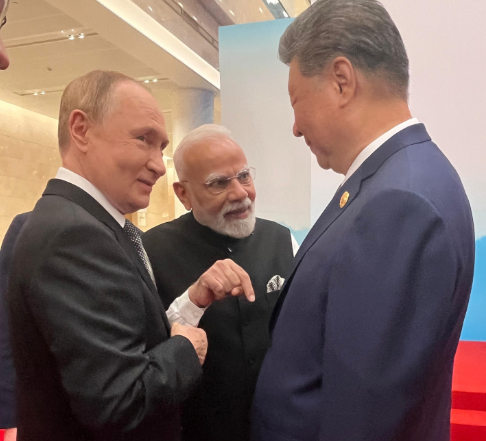
Figure 1: Photo posted by Modi of himself with Putin and Xi at the SCO Summit
on August 31, 2025 (Source: Social Media)
The nascent warming of China-India relations likely makes deeper trilateral cooperation among China, India, and Russia more probable, as China and Russia, as well as India and Russia, already have strong relations. Thus, a warming China-India relationship ameliorates the biggest barrier to the formation of a trilateral dynamic. In addition, all three states likely see political and economic benefits to deepening cooperation.
Areas of Bilateral Intersection and Divergence Among China, India, and Russia
Deepening trilateral cooperation among China, India, and Russia likely serves the strategic foreign policy interests of each state, though the trajectory of any fully formed trilateral dynamic is likely to be shaped by nuanced differences among each state’s foreign policy, as well as the bilateral dynamics within this group.
China’s Foreign Policy
China’s foreign policy toward Russia and India is almost certainly an outgrowth of the country’s primary strategic objectives. These include China’s “core interests,” such as preserving the CCP’s political power, territorial integrity, and economic development, as well as China’s efforts to shape a “multipolar” world, which almost certainly entails independence from US coercion, an increase in China’s international influence, and greater global dependence on China. China very likely sees greater cooperation with Russia and India as supporting these goals, especially in relation to Beijing’s main perceived threat — the US. In particular, China almost certainly considers Russia a political, economic, and military partner that helps legitimize China’s narratives about the need for multipolarity and bolster its ability to defend itself from US coercion. China likely considers India an important economic partner and judges that frayed India-US relations diminish the US’s efforts to encircle and contain China.
India’s Foreign Policy
India almost certainly defines its relationships with China and Russia through its doctrine of “strategic autonomy,” in which New Delhi avoids binding security alliances, instead maintaining flexibility in its relationships with global powers while cultivating influence across the developing world. Shaped by its role in founding the Non-Aligned Movement during the Cold War, New Delhi’s engagement with Beijing and Moscow has been a pragmatic balancing act seeking to promote an increasingly multipolar world order while simultaneously fostering ties with the US. India’s approach to China and Russia is also underpinned by a “multi-alignment” policy, which very likely seeks to promote and safeguard India’s core national interests, including economic growth, national security, territorial integrity, regional stability, and global cooperation. Consistent with its strategic independence, New Delhi has cultivated its role as a “neutral centrepiece” between China and the West while avoiding overt alignment with, or opposition to, any particular state.
Russia’s Foreign Policy
Moscow very likely views its relationships with China and India as beneficial to its core foreign policy goal of enhancing Russia’s global influence by replacing what Moscow sees as a US-centric global system with a multipolar world in which Russia is on equal footing with the US and China. This goal has almost certainly driven Moscow to place increased importance on relationships with non-Western powers, including China and India. Russia’s latest Foreign Policy Doctrine describes this goal as follows:
Russia also sees value in expanding economic cooperation with China and India, as Moscow seeks to replace revenue lost due to Western sanctions. The sanctions that the EU and the US have placed on Russia for its annexation of Crimea in 2014 and full-scale invasion of Ukraine in 2022 have made Russia the most sanctioned state in the world.
China-Russia: Strategic Partners in Countering the West
In recent years, China and Russia have become critical strategic partners, with diplomatic, military, economic, and technological engagement deepening. Although tensions almost certainly exist, particularly in their respective intelligence services, close leader relations and convergence on strategic foreign policy objectives –– particularly pushing back against perceived Western hegemony –– means these low-level tensions are unlikely to undermine China and Russia’s overall cooperative trajectory.
Political Dynamics
Chinese and Russian leadership almost certainly see each other as primary strategic partners in advancing the “multipolar” world. In 2023, Xi said to Putin, “We are the ones driving” changes unseen in a century, and multiple joint statements have noted this goal. Moscow likely views China as having the ability to leverage its significant economic and political influence to amplify Russia’s goal of ushering in a multipolar world with Russia, the US, and China on equal footing. Russia is an advocate for, or a participant in, many of China’s global governance and development initiatives that relate to its goals for a “multipolar” world, including the Global Governance Initiative, Global Security Initiative, and Global Development Initiative.
Putin and Xi very likely have a close political relationship, judging from their official statements and the frequency of their visits. Xi and Putin have met over 40 times since 2012 — more frequently than either has met with any other leader. In February 2022, China and Russia declared a “no limits partnership,” and in May 2025, Putin stated that “The comprehensive partnership and strategic cooperation between Russia and China are built on the unshakable principles of equality, mutual support and assistance, as well as the unbreakable friendship between the two states and two nations.” China and Russia’s political alignment has extended to supporting one another at international institutions. For example, they have used their veto powers on the UN Security Council (UNSC) to support one another’s interests, often vetoing resolutions that the other opposes.
Although Putin and Xi have a close leader-level relationship and there is significant compatibility between Russia’s and China’s goals of increasing their respective global influence at the US’s expense, mistrust almost certainly exists at lower bureaucratic levels. Their voting alignment in the UN General Assembly and UNSC has decreased by roughly 10% since 2018. Though China has an officially neutral, though in practice somewhat pro-Russia, position on the war in Ukraine, the war very likely has had some negative effects on China, including potential trade disruptions and sanctions (1, 2, 3). Nevertheless, China’s foreign minister reportedly made statements to European Union (EU) officials in July 2025 that conveyed that China, while not supporting Russia militarily, prefers a protracted conflict in Ukraine as it diverts the US’s focus away from China.
At least some Russian intelligence officers very likely view China with suspicion, based on a leaked document prepared by the Federal Security Service’s (FSB) Department of Counterintelligence Operations (DKRO) describing China as a significant espionage threat to Russia. Insikt Group lacks context as to the origin and veracity of this memo and whether it reflects unusual levels of concern about Chinese espionage, or simply a recognition by the FSB that Chinese intelligence services –– which are highly capable and aggressive –– are likely to spy on all states, regardless of the level of political cooperation. Even if the memo reflects a concern by the FSB that Chinese espionage might go beyond typical intelligence operations, Putin’s significant control over the Russian bureaucratic apparatus means any misgivings about China among FSB officers are almost certain not to impact the overall China-Russia dynamic.
Economic Dynamics
Russia very likely views economic cooperation with China as a means to solidify its overall relationship with Beijing and make up for revenue lost from Western sanctions, as noted above. China likely views its economic relationship with Russia primarily as a means to achieve the political objectives described above, although China likely also benefits from technological partnership and the opportunity to expand trade denominated in Chinese yuan.
China has purchased increasingly more Russian oil and gas since Western sanctions went into effect following Russia’s annexation of Crimea in February 2014, diminishing Russia’s ability to sell oil and gas to Western markets. Since Russia invaded Ukraine in 2022, China’s import of Russian oil and natural gas has substantially increased. On September 2, 2025, Russia and China signed a legally binding deal to build the long-delayed Power of Siberia 2 pipeline, which will supply 50 billion cubic meters of gas per year. As of 2023, Russia was China’s top crude oil supplier, and China buys Russian crude oil at a price that is above the G7/EU price cap, further contributing to China’s role in providing Russia with sanctions relief. However, Chinese companies are likely wary of sanction penalties, as seen in reportedly cancelled orders of Russian oil imports following US sanctions in late October 2025.
In addition to supporting Russia through increased purchase of Russian oil and gas, Beijing has long allowed –– if not encouraged –– the export of dual-use and military-relevant goods and expertise. As of mid-2025, dual-use exports to Russia likely have at least slightly decreased from their peak in 2024.
Overall trade between China and Russia has also grown significantly since 2014, and particularly since Russia’s full-scale invasion of Ukraine in February 2022. In 2024, total trade reached $245 billion, nearly double that of 2020. The trade balance has been relatively even, with a slight Russian surplus. Russia’s exports to China have mainly consisted of fossil fuels and natural resources, while China’s exports to Russia are primarily manufactured goods such as automobiles, tractors, and electronics. Infrastructure projects –– such as new border crossings –– have helped support increased trade. Technology-oriented research partnerships between Chinese and Russian universities are also expanding, and China and Russia have announced deepening ties for research into information and communication technologies like artificial intelligence and the Internet of Things (IoT).
There is also economic friction between China and Russia, though it is likely not significant enough to meaningfully derail deepening bilateral relations. Despite increasing Russian imports, China very likely seeks to avoid overdependence on Russia and has reportedly pressed Russia for cheaper rates. In fall 2024, Chinese financial institutions reportedly began halting transactions with Russian customers, and at least one bank did so as recently as September 2025 after being sanctioned by the EU. In September 2024, China implemented a mechanism to control dual-use goods exports, which may be contributing (alongside threats of US sanctions) to the aforementioned decrease in dual-use exports.
Military Dynamics
Military cooperation between China and Russia has deepened in recent years, likely with the goal of signaling to the West that they could pose a joint military threat –– a development that is very unlikely to materialize –– and likely sharing tactical and strategic intelligence that could help each state achieve its respective military goals. Since 2018, military exercises between China and Russia have become more frequent and more complex, and are expanding into new geographic areas. In 2018, China became the first country outside the former Soviet Union to participate in Russia’s Vostok (East) military exercise, which involved large-scale land and sea operations centered around contingencies in the Pacific. The Vostok 2022 exercise involved a more comprehensive Chinese contingent, as it represented the first time all three Chinese military components — land, sea, and air — participated in a Russian military exercise. In mid-2024, the Chinese and Russian militaries conducted a joint bomber flight into the US’s air defense identification zone (ADIZ) around Alaska for the first time. In September 2025, China and Russia conducted their first joint submarine patrol (or other exercise) in the Sea of Japan and East China Sea. Insikt Group has not identified any instances of declared Russian and Chinese forces deploying together to an active combat zone.
In October 2024, Russian Minister of Defense Andrey Belousov met with Chinese military officials in Beijing, after which he stated that Russia and China have “common views, a common assessment of the situation, and a common understanding of what [needs to be done]” to maintain global stability. China’s readout from one of these meetings further indicates that bilateral military cooperation aims to defend China and Russia’s “common interests” and “maintain global strategic stability.”
Beyond military exercises, US officials have asserted as recently as September 2024 that Russia, in exchange for support from China for the war effort in Ukraine, is providing military technical support to China in new areas, including in relation to submarine operations, aeronautical design (including stealth), and missile capabilities. The Ukrainian government asserts that China is supplying weapons to Russia, including gunpowder and artillery; that “Chinese representatives” are producing weapons in Russia; and that China is providing Russia with satellite intelligence that supports missile strikes in Ukraine. In January 2023, the US sanctioned a Chinese satellite imagery provider for enabling Russian combat operations. As of September 2025, “Chinese drone experts” were working on military drone development in Russia, according to Reuters. At least two Chinese commercial ships have been involved in Baltic Sea submarine cable-cutting incidents, though Beijing’s involvement in these incidents is unclear.
Despite China and Russia’s deepening military relationship, there likely remain limits to the amount of military support Russia is willing to provide to China in the event China is involved in an active conflict such as an invasion of Taiwan. China and Russia have not established a formal alliance or mutual defense pact, so Russia’s level of support would depend on Putin’s calculus. Given the significant resources Russia has devoted to its conflict in Ukraine –– including casualties higher than all conflicts Russia has fought in since World War II combined –– and the fact that Russia does not have a direct stake in the outcome of a Chinese invasion of Taiwan, Russia likely would provide China with only enough support to prevent alienating Beijing. That could include logistical and intelligence support as well as provision of air defense systems such as the S-400.
Cooperation in Propaganda and Influence Operations
We assess China and Russia have deepened their cooperation on overt state propaganda and influence operations, likely because their shared strategic goal of curbing US influence translates into convergence on desired media narratives and disinformation campaigns. Since the early 2000s, China and Russia have increasingly institutionalized their media relationship, including media forums, journalist exchanges activities, co-produced content, and mutually supportive media. In May 2025, China and Russia released a joint statement stating that they would “jointly articulate a common stance in the global media space.”
China and Russia have very likely amplified each other’s influence narratives, though we do not have evidence to suggest technical coordination of influence campaigns. Leaked correspondence from the Russian State Television and Radio Company (VGTRK) shows that, since at least 2021, Russia and China have had formal agreements to share content and coordinate content distribution at the ministerial level. In December 2022, a China-linked network of inauthentic activity, Empire Dragon (also known as Spamouflage) spread narratives supporting Russia’s claims that the US is developing biological weapons in Ukraine. Empire Dragon has also likely used a Russia-based social media account reseller, and accounts associated with Empire Dragon have, at times, been used to share Russian inauthentic content. China and Russia have likely used the same inauthentic social media account services to disseminate their influence narratives.
Since approximately 2019, China has increasingly used computational propaganda and influence operation tactics likely learned by observing Russia, but whether there is a more formal exchange of methods occurring is unknown. Chinese media outlets consistently frame the Russia-Ukraine war as a US-Russia proxy war, criticize Western hegemony, cast Russia as a rational actor defending its own sovereignty, call Ukraine reckless, and describe the EU as internally fractured. In March 2022, when Meta banned Russian state media outlets from purchasing ads on its platforms, China Global TV Network placed at least 21 pro-Russia advertisements on Facebook in a single month.
China-India: Nascent Thaw of Longtime Tension-Filled Relationship
China-India relations have gone through cycles of cooperation and competition for decades, and have been marked by border tensions since 1962, when China and India fought a war over their contested border. Beijing likely primarily views India through the prism of its broader security environment, and Beijing’s suspicion of India is likely rooted, at least in part, in China’s rivalry with the US and the US’s perceived efforts to encircle China. China’s close relationship with Pakistan, India’s longstanding regional rival, likely also contributes to New Delhi’s wariness of Beijing.
In recent months, China-India relations have likely returned to a positive trajectory, driven primarily by high-level diplomatic overtures and deepening trade relations. US tariff policy towards India has likely driven India to pursue improved ties with China. Modi and Xi have framed their countries as “development partners and not rivals,” challenging years of US efforts to bolster India’s role as a counterweight to China’s growing economic and political influence. Modi’s statement following his meeting with Xi on August 31, 2025, noted that “a stable relationship and cooperation” was critical for “the growth and development of the two countries, as well as for a multipolar Asia befitting the trends of the 21st century” — alluding to India’s view that it constitutes a major power center in Asia alongside China. Despite this nascent rapprochement, significant hurdles and unresolved disagreements remain, making it less likely that China and India will form a long-term strategic partnership.
Political Dynamics
China’s approach to India is likely primarily driven by the perceived threats posed by India’s relationship with other powers and perceived anti-China coalitions, rather than cooperation and competition with India on its own terms. Beijing’s perception that a stronger India-US relationship poses a threat to China’s interests is likely a principal factor today. China has sought to consolidate control over disputed border territories, leading to deadly skirmishes with India and cyberattacks against Indian critical infrastructure. India’s approach to China has likely been rooted in efforts to curb China’s economic ambitions and regional assertiveness, as well as its longstanding border dispute with China.
Over the last year, China and India’s relations have thawed significantly, especially compared to 2020, when the China-India border dispute escalated. In 2024, China and India concluded an agreement that returned the border to its pre-2020 status, thereby completing a disengagement process and reopening border trade. India and China began re-engaging in diplomatic dialogue at the highest level, including a meeting between Modi and Xi on the sidelines of the BRICS summit in Kazan, Russia, in October 2024. In September 2025, Modi visited China for the first time in seven years to attend the 2025 SCO Summit, during which China and India resumed direct commercial flights after a five-year freeze. Chinese Foreign Minister Wang Yi and Indian External Affairs Minister Subrahmanyam Jaishankar emphasized the importance of continued cooperation between the two countries.
Despite China and India’s recent diplomatic and economic overtures, tensions remain, particularly around India’s likely suspicions of China’s regional assertiveness and its likely hesitancy to join a persistent anti-Western bloc. Both countries have endorsed the idea of a multipolar world, but Modi has emphasized the need for a multipolar Asia, likely highlighting continuing tensions that stem from China’s economic influence, military power, and international assertiveness. India likely seeks to balance asserting itself as a regional power while maintaining good relations with the US. As such, India has not mirrored Russia and China’s strong advocacy for de-dollarization and replacing the international financial system with one based on China’s currency; it has only supported inter-BRICS trade based on local currency.
Economic Dynamics
We assess that China-India economic relations are generally positive, though India took steps to limit Chinese investment during the COVID-19 pandemic and during the 2020 border clashes. In April 2020, India issued Press Note 3, which limited Chinese investment and existing investments; new Chinese foreign direct investment cumulatively fell by approximately 80% in the 2021–2024 period compared to prior to 2021, and the number of active Chinese companies in India declined by nearly 500. For example, India reportedly rejected a proposed $1 billion investment by China’s electric car maker BYD in 2023 over national security concerns, and a visa ban on Chinese tourists reportedly constrained BYD’s lobbying efforts.
Despite Indian actions to limit Chinese investment, India’s economy likely remains heavily dependent on Chinese supply chains, which very likely gives Beijing some economic leverage over India.
India faces a significant and growing trade deficit with China — reaching $99.21 billion between 2024 and 2025 — and this imbalance has more than doubled in four years. China remains India’s top import source for many goods and commodities critical to its own industrial output, including electronics, telecommunications, electrical products, and machinery.
India has taken actions to reduce its dependence on Chinese investment and develop its own competitive advantage. Modi’s administration has bolstered investment in domestic production and implemented protectionist policies, such as the “Make in India” policy, the Production-Linked Incentive (PLI) scheme, and, most recently, the “National Manufacturing Mission.” Threatening China’s economic and technological interests, India banned hundreds of Chinese-developed mobile applications and has pursued efforts with the US to develop advanced technology supply chains. China has pushed back against some of these efforts. For example, China may have sought to impede Apple from moving its supply chain for US phones from China to India.
Another area of tension in the China-India economic relationship is very likely China’s increasing investment in South Asia, which conflicts with India’s “Neighbourhood First” policy, in which India views the region as its primary sphere of influence. The policy, considered a “defining subset of its overall foreign policy,” hinges on India fostering connectivity, trade, and stability across the region. India likely perceives China’s engagement in South Asia as an effort to exert dominance in a region vital to India’s strategic interests. India almost certainly opposes China’s Belt and Road Initiative (BRI) because New Delhi views China’s strategy –– an expansive development and investment project originally devised to construct infrastructure linking East Asia and Europe –– as seeking to dominate the region and counter India’s regional influence, posing a direct threat to Indian sovereignty. A specific point of contention is the China-Pakistan Economic Corridor (CPEC) — a 3,000-kilometer, over $60 billion project linking China and Pakistan through roads, railways, and pipelines — which India almost certainly perceived as the most immediate threat to Indian sovereignty, as it runs through disputed territory in Pakistan-occupied Kashmir. The CPEC aims to facilitate Chinese energy imports while strengthening Pakistan’s economy and strategic connectivity, and Beijing’s backing of Islamabad with resources and infrastructure is likely a major concern for India.
Despite tensions, the value of China’s annual exports to India was greater between 2020 and 2024 than between 2016 and 2020, and was approximately $20 billion more in 2021 than in 2018. The total value of foreign direct investment from China into India also returned to an upward trajectory after 2021, and particularly in 2024. Multilateral fora such as BRICS and the Asian Infrastructure Investment Bank (AIIB) likely provide additional mechanisms for economic cooperation. China launched the AIIB in 2016, and the bank has dozens of approved projects in India.
Military Dynamics
We assess that, since 2020, the China-India military dynamic has centered primarily around a longstanding border dispute and each state’s suspicions of the other’s regional ambitions.
India and China share a contested 3,440-kilometer (2,100-mile) border in the Himalayas over which the two countries have had an ongoing, historic dispute. The two states compete to build infrastructure along the border, known as the Line of Actual Control. The border rivalry devolved into open confrontation in the Galwan Valley in June 2020, resulting in the deaths of twenty Indian and four Chinese soldiers. Four years of tension followed, during which each side built up troops in the contested areas. After at least 21 rounds of Senior Highest Military Commander Level (Corps Commander) talks and other efforts, India and China signed an agreement in 2024, which led to the disengagement of troops. Even with border tensions currently defused, the overarching territorial dispute very likely persists as a potential strategic flashpoint in the future. As such, military cooperation is unlikely; after the 2025 SCO summit, Modi did not attend the military parade organized in Beijing to commemorate the 80th anniversary of the end of World War II.
In addition, China’s efforts to assert military power via naval exercises in the Indian Ocean Region (IOR) are likely a particular point of contention between China and India. China’s People’s Liberation Army (PLA) is increasingly active throughout the IOR, often as part of air, land, and sea-based multilateral exercises but also to support the PLA Navy’s “Far Seas Protection” strategy. In addition to military exercises, the PLA makes use of commercial ports in the IOR, some of which are owned or operated by Chinese state-owned enterprises. New Delhi very likely perceives China’s regional cultivation of dual-use commercial ports, naval base in Djibouti, and likely naval facility access in Cambodia — sometimes referred to as a “string of pearls” strategy by analysts outside of China — as an encirclement of India in what New Delhi considers its regional maritime domain. This competition has played out at ports across the region. For example, in 2022, China and India competed to influence Sri Lanka’s decision regarding China’s request to dock a military vessel at the China-owned and operated Port of Hambantota; the ship ultimately called at the port over New Delhi’s objections. In 2023, India objected to the presence of a Chinese state-owned research vessel, which China very likely uses to support PLA requirements. In support of their territorial claims and very likely to facilitate military contingencies, China and India have worked to build out relevant infrastructure along disputed border areas.
Finally, China likely views New Delhi’s joint military exercises with third parties as evidence that India is preparing for a China contingency. In 2022, an annual exercise with the US took place just 62 miles from a disputed border area. In 2024, India organized the first Tarang Shak air combat exercise that involved ten countries, including the US. In 2025, India and the Philippines conducted a joint naval drill in the South China Sea. India almost certainly views China’s military cooperation and integration with Pakistan –– including China’s role as Islamabad’s main supply of arms –– as a grave threat to Indian security. China is responsible for 81% of Pakistan’s arms imports.
India-Russia Relationship: Longstanding and Rooted in Arms Sales and Trade
India and Russia have had a close partnership since at least the 1950s, very likely anchored by a mutual desire to push back against perceived US hegemony, Russian arms sales to India, and, more recently, an increase in Indian purchases of Russian oil. In 2010 and 2024, India and Russia defined their relationship as a “Special and Privileged Partnership.” Following a July 2024 summit, Modi and Putin issued a statement calling the India-Russia partnership a “time-tested relationship which is based on trust, mutual understanding and strategic convergence.”
Political Dynamics
India and Russia’s political partnership very likely dates back to at least the 1950s, when the Soviet Union used its UN veto to support India’s claims on Kashmir, and is anchored by a shared strategic interest in re-balancing post-Cold War US hegemony in favor of a multipolar world order. New Delhi has called Moscow “key to India’s quest for a stable Asian balance of power.” However, India and Russia’s visions for what a multipolar world looks like very likely differ. India’s principle of multi-alignment aims to reform global power dynamics and is not anti-West, in contrast to Russia’s goal of ushering in a world in which Russia, China, and the US are on equal footing. Indian Foreign Minister Subrahmanyam Jaishankar has articulated that India’s “non-West” character does not mean it is “anti-West.” Jaishankar’s book on India’s foreign policy, Why Bharat Matters, asserts that India’s approach that distanced itself from the West “has led [India] to develop dependencies elsewhere” — yet specifically asserts that India “must realize that there is little profit in being anti-West.”
India’s diplomatic approach to Russia suggests it is willing to occasionally compromise on its declared neutral, non-aligned strategy. India abstained on multiple UN resolutions relating to Russia’s invasion and Ukraine’s sovereignty, has not taken a condemnatory stance against Russia’s invasion of Ukraine, and consistently calls for a “peaceful resolution through dialogue and diplomacy.” Modi and Putin have publicly maintained a warm friendship despite US and European criticism of Russia, and Modi has referred to Russia as India’s “all-weather friend and trusted ally.”
Economic Dynamics
Russia very likely views India as a critical, longstanding market for Russian weapons and, increasingly since Russia’s full-scale invasion of Ukraine in 2022, an economic partner that helps Russia recoup revenue lost due to Western sanctions. India’s import of crude oil from Russia increased from $2.3 billion in 2021 to $52.7 billion in 2024, despite Western sanctions on Russia. India’s Ministry of External Affairs has stated that India “does not subscribe to any unilateral sanctions measures,” and “considers the provision of energy security a responsibility of paramount importance to meet the basic needs of its citizens.” Since 2023, Russia has been India’s top supplier of crude oil, and Russian oil exceeded 40% of India’s overall crude imports by May 2025. As a result, India is now the second-largest purchaser of Russian crude oil after China. Discounted Russian oil has fueled India’s surging energy needs and enabled it to become the third-largest exporter of refined petroleum products, which is India’s most exported product. Even after US President Donald Trump placed a 50% tariff to dissuade India from continuing to buy Russian oil, Indian oil imports remained steady in the first half of September 2025. The US subsequently imposed sanctions on Russian oil exporters Lukoil and Rosneft on October 22, 2025, prompting Indian refiners to pause new orders and seek alternatives for sanctioned Russian oil. On October 28, an India-bound tanker carrying Russian crude turned around in the Baltic Sea — an incident that oil analysts attributed to the US sanctions pressure. However, Indian Oil continued to purchase Russian crude from non-sanctioned entities, suggesting the US sanctions are likely to impact, but not halt, India’s imports from Russia.
Total trade between India and Russia amounted to $68.7 billion in FY2025, likely surging as a result of the vacuum left by Western firms. However, India’s imports from Russia account for $63.8 billion, over 90% of the total trade, reflecting a significant trade imbalance. Even so, New Delhi aims to achieve $100 billion in trade with Russia by 2030. Both countries seek to reduce reliance on the US dollar, and 90% of trade is now settled in ruble-rupee transactions. However, India’s trade with the West will likely complicate financial integration; India has been hesitant to adopt sanctions-resistant payment networks with Russia and has dismissed the idea of replacing the US dollar.
Military Dynamics
We assess that India and Russia’s military relationship is centered on Russia’s long history of exporting weapons to India, which has created an Indian dependence on Russian systems. Over the past twenty years, India has purchased roughly $60 billion in Russian weapons, amounting to 65% of its total weapons imports. India’s purchases include Russia’s S-400 missile defense system, which India used in May 2025 to repel Pakistani missile attacks. India and Russia have also pursued joint production of weapons, including T-90 tanks and Su-30MKI aircraft. India-Russia military cooperation has stagnated on other fronts, such as joint training and exercises.
Although Moscow continues to be India’s main arms supplier, India’s arms purchases from Russia have declined since 2024, as India has sought to reduce its reliance on Russia and increasingly purchase from Western suppliers, including France, Israel, and the US. On October 31, 2025, India and the US signed a ten-year Defense Framework Agreement, which Indian Defense Minister Rajnath Singh described as the start of a “new chapter” in India-US defense cooperation and “a signal of our growing strategic convergence.” This agreement likely reflects India’s intent to continue diversifying its military cooperation and arms trade beyond Russia, and shore up its US partnership amid tariff-related strife — further reinforcing the multi-alignment doctrine driving India’s security calculations and reducing the likelihood of a Russia-India-China military alliance.
The documented poor performance of Russian weapons systems in Ukraine likely impacts India’s calculus. A leak by hacker collective “Black Mirror” revealed internal documents from Russia’s state-owned defense conglomerate Rostec detailing how the Russian-manufactured radar system installed in India’s MiG-29K fighter aircraft suffered extensive and systemic failures between 2016 and 2019; this lack of reliability likely encouraged India’s move away from Russian weapons.
State of the Nascent Trilateral Dynamic and Indicators of Deepening Trilateral Cooperation
China, India, and Russia have not declared a formal bloc; instead, in recent months, the three states have taken primarily diplomatic steps to project increased interest in trilateral engagement –– most notably a meeting between Modi, Putin, and Xi at the 2025 SCO Summit. Though the three states did not make any concrete commitments at the summit, the meeting represents the first time all three leaders have met in person since 2019, and very likely reflects an effort by Russia and China to exploit strains in the US-India relationship to draw India away from the US.
Past trilateral engagement, which has primarily occurred at multilateral fora such as BRICS, SCO, and G20 Summits, has not resulted in a solidified, institutionalized trilateral bloc due to divergent national interests that will likely pose a long-term structural impediment. These strategic differences will likely persist and continue to limit the depth and breadth of alignment among the three countries, making it less likely that a solidified trilateral bloc will emerge in the short term. The three primary multilateral fora where trilateral engagement –– short of formation of a bloc –– has occurred are the now-dormant RIC format, BRICS, and the SCO.
RIC Format: Dormant, Though Russia and China Are Interested in Reviving It
The RIC format is likely the multilateral forum in which trilateral engagement would primarily take place, given the apparent interest of Beijing and Moscow in reviving the dormant discussion format and New Delhi’s apparent reserved openness to the possibility. The RIC format, which began formally in 2007 and involves trilateral discussions among the foreign ministers of these countries, has been inactive since late 2021.
Between 2002 and 2020, twenty trilateral ministerial-level meetings occurred, covering topics such as trade, energy, and disaster management. At the most recent RIC foreign ministers meeting in November 2021, the three countries expressed interest in regular high-level meetings, reiterated the importance of international reform for a multipolar and rebalanced world, and opposed unilateral sanctions imposed outside of the UNSC.
In a 2022 joint statement, China and Russia declared their intent to develop cooperation within the RIC format, a sentiment Russian Foreign Minister Sergey Lavrov reiterated in May 2025. In July 2025, an Indian government spokesperson neither rejected nor explicitly supported the revival of the RIC format, likely indicating India’s reserved openness to it.
BRICS: Ill-Equipped to Institutionalize Trilateral Engagement, Though Opportunities Remain for Economic Engagement
The BRICS (Brazil, Russia, India, China, and South Africa) bloc is active, though very likely ill-equipped to facilitate the institutionalization of a trilateral Russia-India-China bloc due to its status as an informal coordinating body, as opposed to an organization that requires mutual commitments. BRICS was formed in 2009 and is an organization committed to perpetuating a multipolar world via political, security, and economic cooperation.
Though Russia and China have sought to make BRICS a geostrategic bloc to rival the West, the organization does not bind its member states to any treaty, alliance, or formal legal structure, thereby limiting the organization’s ability to institutionalize a geostrategic bloc. India views the forum as a key balancing factor in its nuanced multi-alignment strategy, in which New Delhi seeks to position itself as a bridge between Western and non-Western fora.
Despite the overall limitations of the BRICS structure, the connectivity it provides for financial institutions likely raises the possibility of BRICS facilitating trilateral economic integration, should China, India, and Russia choose to pursue that sort of cooperation. BRICS has established two financial institutions, both of which are based on foundational treaties. The New Development Bank (NDB) supports collaborative development projects in emerging markets and developing countries, and the Contingent Reserve Arrangement ensures BRICS’s central banks provide mutual support during a currency crisis. BRICS’s interconnected financial systems could facilitate trilateral economic activity and offer a way for the three countries to conduct trade payments.
We assess that BRICS could also facilitate Russia and China’s efforts to develop alternatives to the US dollar, though India’s hesitation to aggressively push for de-dollarization likely limits the extent to which de-dollarization will become an area for trilateral engagement. BRICS nations have explored the development of a common currency and have specifically created a cross-border digital payment and messaging system backed by cryptocurrency, called BRICS Pay. During the July 2025 BRICS summit in Rio de Janeiro, Brazil, member countries reportedly made progress in “identifying possible pathways to support the continuation of discussions on the potential for greater interoperability of BRICS payment systems.”
Shanghai Cooperation Organization (SCO): Encumbered by Competing Interests
Despite the fact that Russia, India, and China’s latest trilateral engagement took place at the SCO Summit in 2025, the SCO is unlikely to facilitate a deeper trilateral relationship, as it is encumbered by competing interests. The SCO was founded in 2001 to focus on border security and ethnic minority separatism in China’s Xinjiang region, though it has since expanded to encompass counter-drug trafficking efforts, coordination in support of economic development, wider security-relevant matters, and other activities. India joined in 2017, after being an observer since 2005, with Russia’s support and possibly without China’s, as Beijing sponsored Pakistan’s membership that same year.
China and Russia have used the SCO to advance their geopolitical aims, including shaping future multipolarism and projecting power. In particular, China uses the SCO as a foundation for expanding an international security architecture that is consistent with the CCP’s regime security.
We assess that the SCO’s institutional capacity to take unified action is limited, in part by the fact that its members are not consistently aligned. For example, India initially did not participate in crafting a SCO statement criticizing Israeli and US strikes against Iran in June 2025, although it later joined a different SCO statement condemning the same activities. The SCO did not stop China-India border clashes in 2020, although it helped facilitate bilateral discussions. Following the 2025 clashes between India and Pakistan, India reportedly objected to an SCO statement it viewed as undermining its own position. According to one Chinese think tank director, India is using the SCO to contain China’s influence and push back on its development and security initiatives, such as the BRI.
Indicators of Deeper Trilateral Cooperation
The table below highlights potential indicators of increasing trilateral cooperation in the future, as well as the factors most likely limiting trilateral cooperation today and going forward. China-India tension is very likely the primary constraint to the development of a trilateral bloc.
- Increase in trilateral meetings or state visits, especially outside of previously scheduled multilateral summits, such as BRICS and SCO
- Increasing media coverage of personal meetings between the three heads of state, especially public shows of affection or behind-the-scenes coverage
- Increase in trilateral joint statements indicating specific shared political or ideological goals
- Trilateral memorandums of understanding involving cooperation on concrete political initiatives
- Establishment of trilateral civic institutions or nongovernmental organizations with physical locations in all three countries
- Increasing rhetorical alignment criticizing US influence and promotion of anti-Western narratives
- Synchronization of narratives in reaction to major geopolitical events
- Increase in Indian and Chinese state media narratives supporting Russia’s objectives in Ukraine
- Increase in Indian and Russian state media narratives supporting China’s Taiwan ambitions
- Russian involvement in China-India border dialogue
- Formal coordination in UN voting
- India’s domestic policies shifting toward illiberal governance or adopting authoritarian tendencies, consistent with China and Russia’s domestic policies
- Revival of the RIC format
- Strategic partnership agreement, formal pact, or alliance treaty binding the trilateral, separate from bilateral agreements between China-Russia (“Treaty of Good-Neighborliness and Friendly Cooperation”) and India-Russia (“Special and Privileged Strategic Partnership”)
- India’s democratic values are at odds with Chinese and Russian authoritarian governance
- China-India competition for leadership of Asia
- China-India competition for leadership of the Global South
- India’s perceived inferior status to China and Russia’s permanent seats on the UNSC
- India’s long-standing non-aligned policy
- India’s concern over jeopardizing its relationship with the US
- Unresolved border dispute between China and India
- China’s close relationship with India’s rival, Pakistan
- Trilateral gatherings of government ministers or leaders across economic functional areas (ministries of finance, commerce, agriculture, energy, transport, information technology/digital development, and central bank governors)
- Trilateral investment agreements to benefit joint projects
- Trilateral trade agreement reducing or eliminating tariffs and other trade barriers
- Coordination of trilateral sanctions against Western companies or commerce
- Standardization and integration of payment mechanisms in local currency
- India’s effort to diversify supply chains due to a significant trade imbalance favoring China, and to minimize Chinese leverage over critical Indian imports
- China-India competition for trade with Global South partners
- China-India competition for influence in South Asia
- Increase in trilateral military leader engagements
- Trilateral-only (not multilateral) exercises or training
- Trilaterally coordinated security operations, such as counterterrorism
- Trilateral projects for the development and production of defense equipment
- Trilateral intelligence-sharing mechanisms
- Agreements allowing access to each other’s military facilities or bases
- Development of shared infrastructure or logistical hubs
- Establishment of interoperable military system(s)
- Formal pact with a security guarantee or mutual defense treaty with a collective defense clause
- India’s policies of non-intervention and sovereignty are at odds with Russia’s expansionism and China’s efforts to defend its domestic political system globally
- China’s assertive presence in the Indian Ocean is in competition with India’s natural sphere of influence
- Ongoing risk of escalation and military confrontation along the China-India Line of Actual Control
- Tripartite cyber neutrality statement or non-aggression pact/India joining the Sino-Russian Cybersecurity Agreement of 2015
- India joining China and Russia’s convergence in hybrid campaigns against Western democracies
- Amplification of messaging on all three countries’ state-funded/owned media and digital platforms
- India and Russia institutionalizing the adoption of Chinese AI technology
- Trilateral engagement and technology sharing related to authoritarian objectives, such as internet restrictions or monitoring
- India’s apprehension about Chinese technological dominance and Digital Silk Road ambitions
- Difficulty of verification and enforcement of cyber non-aggression pacts — due to ambiguity in attribution, plausible deniability, and unclear thresholds for a prohibited offensive cyber operation — increases the likelihood of cyber operations among the trilateral
- India’s suspicion about Chinese technology in domestic markets, including a ban of Chinese apps
- Chinese state-linked APTs conducting cyberattacks on Russia despite their 2015 agreement
Table 1: Indicators that would likely reflect increasing trilateral alignment, and key challenges that would likely limit trilateral alignment, in four areas of cooperation (Source: Recorded Future)
Implications of Deeper Trilateral Cooperation for the Public and Private Sectors
Tables 2, 3, 4, and 5 outline select political, economic, military, and technological/cyber implications for public and private interests, given varying degrees of potential future trilateral cooperation. However, Insikt Group continues to assess that significant trilateral cooperation remains unlikely.
Lower Cooperation Intensity
Greater Cooperation Intensity
Table 2: Public and private sector implications in the political domain of a deepening trilateral between China, Russia, and India (Source: Insikt Group)
Lower Cooperation Intensity
Greater Cooperation Intensity
Increasing intra-regional trade risks reducing existing market share for US and European businesses, potentially decreasing Western government influence and leverage in these markets
De-dollarization accelerates, supported by all three partners (this assumes India is drawn into alignment with Russia and China on this issue)
Solidification of trilateral trade could lead to fewer opportunities in Chinese, Russian, and Indian markets for Western private companies –– particularly if protectionist measures increased –– potentially forcing Western private sector companies to pursue heightened investment opportunities in nearby markets, such as South and Southeast Asia, where there might be fewer barriers to entry
Increasing opportunity to diversify away from the US and Europe, but with barriers to companies based outside of the trilateral countries and in countries hostile to them
Table 3: Public and private sector implications in the economic domain of a deepening trilateral between China, Russia, and India (Source: Insikt Group)
Lower Cooperation Intensity
Greater Cooperation Intensity
Increasing joint condemnations of US and European military activities, as well as those by other states that they support
Decreasing military engagement between India and the US and Western European countries, as well as growing reluctance to support US visions of the Indo-Pacific order
Increasing trilateral military exercises, including those staged in response to world events opposed by the trilateral
Decreasing options for the US to meaningfully restrict trade to China (such as through the Indian Ocean or Malacca Strait) in a conflict scenario
Fields and technologies with dual-use applications increasingly focus on collaboration, investment, and transactions with companies from the trilateral
Could force adjustments by Western companies in China and India that produce dual-use technologies, to avoid transacting with sanctioned Russian defense entities
Table 4: Public and private sector implications in the military domain of a deepening trilateral between China, Russia, and India (Source: Insikt Group)
Lower Cooperation Intensity
⬇
Greater Cooperation Intensity
As the Indian economy expands due to increased Chinese tech investment, there could be an incentive or pressure for high-skilled technology workers to find employment in Indian technology markets, rather than moving abroad
An expanded Indian technology sector could also provide opportunities for Western technology companies to invest in India
Technology development cooperation deepens based on mutual benefit and complementary technical prowess among the partners, decreasing dependence on Western platforms in the long term and increasing the trilateral’s lead over the US and Europe on some technologies (such as AI)
Global coordinated overt and covert efforts to promote narratives pursuant to the trilateral’s shared objectives, including narratives targeting US influence
Decreasing market share for US and European tech providers as domestic alternatives improve and more developed trilateral trade policies support their adoption, and perhaps institute protectionist policies meant to preference the trilateral above outside entities
Increasing espionage risks stemming from the trilateral, especially by Russia and China, as available technologies are increasingly subject to their national security requirements
Table 5: Public and private sector implications in the technology, cyber, and influence domains of a deepening trilateral between China, Russia, and India (Source: Insikt Group)
Outlook
We assess that a lasting trilateral bloc among China, India, and Russia is unlikely in the near term, despite the heads of state meeting at the September 2025 SCO summit, primarily due to differences between India’s foreign policy goals and those of China and Russia, as well as ongoing China-India tensions. China and Russia are almost certainly committed to increasing their global influence, decreasing the influence of the US, and establishing what they describe as a multipolar world over the long term. India almost certainly also seeks to increase its global influence and endorses a multipolar world, though New Delhi very likely aims to also maintain positive ties with the US and ensure strategic autonomy and independence from China.
A single meeting in Beijing does not inherently signal a lasting coalition; indeed, past trilateral diplomatic engagement has not prevented subsequent tensions. The RIC format emerged in the late 1990s, and India joined the SCO in 2017, yet neither institution prevented the China-India border standoff in 2017, deadly border skirmishes in 2020, or renewed border violence in 2022. In addition, these institutions did not stop India from adopting a foreign policy aimed at competing with China for regional influence and promoting its own security. At the same time, there remains a remote possibility that China and India (with Russia’s likely encouragement) will overcome their longstanding animosity and a cohesive bloc will form. The history of China’s relations with the Soviet Union provides an analogous example of such a development; they were once severely divided — to include a deadly border clash in 1969 — but today, China and Russia are close partners who formally resolved their border dispute in 2008.
There remains a remote possibility of a lasting trilateral bloc, which would almost certainly create challenges and opportunities for the private and public sectors, depending on the depth and intensity of the cooperation. In the short term, limited trilateral cooperation would likely cause increased political and economic volatility as the countries pursue cooperation and the US attempts to forestall a sustained trilateral. A more closely aligned trilateral bloc would likely increase tensions with the US and its allies in key areas of strategic influence, such as in the Indian Ocean, southeast Asian, and Arctic maritime domains.
The formation of a sustained, trilateral bloc likely depends on a variety of factors, including economic opportunities, the willingness of participating states –– particularly China and India –– to compromise on longstanding points of tension, and US policy. US foreign policy, including changes in tariff and sanction policies toward all three states, has the potential to hasten or slow, but not wholly determine, the trajectory of the trilateral dynamic. The US has only limited influence on the trilateral, likely because Moscow and Beijing prioritize pushing back against perceived US hegemony and India has demonstrated an interest in pursuing alternative markets following increases in US tariffs on India. Notably, in August 2025, India paused plans to buy US arms after the US targeted India with additional tariffs. Should India judge that the US is continuing to punish India economically for perceived slights or without consideration for India’s larger strategic goals, it likely increases the prospect of India deepening its partnerships with Russia and China.
Alternatively, if the US works to stabilize relations and focuses on cooperation, India would likely be less motivated to deepen ties with Russia and China, though cooperation would be unlikely to cease. For instance, US-India negotiations, ongoing as of this writing, are reportedly focused on energy cooperation that could lead to India decreasing or halting purchases of Russian oil. Major Indian and Chinese oil companies both reportedly paused (at least in the short term) imports of Russian oil after the US implemented new sanctions targeting Russian producers, contradicting the notion of a unified bloc and exemplifying the potential impact of US policy on the formation of a trilateral. Similar dynamics likely hold true in India’s diplomatic relationship with China, where points of convergence and divergence will likely drive the countries together and apart depending on their contemporary salience to each state’s strategic calculus.