
Money Mule Intelligence
The attack varies. The cashout account doesn't.

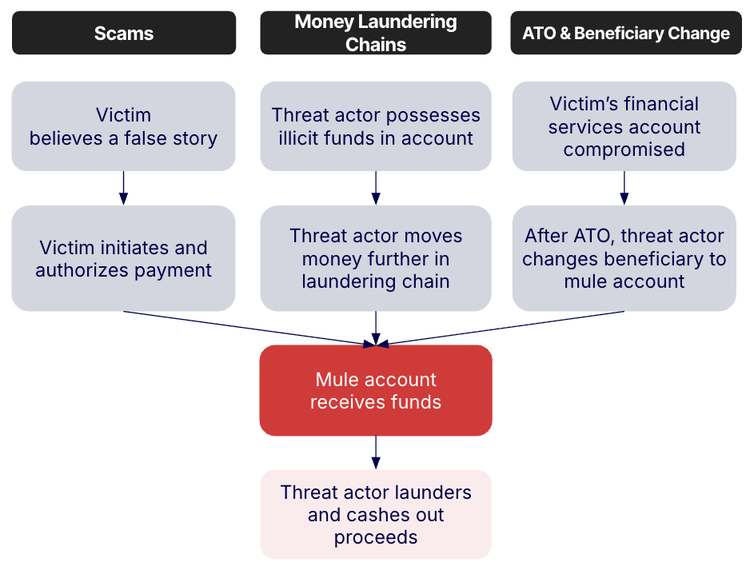
The consistent signal across attack chains
Nearly all crime is financially motivated, so every scheme eventually has to cash out, and the mule account receiving those funds is usually the one reliably traceable signal across attack chains built to evade detection.
Take action where schemes converge
Avoid sending scam payouts
Avoid sending scam payouts
Screen outbound payments against a verified list of suspicious accounts before releasing funds, so payouts and disbursements reach the intended recipient rather than a mule.
Catch account takeover before the payout leaves
Catch account takeover before the payout leaves
Flag when a payment destination is changed to a suspected mule account, surfacing the beneficiary redirection that signals an account takeover may be in progress.
Find the mules inside your customer base
Find the mules inside your customer base
Match your held accounts against suspected mule accounts to surface those potentially operating among your customers before stolen funds move through them.
Turn investigations around faster
Turn investigations around faster
Enrich reviews of suspicious claims, transactions, and activity with suspected, crime-linked account data, so analysts can better identify a mule account instead of chasing a risk score.
Top Money Mule Intelligence capabilities
FAQ
Your questions, answered.

What is Money Mule Intelligence?
Money mules are the bank accounts criminals use to receive and move stolen funds, the destination that nearly every financially motivated scheme depends on to cash out. They are difficult to catch because they are real accounts, often held by people who passed KYC, and criminals keep normal-looking activity on them so they blend in with legitimate customers.
Money Mule Intelligence is Recorded Future's dataset of these suspected accounts, each one validated through direct engagement with the threat actor operating it. Every account arrives with the evidence behind it, normalized into consistent fields such as account identifier, resolving institution, and scam typology, ready to feed fraud, treasury, and investigation workflows. Because each account is validated through direct engagement rather than assigned a probabilistic risk score, teams act on evidence instead of statistical likelihoods.
What problem does Money Mule Intelligence solve?
Money Mule Intelligence addresses the blind spot that sender-side controls can leave open. Mule accounts are real accounts, held by real people who passed KYC, so payments to them are authorized and correctly formatted, and the controls screening the sender have no reason to stop them. By screening the destination against suspected mule accounts, teams can better catch redirected and fraudulent payments that would otherwise clear.
It also helps solve the operational problem of acting on that intelligence. Because the data arrives structured and normalized, teams can ingest it directly into existing fraud, treasury, and claims systems and screen at the payment instruction step, where funds are still recoverable, rather than chasing recovery after the money is gone.
How is Money Mule Intelligence different from other fraud and risk data?
Most fraud tools work from the sender side or assign a risk score to flag accounts that look suspicious. Money Mule Intelligence takes the opposite approach: it identifies accounts suspected to be criminal-controlled, established through direct engagement with the threat actor rather than inferred from behavior, so there is no threshold to tune and no score to defend.
The other difference is where the intelligence comes from. Rather than monitoring for accounts after they surface in fraud reports, the data is collected while fraud operations are active, capturing the destination account before the funds arrive. That gives teams a window to screen and block ahead of the loss.
Who is Money Mule Intelligence for?
Any organization that sends money out or wants to keep criminal funds from moving through its accounts can put Money Mule Intelligence to work. Fraud teams screen outbound payments so refunds, payouts, and disbursements reach the intended recipient rather than a mule. Financial crime and anti-money laundering teams secure the accounts used to launder and cash out illicit funds. Investigators enrich incidents with crime-linked account data instead of chasing risk scores.
Those are the core applications today, but because a mule account sits at the end of nearly every financially motivated scheme, the uses keep expanding. Banks, insurers, wealth and investment platforms, and any business that pays customers directly all face the same underlying problem, and all can act on the same validated intelligence.