
What is an Attack Surface?
Knowing your attack surface is key to securing your data. It includes all the weak points where attackers might gain unauthorized access to your systems. This article cuts through the complexities to provide a clear understanding of your attack surface and offers straightforward strategies to minimize these vulnerabilities.
Key Takeaways
- The attack surface includes all potential vulnerabilities and entry points that attackers can leverage, divided into digital and physical components, necessitating regular assessment and mitigation to minimize cyber risks.
- Attack vectors are methods used to exploit attack surfaces, including weak passwords, outdated software, and social engineering, highlighting the need for a diverse range of security controls to prevent exploitation.
- Proactive external attack surface management involves continuous monitoring, patching vulnerabilities, employing robust security measures like firewalls and intrusion detection systems, and utilizing SOCs for real-time threat detection and response.
Attack Surface Meaning
The attack surface in cybersecurity encompasses the potential vulnerabilities and entry points that attackers can leverage to gain unauthorized access to an organization’s computer systems and networks.
It is crucial for organizations to regularly assess and mitigate their attack surface to minimize security risks. It’s like the surface area of a fortress - the larger it is, the more places potential attackers have to exploit. Just as fortress walls can have weak points, so too can your organization’s digital and physical assets.
A wide attack surface spells potential risks such as unauthorized access, data theft, operational disruption, and damage. This can lead to higher vulnerability to cyber attacks, increased security costs, and even damage to your organization’s reputation and trust.
48% of organizations report that conducting a complete attack surface discovery with their current processes and technologies requires over 80 hours.
According to a study conducted by Enterprise Strategy Group, 76% of organizations have faced a cyberattack originating from the exploitation of an unknown, unmanaged, or poorly managed internet-facing asset, often due to insufficient visibility or context.
One of the best examples of this is the extensive impact of the Equifax breach in 2017, which compromised 147 million personal records and resulted in a $700 million settlement. This underscores the crucial need for effective management of attack surfaces to prevent such significant security missteps.
Reporte Anual 2023 de Recorded Future Refleja este sentimiento:
The challenge lies in managing this attack surface, which is composed of two distinct areas - the digital and physical attack surfaces. Let’s explore these two components in detail.
Digital Attack Surface Components
The digital attack surface is composed of the numerous hardware and software components that connect to an organization’s network. Think of this as the “online” portion of your fortress, including:
- Your company’s applications
- Code
- Ports
- Servers
- Websites
A medida que seguimos adoptando el Internet de las Cosas (IoT) en nuestros lugares de trabajo, la superficie de ataque digital se expande aún más. Los dispositivos IoT, en toda su comodidad, mejoran la superficie de ataque digital de una organización gracias a su mayor conectividad y vulnerabilidades inherentes.
Such a network attack surface teems with vulnerabilities and security weaknesses present in the connected software and hardware, highlighting the need for robust security controls.
Physical Attack Surface Components
The physical attack surface, on the other hand, deals with the tangible aspects of your organization’s security. This includes endpoint devices, physical locations, and even people. Measures such as access control systems, surveillance cameras, and intrusion detection sensors are critical for preventing unauthorized access to facilities.
Securing endpoint devices such as:
- computers
- hard drives
- portátiles
- mobile phones
- mobile devices
is also essential, as these can be physically accessed or compromised, presenting a risk to the organization. Erecting physical barriers like fencing is a measure to reduce the physical attack surface, helping prevent break-ins and harden installations against accidents and disasters.
Attack Vectors and Attack Surfaces
What is the difference between attack vector vs attack surface? Understanding the attack surface is only half of the equation; we must also understand how attackers exploit it. This is where attack vectors come into play.
They are** the means by which attackers infiltrate an environment, and the attack surface refers to the collective vulnerabilities these vectors can exploit**. It’s like a lock and key - the lock is the attack surface, and the key is the attack vector.
Every data entry point into an application or network represents a potential attack vector that forms part of the broader attack surface. A larger diversity of attack vectors leads to a more extensive attack surface for potential exploitation. Now let’s delve into the world of attack vectors and how they target attack surfaces.
Common Attack Vectors
Attack vectors are as varied as the potential vulnerabilities they seek to exploit. For instance, phishing attacks often involve tricking individuals into revealing sensitive information by posing as trustworthy entities. Social engineering via email attachments has been a prevalent attack vector for over three decades.
No todos los vectores de ataque provienen de fuera de tu organización. Los insiders con acceso autorizado son capaces de explotar maliciosamente las vulnerabilidades de una compañía desde dentro de la organización. Las contraseñas débiles o reutilizadas proporcionan un medio sencillo para que los atacantes vulneren sistemas mediante credenciales robadas. Las malas configuraciones del sistema y de la web pueden, sin querer, proporcionar a los atacantes puntos de entrada fáciles para explotar.
How Attack Vectors Target Attack Surfaces
Attack vectors exploit vulnerabilities within the attack surface. Some common attack vectors include:
- Weak passwords, which can lead to unauthorized access
- Outdated software, which may be missing critical security patches that protect against new threats
- Social engineering attacks, like phishing, which target human weaknesses
- Email systems, which can be compromised through spear-phishing
- Weak network security, which can lead to eavesdropping
These examples demonstrate how cybercriminals use specific vectors tailored to different elements of the attack surface.
Complex architectures such as hybrid systems increase the complexity and size of the attack surface, presenting more entry points and thus more opportunities for attack vectors to exploit.
Strategies for Reducing Your Organization's Attack Surface
Now that we’ve explored the expanse of the attack surface and the numerous vectors that can exploit it, let’s pivot to the proactive side of things - reducing the attack surface. By implementing security controls such as:
- firewalls
- intrusion detection and prevention systems
- access controls
- conducting regular security assessments
- providing employee training and awareness programs
By implementing effective strategies to gain access control, organizations can significantly enhance their overall security posture.
Patching software vulnerabilities and ensuring network security are critical strategies for reducing the number of attack vectors, thus effectively decreasing an organization’s attack surface.
But how do we secure the digital and physical aspects of our attack surface? Let’s dig deeper.
Securing the Digital Attack Surface
Securing the digital attack surface involves adding barriers through network segmentation, employing network access control (NAC) strategies, and implementing microsegmentation.
Minimizing vulnerabilities within software and networks can be achieved by regularly updating systems to patch security holes, reducing the amount of executable code, and being cautious of security threats in cloud environments (let’s keep in mind the complexities of managing the attack surface in the cloud).
A recent study indicates that security organizations saw a 133% annual increase in cyber assets, leading to heightened complexity in security and escalating challenges for cloud-based businesses.
Robust password management, protecting against wireless attacks, and enabling multi-factor authentication help mitigate unauthorized network access and credential compromise.
Training employees on cybersecurity best practices is also crucial, as human error is a predominant cause of security breaches.
You can’t defend what you can’t see
Para proteger todos sus bienes con las medidas de seguridad necesarias, debe conocer su existencia. La expansión del teletrabajo amplió aún más la superficie de ataque, lo que hace que la visibilidad sea aún más crucial. Por eso, una solución externa de gestión de la superficie de ataque es la mejor estrategia para minimizarla.
Asset Management Challenges
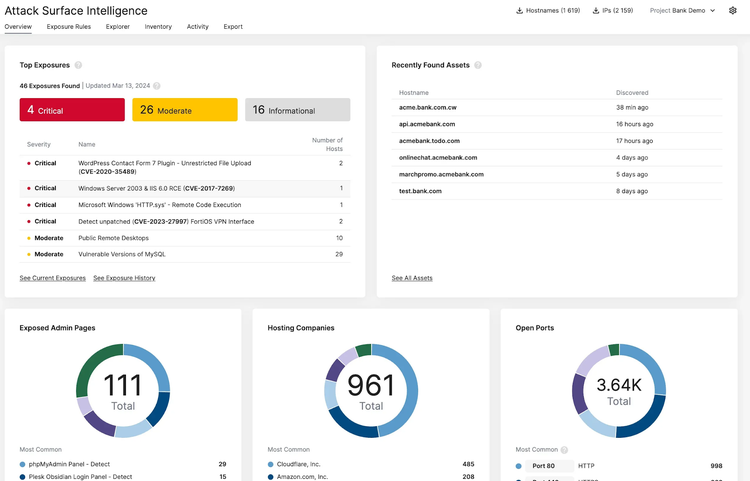
For many companies, keeping track of an ever-growing list of external assets is a significant challenge. Recorded Future’s Attack Surface Intelligence facilitates automatic and continuous identification of internet-facing assets, correctly associating them with the organization to maintain an up-to-date inventory. It also offers detailed insights about each asset, enabling deeper analysis.
Risk Assessment and Mitigation
A large portion of security issues arises not from sophisticated attack methods or zero-day vulnerabilities, but from simple misconfigurations and errors. Organizations need an enhanced understanding of an asset's vulnerabilities, risks, or unusual activities.
Attack Surface Intelligence identifies critical CVEs, misconfigurations, outdated software, and other vulnerable assets, providing dynamic scoring and evidence to help in assessing priorities and planning remediation efforts.
Protecting the Physical Attack Surface
On the physical front, access control systems such as key cards, smart locks, and biometric access control systems, coupled with regular audits, can prevent unauthorized physical access to facilities. Surveillance cameras, intrusion detection sensors, and heat and smoke detectors are essential for monitoring sensitive locations and alerting to physical security breaches or environmental dangers.
Securing endpoint devices is also critical, as these can be physically accessed or compromised, presenting a risk to the organization’s sensitive data.
User training and awareness on best practices for data security, recognizing phishing attempts, and social engineering threats enable employees to actively contribute to protecting the organization’s physical assets.
Mejora las habilidades de seguridad de tu equipo con Formación futura en inteligencia de amenazas universitaria grabada. Este programa ofrece formación práctica y práctica para ayudar a los empleados a identificar y contrarrestar una variedad de amenazas de seguridad, cerciorando que los activos de tu organización estén bien protegidos frente a brechas digitales y físicas.
Attack Surface Analysis and Management: Tools and Techniques
Given the vast complexity of modern attack surfaces, automated tools have become essential for effectively managing an organization’s attack surface, offering capabilities that quantify, minimize, and harden it against adversaries.
Continuous monitoring and dynamic real-time asset mapping are key features of tools such as Attack Surface Intelligence, enabling proactive identification of vulnerabilities and SSL weaknesses. The benefits of using these tools include:
- Proactive identification of vulnerabilities and SSL weaknesses
- Automatic asset inventory updates
- Risk prioritization based on both internal and external data sources
- Maintaining visibility over all entry points
- Effective management of security risks
Analyzing the Attack Surface
Analyzing the attack surface involves identifying:
- all the open ports and protocols
- SSL and cryptographic standards
- hosted applications
- the server platforms hosting them
- All the exposed login panels
Unpatched software vulnerabilities provide a gateway for malware infection, emphasizing the importance of regular security testing and vulnerability scanning in identifying and mitigating potential digital threats.
Security Operations Centers (SOCs) are instrumental in conducting regular risk assessments and utilizing security monitoring and testing protocols to identify and address vulnerabilities effectively. Some key tools and strategies used in SOCs include:
- SIEM software (Security Information and Event Management) for real-time monitoring and analysis of security events
- Penetration tests to simulate attacks and identify weaknesses in the system
- Extended Detection and Response (XDR) solutions for advanced threat detection and response
- Malware protection measures to safeguard against malicious software
Deploying these tools and strategies provides a further layer of protection against cyber threats and contributes to the overall security of the attack surface.
Effective Attack Surface Management Practices
Effective attack surface management requires:
- Continuous monitoring rather than periodic scans
- Maintaining a hardened stance against threats
- Continuous assessment and maintaining visibility
- Recognizing that the attack surface is constantly changing
These practices are essential for attack surface reduction and management.
Mapping the attack surface is a fundamental first step to effective management, identifying exposed digital assets that are vulnerable. Strong security practices include:
- Healthy account management
- Consistent patching
- Data backups
- Network segmentation
- Encryption
These practices effectively minimize the attack surface.
The Role of Security Operations Centers in Attack Surface Reduction
Security Operations Centers (SOCs) play a central role in an organization’s cyber defense, unifying security tools and teams for an enhanced protective barrier against cyber threats. SOCs provide:
- Real-time monitoring
- Utilizing tools like SIEM and XDR systems
- Paired with threat intelligence feeds
- To detect and prioritize looming cybersecurity incidents.
Upon detection of a potential threat, SOCs act as first responders, shutting down affected endpoints, isolating compromised systems, and employing containment strategies to quickly mitigate risks.
An integral part of this process is reducing SOC alert fatigue, which can overwhelm security teams with false positives or non-critical alerts. Proper attack surface management solutions help streamline alerts, ensuring that SOC teams focus on genuine threats and maintain high operational efficiency.
Now, let’s explore how SOCs help minimize risks and how to implement an effective SOC strategy.
How SOCs Help Minimize Risks
SOC teams, consisting of the following roles, each play a pivotal role in organizational safety and risk minimization:
- Security engineers
- Analysts
- Threat hunters
- Forensic investigators
Proactive identification of both known and emerging threats by threat hunters in SOCs is crucial to shrinking the attack surface.
Forensic investigators within SOCs are instrumental in:
- Tracing security incidents to their source, which informs the prevention of future vulnerabilities and minimizes risk exposure
- Using threat intelligence automation, alongside monitoring and alerting technologies, to detect and prioritize threats
- Enabling rapid response to potential breaches
- Overall cyber crime investigation
Implementing an Effective SOC Strategy
Building an effective SOC involves:
- Assembling a strong team of security professionals who are well-versed in managing and reducing the attack surface
- Explicitly communicating scope and responsibilities
- Investing in skilled SOC personnel and their continuous training
This is critical for maximizing SOC performance in mitigating risks associated with the attack surface.
Implementing a combination of security solutions is vital for SOCs to defend against potential security breaches. Some key solutions to consider include:
- MDR (Managed Detection and Response)
- SIEM (Security Information and Event Management)
- Endpoint Protection
- Firewalls
Compliance with evolving internal and government security standards is also a cornerstone of SOC strategy, ensuring that security practices and responses remain appropriate and current.
Real-Life Examples of Attack Surface Exploitation
At this point, you might be thinking, “That’s all well and good, but does attack surface exploitation happen in the real world?” And the answer is a resounding yes.
In January 2021, the zero-day attack on Accellion’s File Transfer Appliance (FTA) software affected about a third of its clients, including high-profile entities, which demonstrates the risks associated with vulnerabilities in widely-used digital tools.
In March 2021, the Calypso APT group exploited vulnerabilities in Microsoft Exchange servers, illustrating the broad and often overlooked dimensions of attack surfaces.
En marzo de 2023, el descubrimiento de CVE-2023-27997 expuso vulnerabilidades en más de 200.000 firewalls Fortinet SSL VPN, lo que demostró la necesidad crítica de una gestión estable de la superficie de ataque para evitar que los atacantes exploten dichas debilidades y amenacen la seguridad de la red.
Another example: the importance of managing attack surfaces in critical infrastructure is clearly illustrated by the Colonial Pipeline incident in 2021, where attackers exploited vulnerabilities to disrupt fuel supply across the Eastern U.S., showing how cyber threats can translate into real-world crises.
These incidents underscore the importance of proper attack surface management and highlight the consequences of neglecting it.
Frequently Asked Questions
What is an attack tree?
Attack surface is a written description of the entry points in an IT environment for potential attackers, while an attack tree is a diagram depicting the attacker's objective and methods for achieving it.
What is the difference between attack surface and threat?
The difference between attack surface and threat is that threats refer to the various types of dangers and motivations, while attack surface involves identifying vulnerable areas in security.
What are the three types of attack surfaces?
The three types of attack surfaces are the digital attack surface, the physical attack surface, and the social engineering attack surface.
Summary
In a world where cybersecurity threats are constantly evolving due to the dynamic expansion of the cloud, understanding and managing your attack surface is crucial. We’ve taken a deep dive into what attack surfaces are, the common attack vectors, and the critical role of Security Operations Centers (SOCs) in minimizing these threats.
The key takeaway is clear: a proactive approach to attack surface management, involving regular security assessments, continuous monitoring, and employee training, is instrumental in safeguarding your organization.
La Attack Surface Intelligence de Recorded Future equipa tu SOC con las herramientas para contrarrestar proactivamente las amenazas cibernéticas. Al proporcionar inteligencia en tiempo real e información accionable, permite a tu equipo anticipar a posibles brechas de seguridad. Reserva tu demo hoy.

Esteban Borges
Esteban is a seasoned security researcher and IT professional with over 20 years of experience, specializing in hardening systems and networks, leading blue team operations, and conducting thorough attack surface analysis to bolster cybersecurity defenses. He's also a skilled marketing expert, specializing in content strategy, technical SEO, and conversion rate optimization. His career includes roles as Security Researcher and Head of Marketing at SecurityTrails, before joining the team at Recorded Future.