North Korea’s Ruling Elite Are Not Isolated

In-depth analysis of North Korean internet activity reveals an informed, modern, and technologically savvy ruling elite.
Executive Summary
Esta es la segunda parte de nuestro serial sobre Corea del Norte. En la primera parte titulada "Corea del Norte no está loca", revelamos que los actores cibernéticos norcoreanos no están locos ni son irracionales: simplemente tienen un alcance operativo más amplio que la mayoría de los demás servicios de inteligencia.
Aquí enriquecemos nuestro análisis a través de nuestro socio de inteligencia, Team Cymru, y realizamos un estudio exhaustivo que revela perspectivas únicas sobre cómo el liderazgo norcoreano y la élite gobernante emplean Internet y qué puede decirnos sobre sus planes e intenciones.
Our analysis demonstrates that the limited number of North Korean leaders and ruling elite with access to the internet are actively engaged in Western and popular social media, regularly read international news, use many of the same services such as video streaming and online gaming, and above all, are not disconnected from the world at large or the impact North Korea’s actions have on the community of nations. Further, we have concluded that:
- Attempts to isolate North Korean elite and leadership from the international community are failing. In fact, their internet activity is in many ways not that different from most Westerners.
- The data set reviewed suggests that general internet activity in North Korea may not provide early warning of a strategic military action, contrary to conventional hypotheses. If there is a correlation between North Korean activity and missile tests, it is not telegraphed by leadership and ruling elite internet behavior.
- North Korea is not using territorial resources to conduct cyber operations and most North Korean state-sponsored activity is likely perpetrated from abroad, which presents an opportunity to apply asymmetric pressure on the Kim regime.
This analysis, together with part one of our blog series, demonstrates that there are likely other regime pressure points, and as a result, other tools, techniques, and partners that could be explored toward a path for North Korean denuclearization.
Background
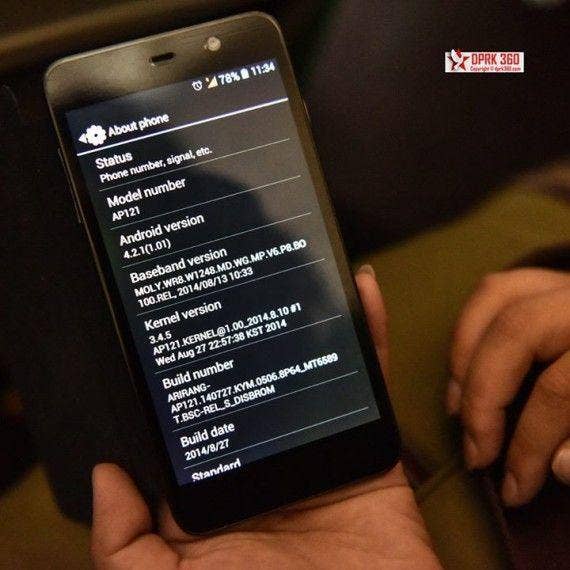
Los medios surcoreanos evalúan que podría haber hasta 4 millones de dispositivos móviles en Corea del Norte. Así que, aunque los dispositivos móviles están muy extendidos en Corea del Norte, la gran mayoría de los norcoreanos no tiene acceso a Internet. Los dispositivos móviles (ver imagen de un dispositivo fabricado en Corea del Norte más abajo) vendidos a norcoreanos comunes cuentan con servicios 3G mínimos, incluyendo voz, mensajes de texto y mensajería de imágenes/videos, y están restringidos a operar únicamente en la red nacional de proveedores norcoreanos, Koryolink.
Una pequeña minoría de usuarios, como estudiantes universitarios, científicos y funcionarios gubernamentales selectos, tiene acceso a la intranet estatal nacional de Corea del Norte a través de computadoras de uso común en universidades y cibercafés. Slate describió la intranet doméstica de esta manera:
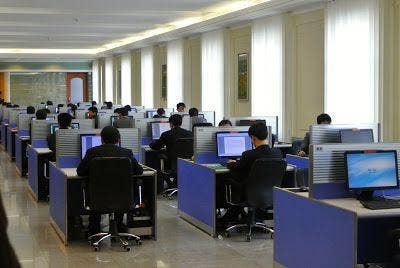
Laboratorio de informática en la Universidad Kim Il Sung. Fuente: Sophie Schmidt.
Entre los pocos con licencia para usar la intranet del país hay un grupo aún más reducido de los líderes más altos y la élite gobernante que tienen atajo a Internet mundial. Aunque no hay cifras fiables de usuarios norcoreanos de Internet, los periodistas estiman que van desde "solo un número muy pequeño" hasta "el círculo íntimo del liderazgo norcoreano" o "solo unas pocas docenas de familias". Independientemente del número exacto, el perfil de un usuario de Internet norcoreano es claro; afiliado a confianza o familiar de la clase dominante.
There are three primary ways North Korean elites access the internet.
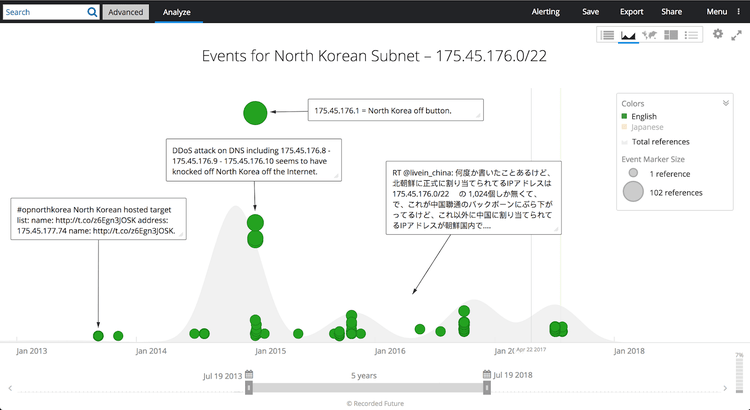
La primera es a través de su .kp asignado 175.45.176.0/22, que también alberga los únicos sitios web accesibles por Internet del país. Estos incluyen nueve dominios de primer nivel (como co.kp, gov.kp y edu.kp) y aproximadamente 25 subdominios para diversos medios estatales norcoreanos, >viajes y sitios relacionados con la educación.
El segundo método es mediante un rango asignado por China Netcom, 210.52.109.0/24. El nombre de red "KPTC" es la abreviatura de Korea Post and Telecommunications, Co, la compañía estatal de telecomunicaciones.
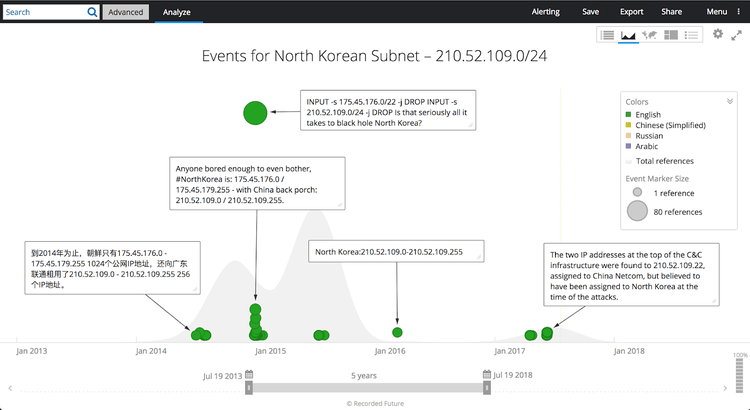
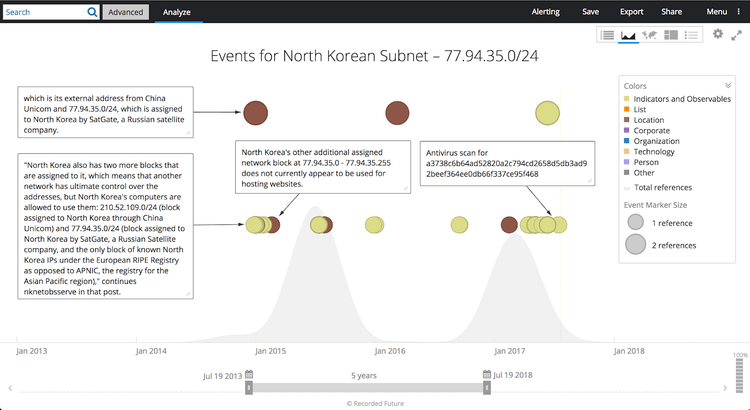
The third method is through an assigned range, 77.94.35.0/24, provided by a Russian satellite company, which currently resolves to SatGate in Lebanon.
Editor's Note
Two important notes: One, from this point on when we refer to “North Korean internet activity” or “behavior,” we are referring to use of the internet (not the North Korean domestic intranet Kwangmyong) by the select few leaders and ruling elite that are permitted access. This data does not give us any insight into intranet activity or behavior by the larger group of privileged North Koreans permitted access to Kwangmyong or diplomatic and foreign establishments that are located in North Korea.
Two, we chose this date range, April 1 through July 6, 2017, because it represented one of the periods of highest missile launching and testing activity, and also because it was the time period during which the data had the greatest depth and fidelity. While we have data stretching back to January 1, 2017, that dataset (January 1 to March 31) is much less robust.
Analysis
In the early hours of April 1, 2017, as many in the West were just waking up, checking email and social media, a small group of North Korean elites began the day in much the same manner. Some checked the news on Xinhua or the People’s Daily, others logged into their 163.com email accounts, while still others streamed Chinese-language videos on Youku and searched Baidu and Amazon.
Recorded Future’s analysis of this limited-duration data set has given us new insight into this isolated country and ruling regime. Our analysis demonstrates that the limited number of North Korean leaders and ruling elite with access to the internet are much more active and engaged in the world, popular culture, international news, and with contemporary services and technologies than many outside North Korea had previously thought. North Korean leaders are not disconnected from the world and the consequences of their actions.
While this data source is not absolute, it gives us a detailed picture of North Korean internet use and activity during the April to July 2017 timeframe, and as a result, we are able to reach a number of unique new insights.
The data reveals that North Korea’s leadership and ruling elite are plugged into modern internet society and are likely aware of the impact that their decisions regarding missile tests, suppression of their population, criminal activities, and more have on the international community. These decisions are not made in isolation nor are they ill-informed as many would believe.
Patterns of Use Mirror Western Users
North Korean elite and leadership internet activity is in many ways not that different from most Westerners, despite the extremely limited number of people who can access the internet; the relatively few numbers of both computers and IP space from which to reach it; the linguistic, cultural, social, and legal barriers; and sheer hostility to the rest of the world.
Por ejemplo, al igual que los usuarios en el mundo desarrollado, los norcoreanos pasan gran parte de su tiempo en línea consultando cuentas en redes sociales, buscando en Internet y navegando por Amazon y Alibaba.
Facebook is the most widely used social networking site for North Koreans, despite reports that it, Twitter, YouTube, and a number of others were blocked by North Korean censors in April 2016.
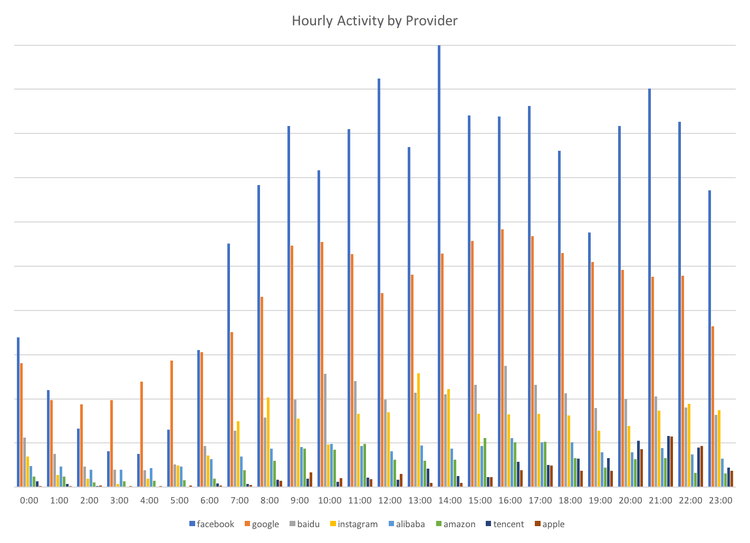
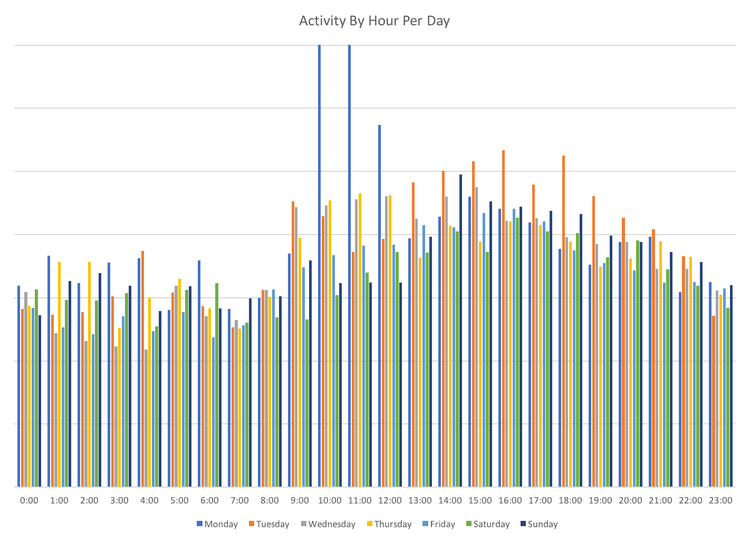
Additionally, North Koreans have distinct patterns of daily usage over this period as well. On weekdays, times of highest activity are from approximately 9:00 AM through 8:00 or 9:00 PM, with Mondays and Tuesdays being the days of consistently highest activity.
Not an Early Warning for Missile Activity
Many researchers and scholars have hypothesized that there may be a connection between North Korean cyber activity and missile launches or tests. In particular, that we may be able to forecast or anticipate a missile test based on North Korean cyber or internet activity. While we were not able to examine levels of North Korean malicious cyber activity, for this limited time period using this data set, there does not appear to be a correlation between North Korean internet activity at large and missile tests or launches.
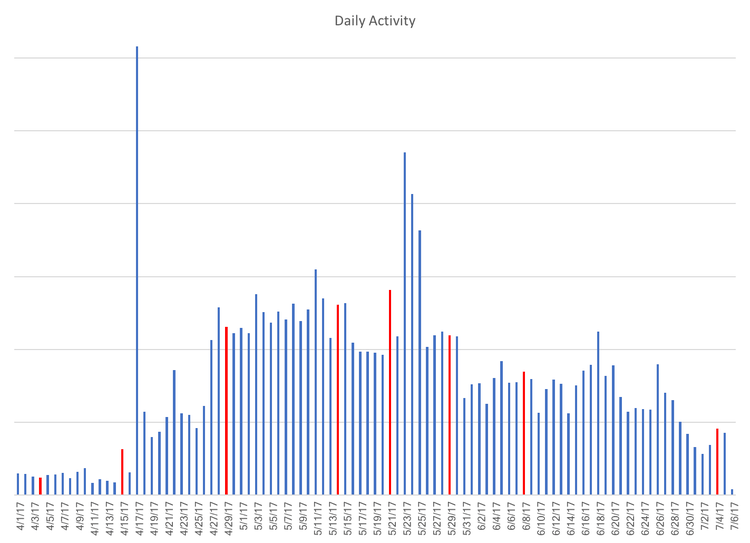
Daily actual internet activity for April 1 through July 6, 2017. Red bars are dates of North Korean missile tests or launches.
This current data set is too short a duration of time to apply any long-term conclusions about the utility of internet activity as a warning device for missile tests. However, our analysis does suggest that if there is a correlation between North Korean activity and missile tests, it is not telegraphed by leadership and ruling elite internet behavior.
Presence in Foreign Countries
The near absence of malicious cyber activity from the North Korean mainland from April to July 2017 likely indicates that, for the most part, they are not using territorial resources to conduct cyber operations and that most state-sponsored activity is perpetrated from abroad. This is a significant operational weakness which could be exploited to apply asymmetric pressure on the Kim regime, limit current North Korean cyber operational freedom and flexibility, and reduce the degree at which they are able to operate with impunity.
Estos datos y análisis demuestran que existen una presencia física y virtual significativa de Corea del Norte en varios países del mundo — países donde probablemente los norcoreanos están participando en actividades cibernéticas y criminales maliciosas (como se demuestra en la primera parte). Estas naciones incluyen India, Malasia, Nueva Zelanda, Nepal, Kenia, Mozambique e Indonesia.
Based on our analysis, we were able to determine the following:
- Está claro que Corea del Norte tiene una amplia presencia física y virtual en India. Caracterizada por el Ministerio de Asuntos exteriores de la India como una relación de "amistad, cooperación y comprensión", los datos que analizamos respaldan los reportes de relaciones diplomáticas y comerciales cada vez más estrechas entre India y Corea del Norte.
- Patterns of activity suggest that North Korea may have students at least seven universities around the country and may be working with several research institutes and government departments.
- Nearly one-fifth of all activity observed during this time period involved India.
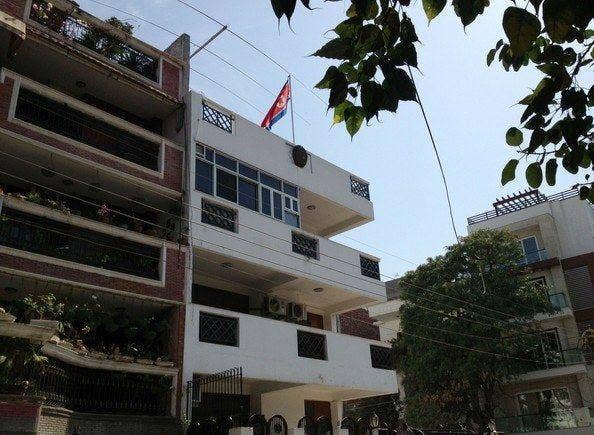
Embajada norcoreana en India. (Fuente)
North Korea also has large and active presences in New Zealand, Malaysia, Nepal, Kenya, Mozambique, and Indonesia. Our source revealed not only above-average levels of activity to and from these nations, but to many local resources, news outlets, and governments, which was uncharacteristic of North Korean activity in other nations.
Se ha informado ampliamente de que Corea del Norte tiene presencia física en China para llevar a cabo operaciones cibernéticas, incluyendo la copropiedad de un hotel en Shenyang con ciudadanos chinos desde el cual Corea del Norte realiza actividades cibernéticas maliciosas. Casi el 10 por ciento de toda la actividad observada durante este periodo involucró a China, sin incluir los puntos de acceso a Internet proporcionados por las compañías de telecomunicaciones chinas.
Our analysis finds that the profile of activity for China was different than the seven nations identified above, mainly because North Korean leadership users utilized so many Chinese services, such as Taobao, Aliyun, and Youku, which skewed the data. After accounting for use of Chinese internet services, which of course do not signify either physical or virtual presence in China, the pattern of activity to local Chinese resources, news outlets, and government departments mirrored the seven previously identified nations.
This Chinese example, where the distinct pattern of activity we discovered combined with the already known facilities for cyber operations, provides us with a model we can apply to the other seven nations.
Together with the fact that North Korea has a significant physical and virtual presence in several nations around the world, and our previous research in part one, it is highly likely that North Korea is conducting cyber operations from third-party countries. Therefore, an alternative avenue to explore would be whether malicious cyber activity from these nations correlates with missile launches or tests, as opposed to activity from territorial North Korea.
Poor Security Leads to New Intelligence
Menos del uno por ciento de la actividad en Internet norcoreana durante este periodo fue ofuscada o protegida de alguna manera. Entre las actividades que cumplían con este criterio, la técnica técnica variaba ampliamente, desde una implementación incorrecta de TLS/SSL hasta la utilización de cadenas casi imposibles de rastrear de múltiples redes privadas virtuales (VPN) y servidores privados virtuales (VPS) para transferir grandes cantidades de datos.
Como ejemplo de una implementación incorrecta, un usuario norcoreano se molestó en usar Tor (The Onion Router) para ofuscar su actividad, pero luego procedió a usar el intercambio de archivos torrent y salió de la red Tor desde el mismo nodo todos los días durante más de tres meses.
Of the users that employed obfuscation technologies, a wide range of VPN and VPS services and providers were utilized. Almost all VPN and VPS consumed by North Koreans are monthly subscriptions, likely managed by an individual or government department.
It is not clear how these services are purchased and many of the providers are large and well-known Western companies. These include Sharktech, iWeb, Digital Ocean, Linode, Leaseweb USA, Telemax, Touch VPN, and others.
Many VPN and VPS were used to obfuscate or facilitate browsing, either from passive internet monitoring or domestic censors.
One U.S. VPN was used by an iPad to check a Gmail account, access Google Cloud, check Facebook and MSN accounts, and view adult content. Other VPN and VPS were used to run Metasploit, make purchases using bitcoin, check Twitter, play video games, stream videos, post documents to Dropbox, and browse Amazon.
As a result of this generally poor obfuscation, this data afforded us insight into North Korean leadership and elite interests that we have never had before. For example, many users utilized VoIP services to talk and message others overseas; others still had AOL accounts and checked them regularly; some users frequented beauty and health sites; others purchased expensive sneakers online; many users investigated industrial hardware and technology optimization services; others used iPhones, iPads, and Blackberries to communicate.
Otros usuarios dedicaban tiempo cada día a investigar compañías de ciberseguridad y sus investigaciones, incluyendo Kaspersky, McAfee, Qihoo360 y Symantec; y compañías y tecnologías de prevención de DDoS como DoSarrest y Sharktech. Un usuario recibió formación en el uso de THURAYA y equipos de comunicaciones por satélite, y otros investigaron los departamentos de física e ingeniería en varias universidades de Malasia, EE. UU. y Canadá.
Los juegos de video y el streaming de contenidos representaron el sesenta y cinco por ciento de toda la actividad en Internet en Corea del Norte. En general, los usuarios consumen contenido principalmente del servicio chino de alojamiento de videos Youku, iTunes y varios BitTorrent y servicios de streaming peer-to-peer. En cuanto a juegos, los usuarios norcoreanos parecen preferir juegos alojados por Valve y un juego multijugador masivo en línea llamado World of Tanks.
Suspect Activity
While the majority of activity from North Korea during this timeframe was not malicious, there was a smaller, but significant, amount of activity that was highly suspect. One instance was the start of Bitcoin mining by users in North Korea on May 17.
Según la wiki de Bitcoin, la minería de bitcoin es "el proceso de agregar registros de transacciones al libro mayor público de transacciones pasadas (o cadena de bloques)". La minería de Bitcoin es difícil porque es una tarea computacionalmente compleja y puede requerir hasta el 90 por ciento de la potencia de una máquina.
The benefit to using all of this energy and adding the transaction records to the blockchain is that each miner is awarded not only the fees paid by the users sending the transaction, but 25 bitcoins once they discover a new block.
Antes de ese día, prácticamente no hubo actividad en sitios o nodos relacionados con Bitcoin, ni en el uso de puertos o protocolos específicos de Bitcoin. A partir del 17 de mayo, esa actividad aumentó exponencialmente, pasando de nada a cientos al día. El momento de esta minería es importante porque comenzó muy poco luego de los ataques de ransomware May WannaCry , que la NSA atribuyó al servicio de inteligencia norcoreano, el Reconnaissance General Bureau (RGB), como un intento de recaudar fondos para el régimen de Kim.
By this point (May 17) actors within the government would have realized that moving the bitcoin from the three WannaCry ransom accounts would be easy to track and ill-advised if they wished to retain deniability for the attack.
It is not clear who is running the North Korean bitcoin mining operations; however, given the relatively small number of computers in North Korea coupled with the limited IP space, it is not likely this computationally intensive activity is occurring outside of state control.
Additionally, during this time frame it appeared that some North Korean users were conducting research, or possibly even network reconnaissance, on a number of foreign laboratories and research centers.
En individuo, la actividad dirigida al Centro Nacional de Teledetección de la Organización India de Investigación Espacial, al Laboratorio Nacional de Metalurgia de la India y al Departamento de Ciencia y Tecnología de Filipinas en Institutos de Investigación Avanzada en Ciencia y Tecnología levantó sospechas, pero no pudimos confirmar comportamientos maliciosos.
Impact
The international policy and engagement strategy toward North Korea has struggled to be impactful for decades because it has relied on the same set of tools (sanctions, increasing international isolation) and engaged the same nations (China, Russia, UN Security Council Permanent Five) as partners. This two-part series demonstrates that there are likely other pressure points on the regime and as a result, other tools, techniques, and partners that should be explored.
Team Cymru’s intelligence and Recorded Future’s analysis have revealed two separate realities.
First, in spite of the sanctions and massive international pressure, North Korea’s leaders are not isolated from the outside world. They are active and engaged participants in the contemporary internet society and economy; meaning that attempts to shut North Korean leadership off from the global economy have largely failed.
Second, new tools that do not focus on Pyongyang and territorial North Korea are needed to achieve a lasting negative impact on the current Kim regime. We have identified other nations with which the West could partner and alternate tools and techniques that could be utilized to apply asymmetric pressure on North Korea. Partnering with nations such as India, Malaysia, Indonesia, or others identified above, would enable the U.S. and other Western nations to circumvent uncooperative partners in China and Russia and exert pressure on the broad North Korean operational diaspora, which, because of the regime’s dependency, would likely impose larger real costs on leadership.
For cybersecurity professionals and network defenders, this two-part series reveals just how complex defending from North Korean malicious cyber activity can be. We continue to recommend that financial services firms and those supporting U.S. and South Korean military THAAD deployment as well as on-penninsula operations maintain the highest vigilance and awareness of the heightened threat environment to their networks and operations on the Korean peninsula.
Similarly, energy and media companies, particularly those located in or that support these sectors in South Korea, should be alert to a wide range of cyber activity from North Korea, including DDoS, destructive malware, and ransomware attacks. Broadly, organizations in all sectors should continue to be aware of the adaptability of ransomware and modify their cybersecurity strategies as the threat evolves.