
Chinese State Media Seeks to Influence International Perceptions of COVID-19 Pandemic
Recorded Future analyzed data from several Western social media platforms from January 1 to March 9, 2020 to determine how the Chinese state exploits social media to influence Western public perceptions of the coronavirus disease 2019 (COVID-19) outbreak. This report details those techniques and campaigns using data acquired from the Recorded Future® Platform, social media sites, and other OSINT techniques. This report will be of most value to government departments, geopolitical scholars and researchers, and all users of social media.
Executive Summary
Over the course of 2019, we published research on Chinese English-language social media influence operations, revealed that they are seeded by state-run media, and that they generally present a positive, benign, and cooperative image of China. This research examines Chinese influence attempts during the novel coronavirus, known as the coronavirus disease 2019 (COVID-19) outbreak, and is an effort to characterize Chinese state-run media’s attempts to influence Western public perceptions of the pandemic.
Chinese overt messaging around COVID-19 has evolved over the course of this pandemic. Insikt Group’s research has identified two distinct phases of Chinese overt messaging. The first, from January 9 through February 10, consisted of an initially informative public response that followed the progression of the outbreak. The second, from February 11 to the present, was characterized by shifts — shifting the blame for the pandemic away from the Chinese government, highlighting the prominence of Xi Jinping as the leader of effective response, and shifting from China as the source of the pandemic to China as a global leader in its response.
Key Judgments
- Evaluamos que el esfuerzo que vemos hoy para sembrar dudas sobre el origen de la COVID-19 y desviar la culpa de China comenzó a mediados de febrero, con la transición del uso de hashtags específicos de Wuhan en las publicaciones sobre COVID-19.
- Chinese overt influence accounts did not address the COVID-19 crisis until January 9, 2020. This was nine days after the Wuhan Health Commission declared the outbreak, yet 11 days before national-level state media would acknowledge the crisis domestically on January 21.
- Sentiment and content analysis revealed that Chinese state-run influence accounts waged a broadly positive messaging campaign on Western social media. However, messaging surrounding COVID-19 was starkly more negative than around campaigns we have previously studied.
- Contrary to other English-language social media campaigns that we have tracked, the numbers of positive and negative sentiment posts were nearly the same. Additionally, as the number of both negative and positive posts increased, the strength of the negative and positive sentiment did as well. Comparatively, we assess that this COVID-19 campaign was far more negative than prior Western-focused influence operations run by China.
Background
According to the World Health Organization, the novel coronavirus, known as coronavirus disease 2019 (COVID-19), was first reported as originating from Wuhan, China on December 31, 2019. COVID-19 is a viral, respiratory disease that has spread throughout the world, causing fear and panic as the outbreak progresses. To date, hundreds of thousands of people have been infected across the world, and tens of thousands have died.
Insikt Group conducted a retrospective analysis of numerous accessible, non-Chinese language social media posts from accounts run by Chinese state-run media organizations and associated foreign influence accounts on Western social media platforms. The data set includes posts from several social media platforms from January 1 through March 9, 2020 that included terminology related to COVID-19. There were no mentions of COVID-19 among Chinese overt influence accounts prior to January 9, 2020.
Analysis
As of March 9, 2020, Chinese overt influence accounts had published over 32,000 posts related to COVID-19 on several Western social media platforms. Nearly half of all posts from Chinese overt influence accounts since January 9 mention “coronavirus” or “COVID-19.”
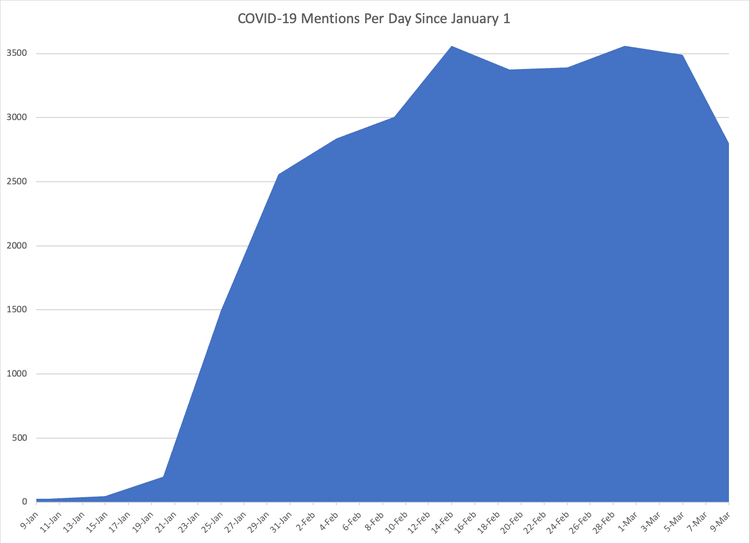
The progression of Chinese overt influence account messaging around the COVID-19 outbreak on Western social media platforms.
Los relatos chinos de influencia abierta abordaron por primera vez el COVID-19, entonces conocido como el "brote de neumonía previamente no identificado", el 9 de enero. Ese mismo día la Organización Mundial de la Salud (OMS) anunció que las autoridades chinas determinaron que la enfermedad era un nuevo coronavirus. El anuncio de la OMS incluyó varias declaraciones elogiosas sobre el sistema sanitario chino y su capacidad para responder a brotes, así como una garantía de que el virus "no se transmite fácilmente entre personas."1 Varias cuentas estatales de influencia, incluyendo el People's Daily, CGTN, Global Times y China Daily, publicaron su primer contenido en redes sociales sobre el brote en la mañana del 9 de enero (GMT).

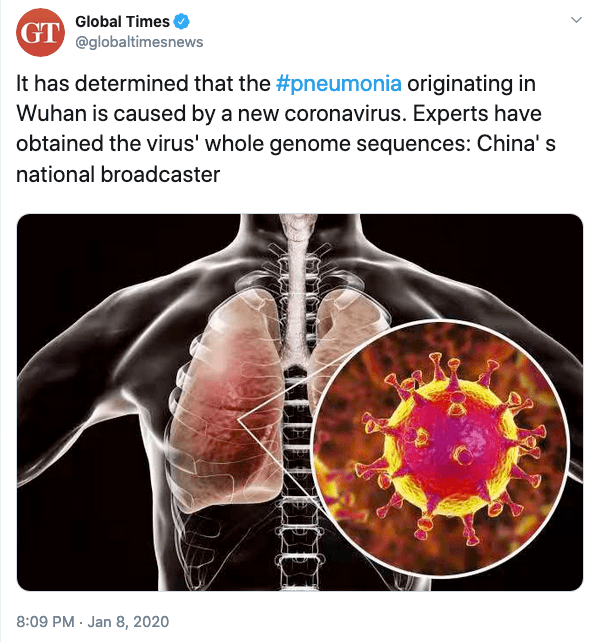
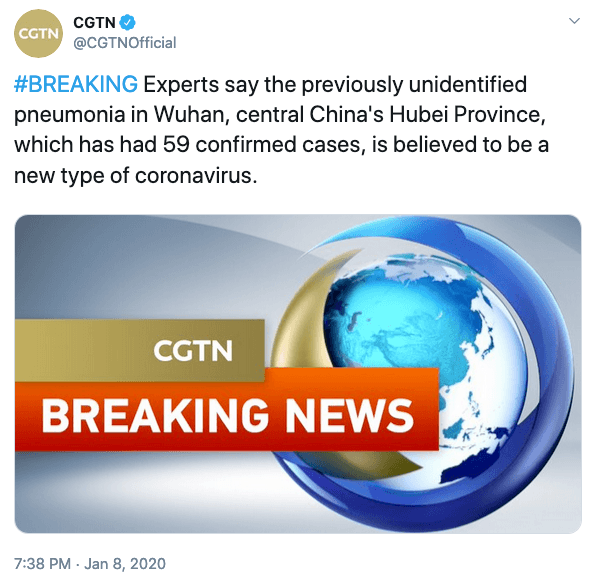
Examples of the first posts addressing COVID-19 posted by Chinese state-run influence accounts.
Over the course of the first five days of messaging, Chinese overt influence accounts repeatedly emphasized two points: First, that China was being transparent and helpful to the international community, and second, that the spread of the virus to new areas was limited.
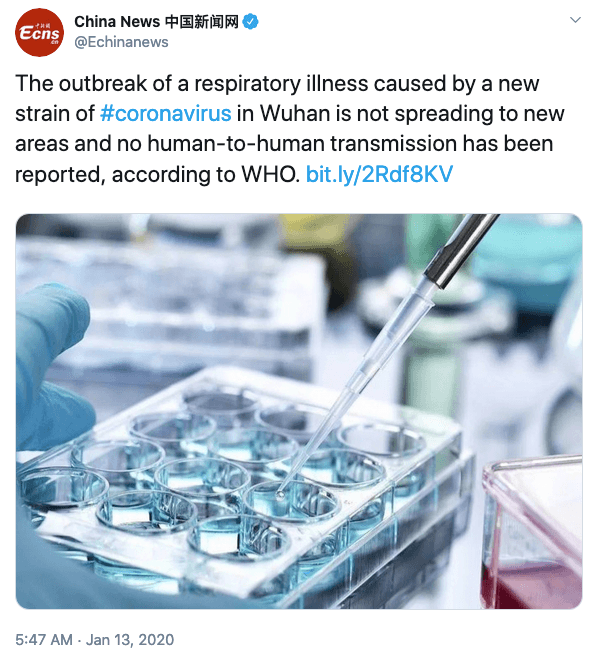
An example post from a Chinese state-run influence account addressing COVID-19.
A medida que avanzaba enero, los relatos chinos de influencia abierta continuaron minimizando el brote y el potencial de transmisión de persona a persona, a pesar de la confirmación del 20 de enero por parte de funcionarios chinos de que estaba ocurriendo.
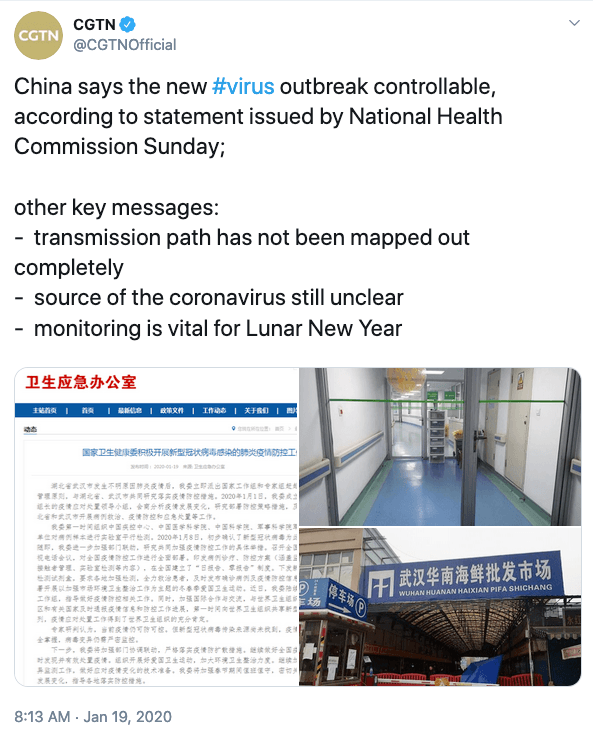
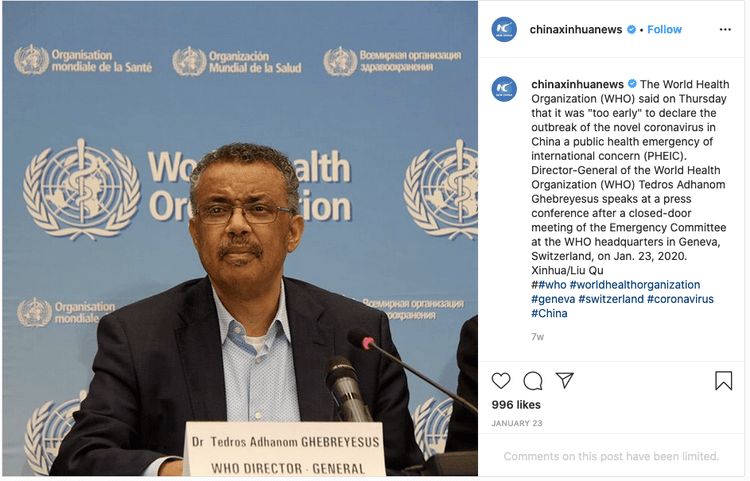
Examples of posts addressing COVID-19 posted by Chinese state-run influence accounts.
Further, China’s role in containing the virus and working with the international community continued to feature prominently in social media messaging. This included posts on the Chinese government setting up resources to share information on the virus, Chinese cooperation with the WHO, and Chinese companies increasing production of medical supplies.

An example of a post by a Chinese state-run influence account addressing how Chinese companies were responding to COVID-19.
By late January, the volume of posts concerning COVID-19 by Chinese overt influence accounts operating on Western social media spiked dramatically. Themes of the posts emphasized economic and price stability, the everyday heroism of nurses and doctors working the epidemic, and China’s transparent and positive role in addressing the crisis.
A principios de febrero, a medida que la enfermedad se extendía a los cruceros y aumentaba el número de muertes, el mensaje de las cuentas de influencia abierta comenzó a cambiar. Los esfuerzos del gobierno y de Xi Jinping se destacaron con mayor frecuencia, y los relatos de influencia abierta pusieron de relieve declaraciones de apoyo corporativo a los esfuerzos del gobierno chino.

An example of a post addressing COVID-19 from Chinese state-run influence accounts.
Among the top 20 hashtags used by Chinese overt influence accounts through mid-February, only two — #Shanghai and #XiJinping — were not related to the COVID-19 crisis. Shanghai-focused posts highlighted public health measures and indicators of economic stability, while Xi Jinping-focused posts spotlighted his domestic and international leadership.
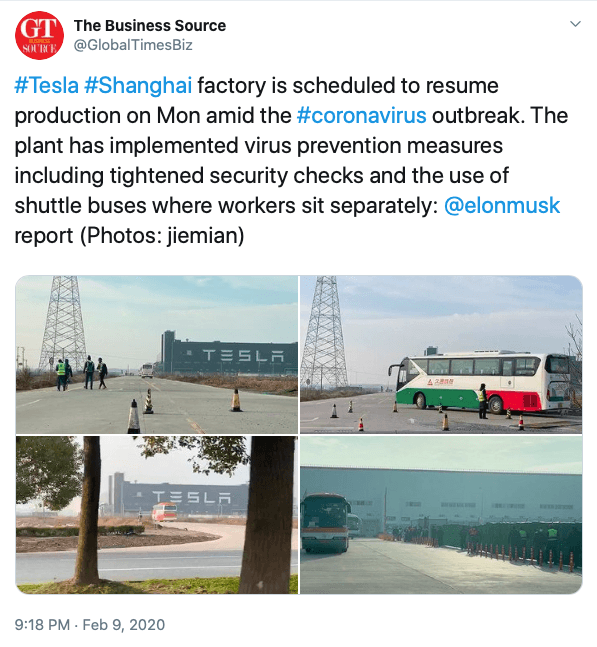
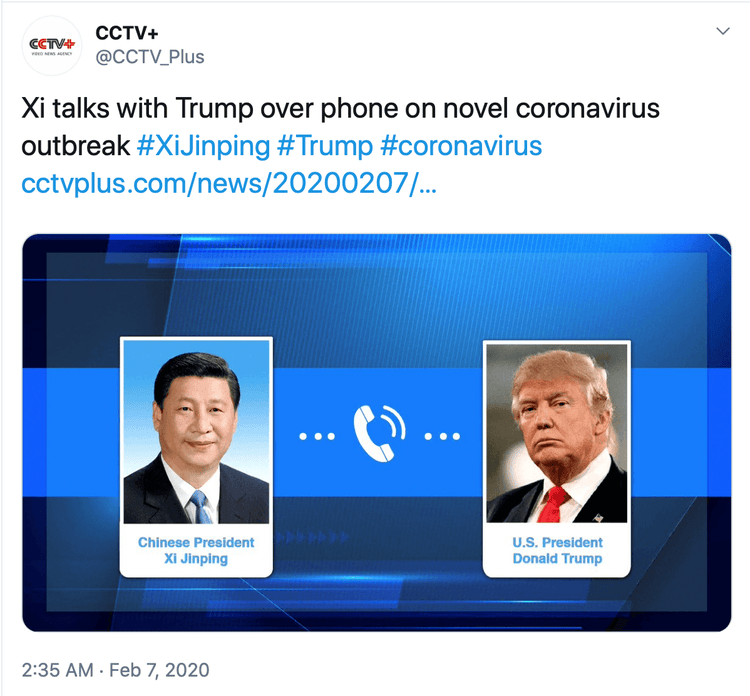
Examples of posts addressing COVID-19 from Chinese state-run influence accounts.
By late February and early March, overt influence account messaging shifted again, with the following themes remaining consistent:
- China has successfully managed the outbreak and its response should be the model for containing the spread of the virus in other countries. Some sub-themes of this message include: (1) China has a better system of governance, which enabled it to respond better and faster than the West; and (2) now that China’s outbreak is over, it is China’s turn to help the world (China as a good global citizen).
- The West is using COVID-19 as an excuse and a tool to contain China’s rise.
- Origins of COVID-19 are unclear and the Chinese government is not at fault.
In the early days of the outbreak, Chinese overt influence accounts were using several hashtags to post about COVID-19. The top hashtags used to describe the virus in January and early February included:
- #wuhancoronavirus
- #wuhanpneumonia
- #coronavirusoutbreak
- Combinations of #wuhan, #coronavirus, and #novelcoronavirus
By February 11, all Chinese overt influence accounts had stopped using the #wuhancoronavirus and #wuhanpneumonia hashtags completely. They were instead replaced with #covid19 and #coronavirus. At this point, the accounts also started to address both real and perceived misinformation around the origin of the virus and its global and financial impacts.
Por ejemplo, a finales de febrero, relatos de influencia abierta intentaron refutar la teoría de que el Instituto de Virología de Wuhan fue la fuente original del virus COVID-19.

An example of a post from Chinese state-run influence accounts addressing the actions taken by the Wuhan Institute of Virology.
Simultáneamente, las cuentas empezaron a publicar contenido denunciando la politización de la pandemia y la culpa que muchos países estaban echando a China. Evaluamos que estas publicaciones en febrero fueron el inicio del esfuerzo que vemos hoy para sembrar dudas sobre el origen de la COVID-19 y desviar la culpa de China promoviendo conflictos sobre la convención de nombramiento de virus.
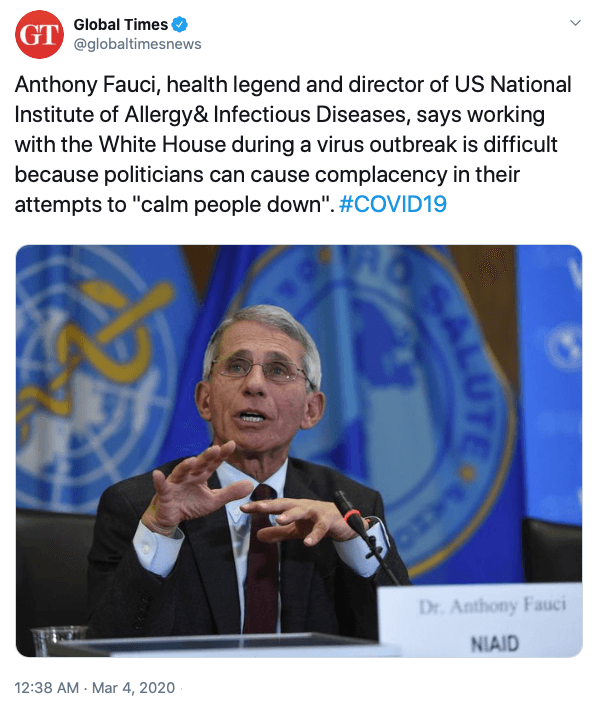
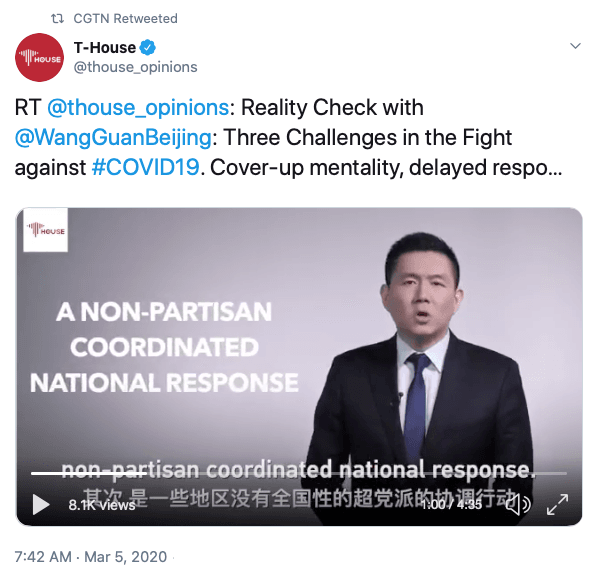
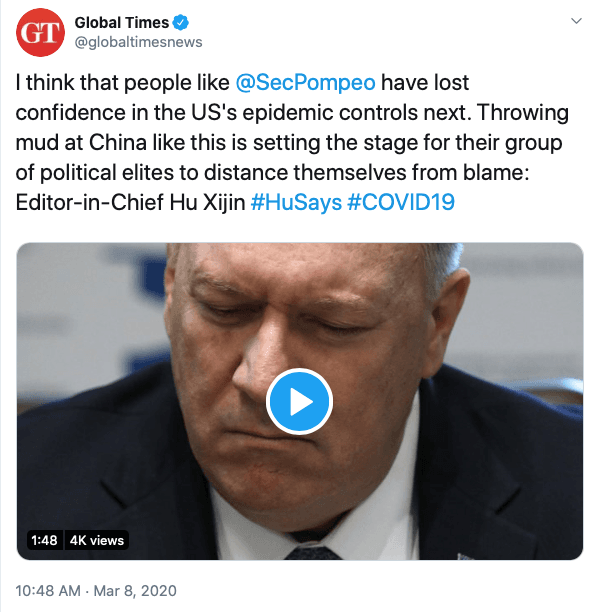
Examples of posts from Chinese state-run influence accounts shifting attention away from China.
Sentiment Analysis
Insikt Group also conducted a sentiment analysis of Chinese overt messaging on COVID-19 during this time period. Sentiment analysis assigns a number value to a message based on a set of established lexical rules. These rules position certain words, phrases, word placement, punctuation, and other vagaries of human speech into sets, which then score messages based on these inputs.
Recorded Future proprietary sentiment analysis assigns a score to each message based on the strength of sentiment within the message. On a scale from zero to one, a message with a strongly positive sentiment would yield a higher number on the positive sentiment metric (.675, for example) and a message with a strongly negative sentiment would yield a higher number for the negative sentiment metric (again, .675, for example).
Below are two examples — first of content that was scored as highly positive, and second of content that was scored as highly negative.
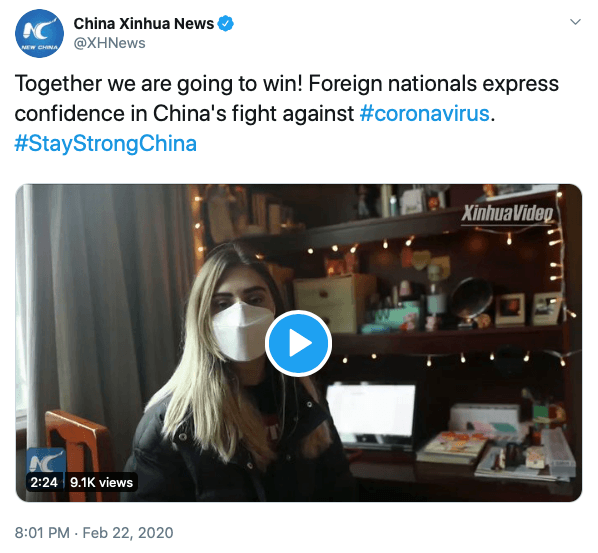
Example of a post that was scored as highly positive.
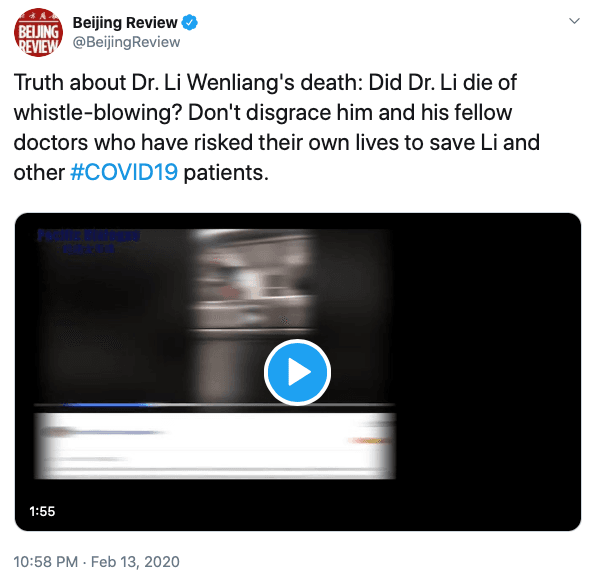
Example of a post that was scored as highly negative.
Over the course of the messaging campaign surrounding COVID-19, Chinese overt influence accounts projected an overall positive message. Contrary to other English-language social media campaigns that we have tracked, the numbers of positive and negative sentiment posts were nearly the same. There were only 6% more positive sentiment posts than negative sentiment ones through March 9. Over that time frame, as the number of both negative and positive posts increased, the strength of the negative and positive sentiment did as well.
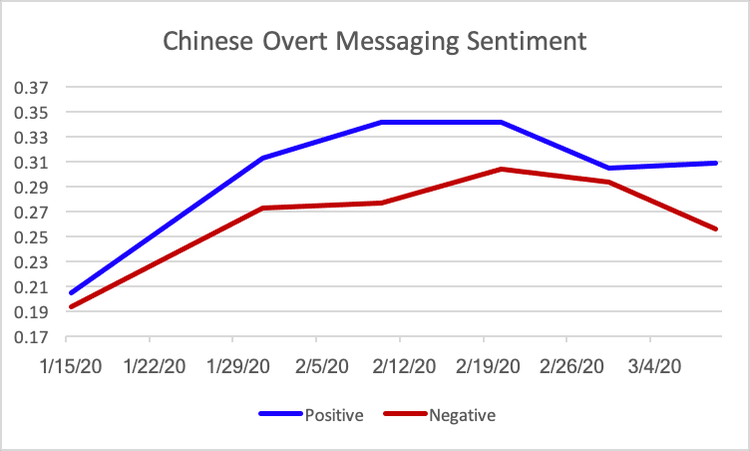
The progression of Chinese overt influence account messaging sentiment around the COVID-19 outbreak on Western social media platforms.
Outlook
This research examines Chinese state-run influence attempts during a critical period for Chinese leadership. It is an effort to characterize how Chinese state-run media is attempting to influence Western public perceptions of one timely issue — the COVID-19 pandemic.
To date, Chinese overt messaging around COVID-19 has evolved over the course of this pandemic. Insikt Group’s research has identified two distinct phases of Chinese overt messaging. The first, from January 9 through February 10, was the initial, largely informative public response. We believe that during this period, Chinese Communist Party censors and propagandists had not yet communicated coordinated guidelines for foreign messaging by state-run media.
The second, from February 11 to the present, is characterized by shifts — shifting the blame for the pandemic away from the government, shifting the prominence of Xi Jinping as the leader of effective response, and shifting from China as the source of the pandemic to China as a global leader in its response.
We believe it is important to continue to research Chinese influence operations on Western social media platforms for purposes of fact checking, countering blatantly false or misleading information, and to gain a greater understanding of how the Chinese Communist Party and government react in a public emergency. Our series of research pieces on this topic, as well as the work of others, have illuminated a general pattern in Chinese leadership crisis messaging on Western social media platforms. This pattern indicates that in the early days of a crisis, social media posts from state-run organizations are likely at their most transparent and accurate. The utility of social media posts are high at first, as they give early insight into a crisis, but degrade over time as the propaganda machine kicks in to influence the message being sent abroad.
Footnotes
1This assertion has since been disputed, and the CDC states that COVID-19 “seems to be spreading easily and sustainably in the community.”