
Understanding the Impact of Kinetic Warfare on Digital Infrastructure
- Military strikes on AWS facilities in the UAE and Bahrain mark the first time a major cloud provider has been knocked offline by direct military action, redefining data centers as high-value wartime targets.
- The simultaneous destruction of multiple Availability Zones bypassed typical cloud backup protocols, triggering localized financial paralysis and the physical loss of critical infrastructure.
- Recorded Future's AI Insights, Timeline view, and multi-section queries help analysts rapidly triage hundreds of references and correlate threat actor movements with infrastructure failures.
The conflict between the U.S., Israel, and Iran marks the first time that a major U.S. cloud provider’s data centers have been knocked offline by military action.
Kinetic strikes on Amazon Web Services (AWS) facilities in the UAE and Bahrain represent a critical "convergence event," where traditional warfare has directly targeted civilian digital infrastructure. The event has turned a regional conflict into a systemic economic crisis, and it has confirmed that data centers are now primary objectives in modern warfare. The simultaneous destruction of multiple Availability Zones (AZs) bypassed standard cloud redundancy, resulting in localized financial paralysis and the physical loss of critical digital hardware.
In this blog, we’ll show you how we are tracking and analyzing the situation in the Recorded Future Platform. Customers can replicate our steps to proactively identify threats to their own operations and mitigate business risk.
Monitoring and analyzing warzone threats with queries, AI Insights, Watch Lists, and more
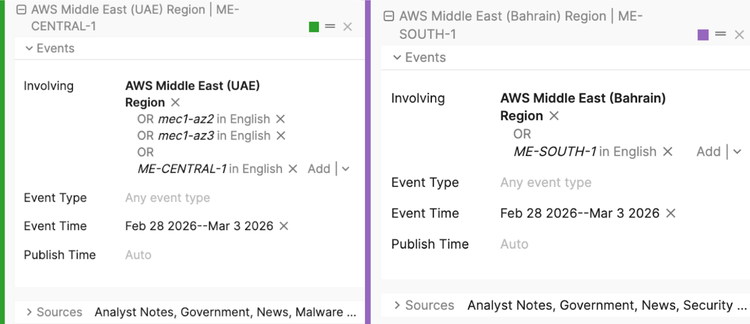
To begin, we constructed a multi-section query in the Platform to aggregate intelligence on the kinetic strikes.
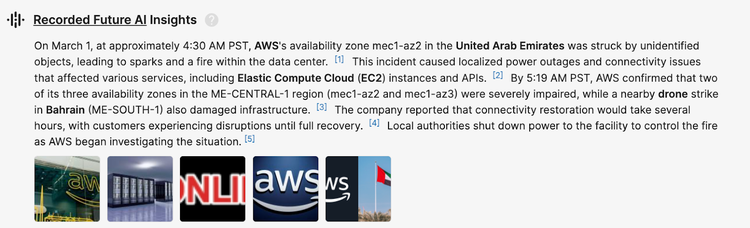
Using Recorded Future’s AI Insights, we distilled hundreds of references into a high-level executive overview. By surfacing critical details about power outages and connectivity disruptions, the Platform eliminated manual triage and helped us quickly identify infrastructure failures.
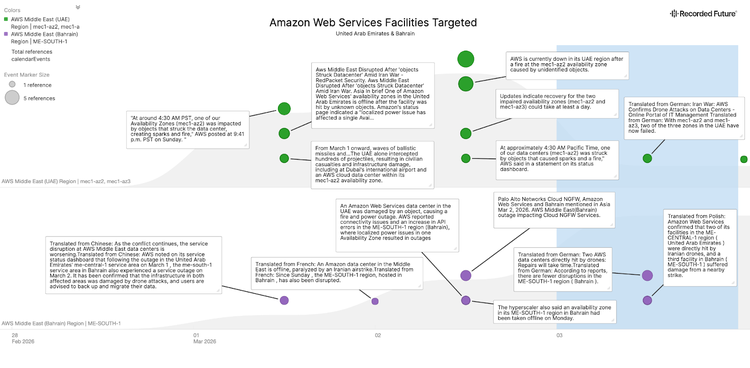
Understanding the tactical progression of these strikes enabled us to move from reactive analysis to proactive monitoring by integrating AWS facility locations into a Private Facilities Watch List.
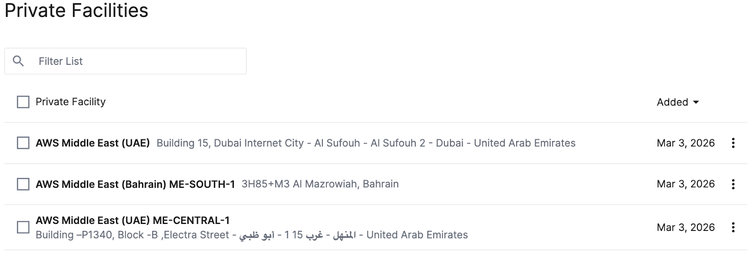
To ensure visibility into critical events, we also activated a Facility Risk Event Alert.
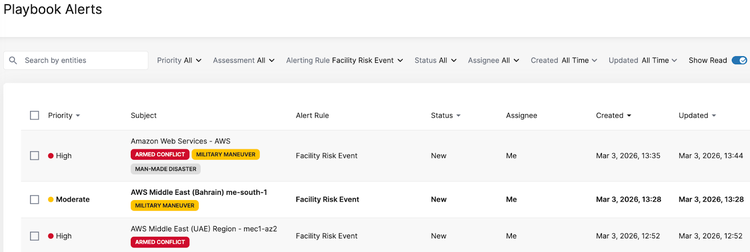
Now, once specific threat proximity or severity thresholds are met, the system will trigger automated Facility Status Change alerts and email notifications.
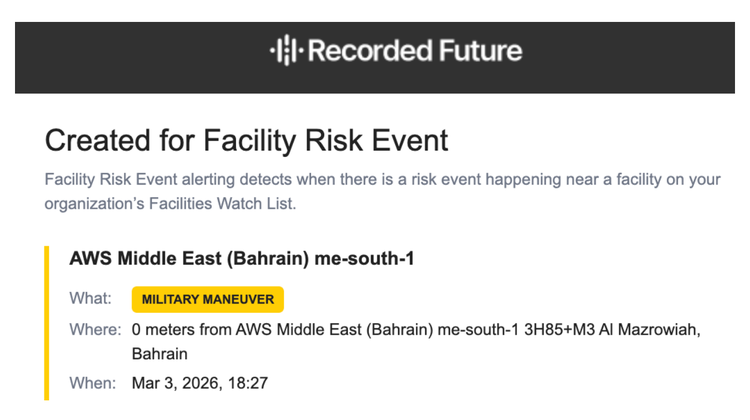
From an email Alert, our analysts can pivot directly to the Playbook Alert. This view provides context on how the unfolding event is affecting regional infrastructure and dependent operations.
Stay ahead of threats to your critical operations
In contested environments, the cloud is no longer an abstract, "always-on" utility. As we’ve seen in the current conflict, strikes have disabled two out of three Availability Zones in a single region, bypassing standard backup protocols and redefining data centers as high-value targets.
Understanding this shift is the first step. To protect your people and critical assets like facilities and supply chains, you need an intelligence platform that can connect the dots between physical, cyber, and geopolitical threat activity.
By using Recorded Future to monitor kinetic threats such as drone launches and troop movements, you can transform data from unpredictable environments into actionable intelligence to protect your operations.
Book a custom demo to learn more.