
The Shift: Rethinking the Human in the Loop
The Hiring Automation “Doom Loop” Is a Warning
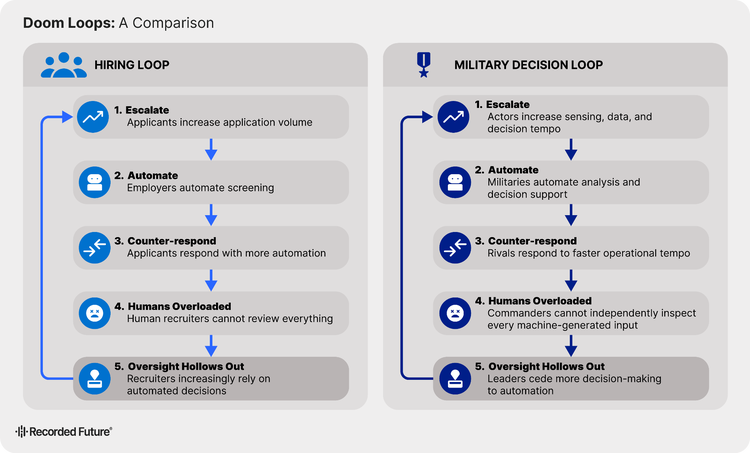
Hiring offers an instructive example of how humans can be sidelined by a process accelerated by unchecked automation. Machine-assisted decision-making has long been used in the hiring process to manage volume and improve fairness and efficiency. However, generative AI has made reading and writing job applications almost completely machine-dominated, leading the CEO of Greenhouse, a human resources platform, to declare that AI had created a "doom loop" in hiring. No one intended to create this doom loop, but the adoption of automation in one area led to accelerated adoption in others, ultimately sidelining humans from hiring decisions.
The hiring doom loop is driven by two mutually reinforcing trends: more applicants are applying for each position, and more companies are relying on automation to sift through the growing volume of applications. Applicants per hire tripled between 2021 and 2024, according to one survey of hiring managers, and Greenhouse reported a 412% increase in applicants per post. Applicants are almost certainly using generative AI to spin up customized applications to hundreds of jobs at once.
Meanwhile, 91% of HR departments report using AI in recruitment, and Greenhouse data shows that the number of human recruiters has dropped by over 50%. The recruiters who remain cannot meaningfully evaluate any single application at this volume, further reducing human decision-making in the hiring process. Some companies now use AI to conduct interviews, meaning applicants may not meet an actual human at the company until very late in the process, if at all.
Despite the intention of using AI to improve efficiency and manage scale, only one-third of recruiters reported improvements in time-to-hire using AI, while 25% reported it got slower. More companies are lengthening probationary periods, a sign that they're increasingly unable to identify unsuitable candidates before hiring them. Many job hunters express frustration with encountering bots instead of real humans at their potential future employer. At the same time, scammers and state-sponsored cybercriminals have taken advantage of this automated landscape to advance candidates whose real objective is to steal secrets or cryptocurrency.
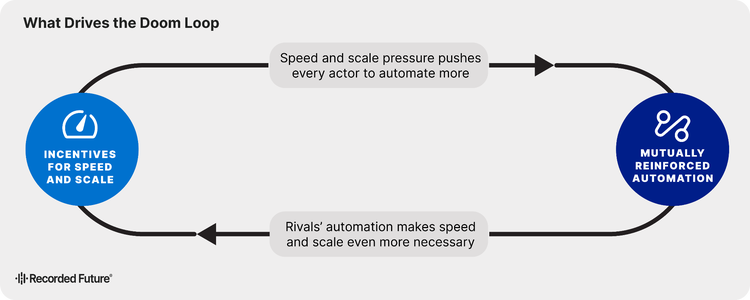
A few factors made hiring one of the first processes to fall victim to the doom loop. Hiring managers were early adopters of automation, using technology like keyword-based filters to parse resumes. At the same time, successful cover letters and resumes tend to follow a formula, which makes them easy to convincingly replicate with generative AI. However, there are two factors that are not unique to hiring that make it susceptible to doom loop dynamics:
- Incentives for speed and scale: as competition increases, candidates are rewarded for applying to more jobs, faster.
- Mutually reinforced automation: as application volume outgrew what individuals could manage, automation spread further into the hiring process. This, in turn, drives candidates to prioritize impressing the bots rather than their future human co-workers.
The hiring doom loop is a valuable case study for managing automation because it forces leaders to account for factors outside of their direct control. Instead of responding to machine volume with more automation, developers must think strategically about the intended outcomes and potential second-order effects to ensure systems remain aligned with human intent.
Automation and Military Decision-Making
Hiring is not the only process at risk. As agents integrate into more of our institutions, the same spiral will recur elsewhere, and many of these processes will have more serious consequences than an unsuitable hire.
Heads of state, for example, need to consider how automation should be adopted in military systems. Nearly every country agrees that nuclear weapons should stay under human control, and leading AI companies have pledged not to build autonomous weapons systems or autonomous mass surveillance. But the same incentives for speed and scale that have hollowed out hiring are also present in the global arms race, creating the same doom-loop dynamics that risk sidelining humans from meaningful oversight. The challenge for leaders is to anticipate where these spirals will arise and how to mitigate unwanted outcomes.
There are two distinct outcomes of automation that accelerate the doom loop in military decision-making systems. The first is decision volume: targeting decisions sit downstream of a long chain of intelligence collection, battlefield analysis, and legal review, and AI can now ingest and act on that chain faster than any human review process can follow. Humans-in-the-loop become a strategic disadvantage, as systems that pause for human sign-off lose ground to those that don’t, pressuring us toward faster automation. In a significant escalation in “the first AI war”, Russian forces launched AI-enabled drones that very likely made the targeting decision that killed three Ukrainian civilians autonomously, without human input. Autonomous AI targeting is a necessary component of drone swarms, an escalation in drone warfare where hundreds of drones operate both individually and as a unit, making decisions to maximize damage at a speed and scale that would be impossible for human controllers to monitor. Despite questions of whether autonomous swarms violate laws of war, it’s hard to imagine any side refusing to use them against an adversary that does.
The second outcome is AI-determined information control. A commander who approves a strike based on an AI system's threat assessment isn't independently evaluating the battlefield but rather ratifying a picture of the battlefield that the AI assembled, filtered, and presented. The commander retains formal authority to say yes or no, but the AI system retains functional control over what gets weighed, what gets omitted, and what "yes" or "no" is even being asked about. This means that the human in the loop is not providing meaningful oversight on AI decision-making. Subject-matter expertise may mitigate this, as subject-matter experts (SMEs) in the loop are better equipped to recognize when a decision is framed inaccurately or based on questionable intelligence, but the doom loop dynamics set in when these SMEs cede analytical work to AI. This “cognitive offloading” has been shown to weaken users’ skills over time, making the human in the loop increasingly less capable of providing critical oversight.
The use of AI in military systems highlights a challenge for all leaders: pressure to match adversaries’ speed without sacrificing control over consequential decisions. The priority is to ensure that automated systems advance organizational goals and operate within legal and ethical limits. This requires ensuring transparency into how decisions are made, confidence in the underlying data, and clear boundaries on what systems can do without human approval.
Effective Human Oversight
When speed and scale become competitive necessities, people are pushed toward more automation, regardless of intent. That pressure produces three related challenges:
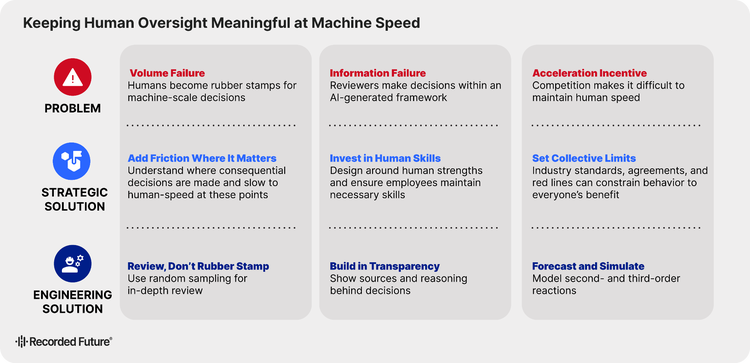
- Volume failure: Humans asked to review high volumes of AI-flagged decisions become rubber stamps rather than thoughtful reviewers.
- Information failure: Even when a human genuinely wants to scrutinize a decision, they can only evaluate what the AI system chooses to show them, limiting meaningful oversight.
- Acceleration incentive: Organizations want to slow down to human speed but are unable to do so due to their competitive environment.
To address these, leaders need to tackle both the engineering problems they can control, as well as the second-order challenges of operating in a competitive ecosystem. Both require strategic foresight to anticipate when and where future doom loops will occur.
Many decisions can and should be automated. Every organization has processes that can be monitored primarily through agentic oversight, in which agents can perform as well or better than human operators. Understanding what kinds of tasks for which AI is best suited and where those tasks best align with business functions can help leaders automate with intention. Ensuring automated systems are operating based on high-quality, real-time data is essential for quality machine-speed outcomes. In other words, better intelligence fuels better decisions, making AI systems safer.
Guardrails can be established around three core principles: (1) AI agents only take actions they have been authorized by humans to perform, (2) AI agents must not harm humans, and (3) AI agents must comply with applicable laws. However, high-consequence systems will require meaningful human oversight to ensure that agents continue to follow these rules. For these systems, leaders must engineer processes from the outset that allow for meaningful human review.
One potential approach might include instituting a mandatory 24-hour pause between recommendation and action, or requiring third parties or red teams to evaluate a decision. This way, leaders strategically add friction to a process, allowing for human deliberation at key points. For high-volume workflows where human review is absolutely necessary, random sampling for in-depth reviews would provide more meaningful evaluation of agentic decision-making than attempting to approve every agentic decision.
To mitigate the risk of information failures, system developers must ensure that humans understand what they are being shown and why. That means building transparency into AI decision-making, including showing sources and reasoning. It also means investing in the human skills needed to interpret AI outputs independently rather than simply accepting them. This means understanding which kinds of tasks humans are better suited to address — notably those involving creativity, critical thinking, and contextual judgment — and designing human-speed workflows around them.
None of this addresses the acceleration incentive, which is the hardest problem of the three. Thoughtful workflow design can account for human strengths and weaknesses, but it can't remove the competitive pressure to automate faster than the other side. Forecasting not just the immediate consequences, but also the second- and third-order impacts, is necessary to anticipate how external actors will react to acceleration. Some outcomes will require simulating how collective entities, such as the public, users, or the markets, will react to acceleration, necessitating high-quality, trustworthy intelligence to inform scenario development. Anticipating likely second-order effects can help engineers identify doom loops and pre-empt adverse outcomes.
Conclusion
The doom loop in hiring shows what happens when machine scaling meets ordinary market incentives with no plan behind it: automation took over, and now hiring is slower and possibly less effective. The nuclear and defense systems that government leaders are most worried about face an identical dynamic, with catastrophic consequences if a doom loop takes hold. Automating deliberately, with serious considerations of where speed and scale are likely to cause the most harm, can help ensure that the human in the loop remains a meaningful check.
Go deeper on agentic AI security risk
The Hugging Face incident showed how rogue agents add another element of risk to deploying agentic AI. Learn more about emerging AI safety risks in Insikt Group’s latest webinar.
AI Hype vs Reality: What the Hugging Face Breach Means for the State of Autonomous Threats
Insikt Group adheres to responsible disclosure procedures in conducting its research.
About Insikt Group®
Recorded Future’s Insikt Group, the company’s threat research division, comprises analysts and security researchers with deep government, law enforcement, military, and intelligence agency experience. Its mission is to produce intelligence that reduces risk for customers, enables tangible outcomes, and prevents business disruption.