
TAG-217 Targets South Korean Financial Services with ARTEX
The threat actor linked to recent AI-assisted attacks on South Korean financial institutions was testing infrastructure and assembling attack tools as early as August 2026, weeks before the banking campaign became public, according to new research from Recorded Future’s Insikt Group. Subsequent public reporting indicated that the breaches exposed personal data belonging to at least 68,000 people across at least seven financial institutions.
Insikt Group’s investigation expands the known timeline and capabilities of the actor, tracked as TAG-217. Insikt Group uncovered tools designed to steal cryptocurrency wallet files, gain greater access to Linux systems, and test weaknesses in mobile devices. The findings illustrate the “jagged edge” of AI-enabled attacks: threat actors realizing significant gains while committing basic operational security mistakes. AI helps attackers pursue more targets across more environments, but does not prevent them from making the security mistakes that allowed Recorded Future to uncover preparations and capabilities beyond the reported banking campaign. Those mistakes give defenders opportunities to identify related activity and disrupt operations.
Targeting South Korean Banks
In early October 2026, South Korea’s Financial Services Commission (FSC) disclosed that multiple financial institutions had been hit by cyberattacks. The attacks had compromised different systems and allowed unauthorized access to different data at each victim entity, with one breach exposing the personal information of an outsourced developer and another resulting in the theft of customer data. Industry sources reported that the attacks involved the use of ARTEX, a Chinese-language, open-source AI penetration testing framework. The variety of targets at each financial institution likely demonstrates an advantage of AI over human operators: the ability to opportunistically test for weaknesses at scale until a valuable target is found.
On October 7, 2026, public analysis of the incident identified that the threat actor, suspected to be a Chinese speaker, used several AI tools as part of their campaign, including Claude Code, DeepSeek, Grok, and Zhipu AI. Other reports shared network infrastructure indicators used in the campaign, including a primary server running ARTEX and the use of residential proxies, likely to obfuscate the origin of the activity.
Recorded Future investigated this infrastructure to better understand the actor’s operations and tracked this activity under the designation TAG-217.
Putting Together a More Complete Timeline for TAG-217
Differentiating between agentic and human-operated attacks can be difficult, especially when skilled threat actors use AI to enhance operational effectiveness. Agentic attacks use the same tactics and techniques as human operators, though faster and at scale. In the case of TAG-217, operational security mistakes allowed Insikt Group to piece together how the threat actor used AI tools to amplify their intrusion attempts across multiple environments and to uncover earlier preparations and a broader set of capabilities than public reporting revealed.
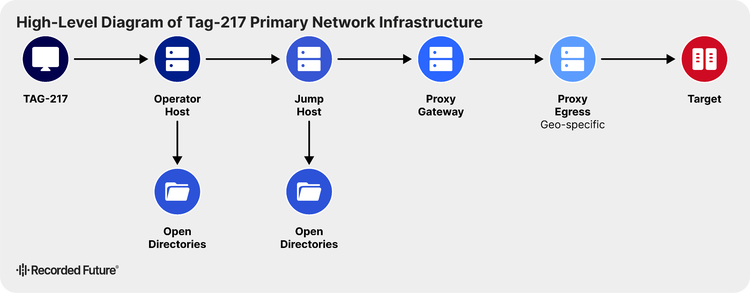
Using open directories and other evidence left exposed by TAG-217, Insikt Group identified activity beginning weeks earlier than previously reported, as well as additional attempts to carry out a variety of financially motivated operations. A reconstructed timeline of events is as follows:
- August 17–22, 2026: TAG-217 tested infrastructure designed to maintain remote access to computers and conducted internet scanning. Its logs recorded repeated test connections between its own servers, but did not indicate successful access to victim systems.
- By August 22: The threat actor had assembled tools to attack cryptocurrency mining operations using the YiiMP platform. These tools could try default passwords, steal cryptocurrency wallet configuration and key files, maintain remote access, and send Telegram alerts when credentials were captured. Additional tools targeted known Linux weaknesses to gain greater control or extract protected password data after gaining access to victim systems.
- By September 5: TAG-217 had established a workspace for testing weaknesses in iPhones and modifying Android system software. The log files identified by Insikt Group indicated experimentation with mobile exploitation techniques, but did not demonstrate successful compromise.
- By September 26: The threat actor’s working environment contained AI tools and records referencing activities such as reconnaissance, network traffic proxying, payload delivery, and the examination of payment processes.
- TAG-217 had also prepared tools to conceal and sustain its operations. These routed traffic through residential internet connections, maintained links between servers, and copied AI working-memory files between servers controlled by TAG-217.
For a complete analysis of TAG-217 activity and relevant indicators of compromise (IoCs), customers can view the note in the Recorded Future Intelligence Platform.
What This Means for AI-Enabled Attacks
TAG-217’s activity illustrates how an opportunistic threat actor can combine AI services with established techniques and tools to pursue multiple potential attack pathways. TAG-217’s infrastructure included capabilities for cryptocurrency theft, Linux exploitation, and mobile security testing beyond those previously associated with the aforementioned attacks on South Korean financial services. The available evidence does not establish the extent to which AI accelerated these attacks, but does show the breadth of capabilities and environments the actor explored, as well as its use of AI services, likely in opportunistic pursuit of financial gain.
These gains also reflect the “jagged edge” of AI capabilities: advanced performance in some tasks sits alongside surprising failures in others. AI can help threat actors find and exploit weaknesses across multiple operational environments, tasks that might previously have required several specialists working over long periods of time, yet the same AI capabilities did not prevent basic security mistakes that experienced threat actors would likely have caught. As AI adoption grows, defenders should expect faster, broader attacks that may still be noisy, traceable, and vulnerable to disruption.
Defenders should pay particular attention to internet-exposed applications, especially where they provide access to sensitive information. Unresolved vulnerabilities and weak credentials remain potential entry points, regardless of whether a human operator or an AI-assisted workflow identifies them. While capabilities associated with TAG-217 largely involve familiar techniques, AI-assisted target reconnaissance can make it easier for attackers to test more systems and exploit weaknesses organizations have left unresolved. This increases the urgency of addressing existing exposure.
What Defenders Can Do
Use of ARTEX and other AI penetration testing tools is not limited to TAG-217, and Insikt Group assesses that it is highly likely that more threat actors will incorporate these tools into their operations. While AI can help attackers, the lapses in security in the infrastructure supporting those operations create opportunities for defenders to detect the activity. Insikt Group’s analysis connected exposed files, scripts, and servers to reconstruct TAG-217’s operations. Organizations should use this kind of intelligence insight to guide both immediate responses and longer-term strategic improvements as more threat actors adopt AI tools. Insikt Group recommends the following:
- Close the gaps around sensitive data. Identify all internet-accessible services, including employee and partner applications, and verify that users can access only the records they are authorized to see. Prioritize weaknesses according to their exposure and the data or systems they could put at risk. Implement logging and monitoring workflows on internet-accessible services.
- Deliver intelligence at machine speed. Connect continuously updated threat intelligence to monitoring and response systems so new findings can automatically enrich alerts, trigger searches of historical activity, and update protections where confidence is sufficient. Intelligence has greater defensive value when it reaches systems capable of acting on it while the threat is still relevant.
- Connect behaviors across changing infrastructure. Combine intelligence about attacker infrastructure with internal evidence of unusual sign-ins, repeated requests for different customers’ records, unexpected remote access, and abnormal data transfers. This helps defenders recognize an operation even when its source addresses change.
- Automate responses with clear limits. Preauthorize proportionate actions for well-understood threats, such as terminating a confirmed malicious session or temporarily blocking verified attacker-controlled infrastructure. Require additional review when evidence is uncertain or an action could disrupt customers, particularly when an address belongs to a shared proxy service.
For security leaders, intelligence at machine speed should mean a shorter, measurable path from discovery to protection. That requires current information, context about its relevance to the organization, and response processes that can act on it quickly and reliably.
Separate AI Hype From Reality
What do advances in AI mean for your security priorities? Explore Insikt Group’s “AI Hype vs. Reality” series for a clear analysis of emerging threats and what defenders can do about them.
Insikt Group adheres to responsible disclosure procedures in conducting its research.
About Insikt Group®
Recorded Future’s Insikt Group, the company’s threat research division, comprises analysts and security researchers with deep government, law enforcement, military, and intelligence agency experience. Its mission is to produce intelligence that reduces risk for customers, enables tangible outcomes, and prevents business disruption.