Mines, Minds, and Machines: The Journey of AI
The Backdrop
The world has fractured into competing spheres of influence, and the powers that are now fighting it out have concluded that the fourth industrial revolution will crown its own winners. History offers a blunt lesson on this point: China has learned the hard way that the nation that integrates new technology into its economy first wins: Britain harnessed the power of steam and ruled for a century; America maximized the use of steel and electricity, then silicon.
One of the main technologies in question this time is artificial intelligence, specifically its final form, embodied AI, which is essentially physical intelligence with cameras, motors, and hands.
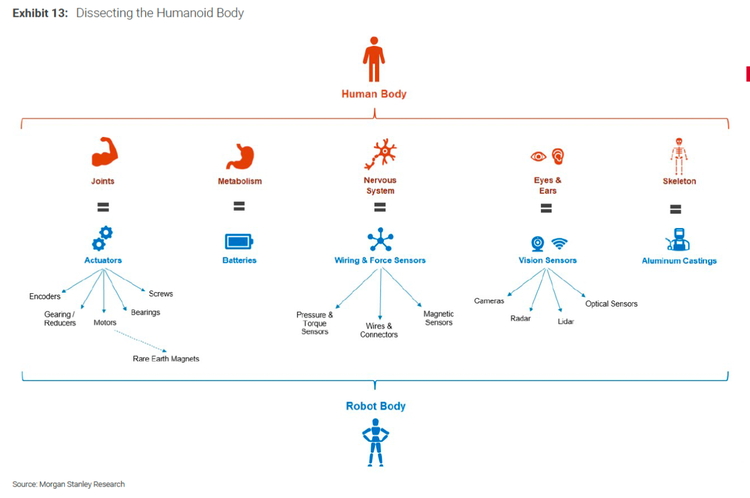
The journey from Earth to embodiment follows a chain: minerals become chips; chips fill data centers; data centers provide the compute power to train models; and models become the brains of the machines. Just take a look at NVIDIA Isaac, for example.
Each link in that chain is now a theater of geopolitical competition, and each is being probed, quietly and persistently, by state-sponsored and criminal hackers. For security leaders, understanding this journey we are on is more important than ever.
The Mines
Let’s start with the minerals. Rare earth elements, a family of seventeen metals, are used in small quantities but determine the efficiency, precision, and reliability of advanced equipment. Critical elements such as lithium, copper, nickel, cobalt, and graphite are consumed in bulk and form the physical backbone of batteries, wiring, and digital infrastructure. In simple terms, critical elements build the systems; rare earths enable them to function. These minerals are not mere commodities; they are increasingly becoming strategic dependencies for nations.
Beijing’s foresight in this area is now paying dividends. China's leverage stems less from what it digs up than from what it refines: over 90% of the world's rare earth elements are processed there, and refining capacity is slow and expensive to replicate.
China has increasingly demonstrated what its leverage buys. In 2025, it threatened to suspend rare earth exports to America, and Washington duly backed away from plans to restrict the transfer of critical semiconductor technology. The American response has been a scramble of stockpiling, domestic mining investment, and attempts to assemble critical minerals trade blocs with allies.
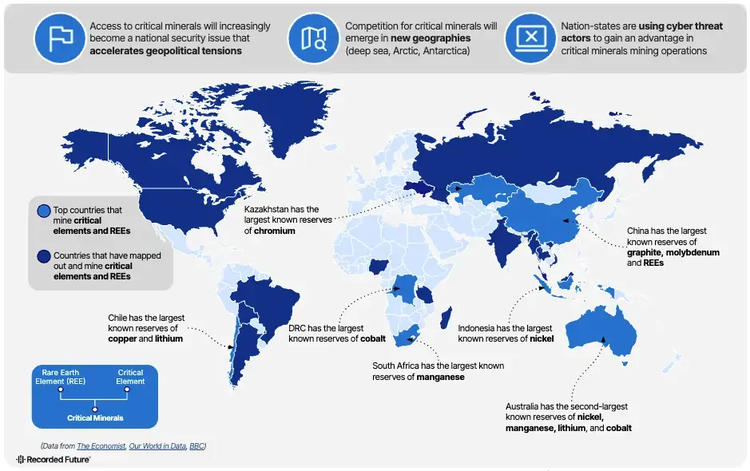
The next scramble for critical minerals is moving beyond familiar territory. With the easiest deposits already claimed, competition is pushing into harder, colder, deeper, and more politically awkward places. Japan has recovered rare earths from 6,000 meters beneath the Pacific; Washington has ordered a rapid scaling of seabed mining capability; Arctic ice has lost more than 70% of its volume since the 1980s, exposing deposits and shipping lanes; Greenland holds 25 of the European Commission's 34 designated critical raw materials; and China and Russia are expanding their presence in Antarctica, where mining is off-limits but only until 2048. Space is next on the prospectus. We need to start looking at all of these theaters more than ever.
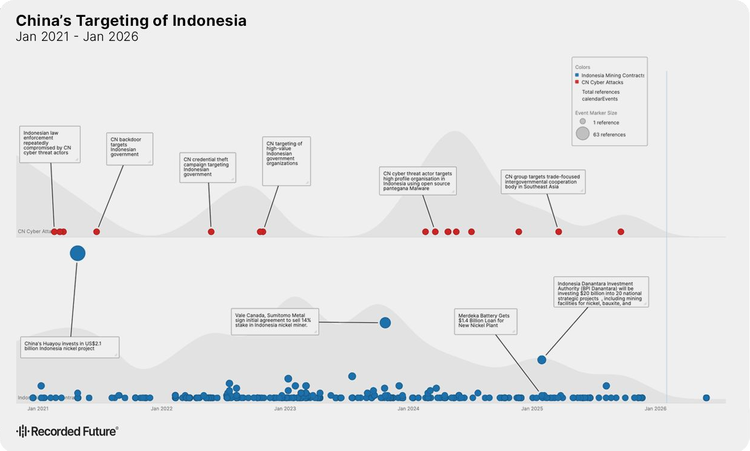
This quest for minerals is accompanied by cyber-enabled battles. Insikt Group has linked infrastructure associated with a state-sponsored group to the targeting of a Canadian base-metals miner, and, in 2025, identified state actors targeting an organization that monitors and regulates seabed mining, just as Beijing signed seabed partnerships with Pacific island states. Indonesia, which holds over 40% of global nickel reserves and whose refining capacity is increasingly controlled by Chinese companies, has absorbed repeated, sophisticated intrusions over the past five years. Criminal groups are also part of the picture: after Australia's Northern Minerals ordered China-linked investors to divest, the ransomware group BianLian published its stolen data.
The Minds
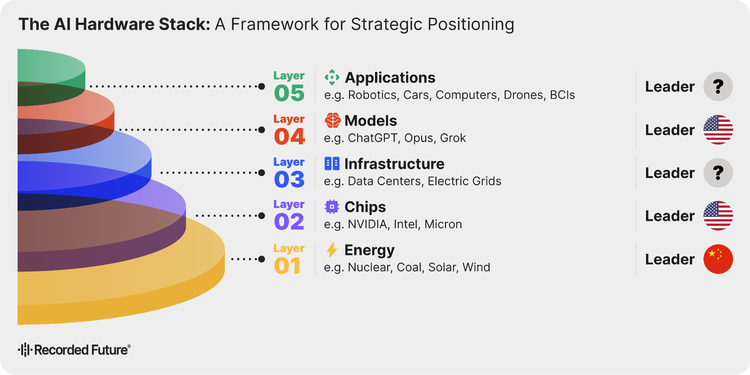
If AI is pictured as a layered stack (see Figure 4), layer one is energy, where China's build-out of nuclear, coal, solar, and wind gives it a comfortable lead.
Layer two is chips, where America and its allies dominate design, and Taiwan's TSMC dominates fabrication.
Layer three is infrastructure, the data centers, where leadership is genuinely contested. While the United States (US) has many data centers, they are at risk of becoming a massive cost for short-term economic gain. China, on the other hand, can bide its time and build them at speed when the time is right.
Layer four is models, where American labs still set the pace in terms of advanced models, but China’s rapid dumping of cheaper AI models threatens to undermine the US. Moreover, China is determined to catch up — remember what Beijing did to the US with cheap steel.
Layer five is applications, from phones to cars, from drones to robots. This key layer is where companies actually embed AI to improve productivity. Failure to successfully apply AI will be economically fatal in the race for technological supremacy.
The chip layer illustrates how the competition plays out in practice. Taiwan produces many of the advanced semiconductors on which frontier models depend, and it is targeted accordingly. Insikt Group observed the Chinese state-sponsored group RedJuliett conducting vulnerability scanning or attempting exploitation against a Taiwanese semiconductor company, electronics manufacturers, technology universities, and computing industry associations. Some 85 Taiwanese organizations were targeted in a single campaign. This is not an opportunistic crime; it is a systematic reconnaissance of the stack layer that an adversary most needs and least controls.
Control of the infrastructure layer, meanwhile, is the least settled and most economically relevant of the five. Data centers are the new refineries, converting gigawatts and chips into intelligence, and their siting has become a matter of statecraft: nations are courting them with power deals and land, and plans are already circulating for compute in orbit and on the Moon, with China and Russia discussing a nuclear plant to power a lunar station. Whoever ends up owning the infrastructure layer will collect rent from everyone above it, which is precisely why its leadership remains the open question in the stack.
It must be noted that a key driver for this technological revolution is demographics. The United Nations expects the world's population to peak in the mid-2080s, working-age populations in industrialized economies are already shrinking, and global population predictions grow bleaker each year.
Modern economies have been built on the assumption of an ever-expanding labor pool that pays taxes and consumes. Unless we find a solution to maintain productivity, the economic models we have in place will fail, which is why it’s vital to understand the application layer of the AI stack.
The Machines
This brings us to the top of the stack and a possible solution to the impending population collapse expected before the end of the century: artificial intelligence in a machine, or “embodied AI.”
Humanoid robots are increasingly leaving research and development programs and entering the workforce. BMW reports that the Figure 02 humanoid robot (developed by Figure AI) has assisted in the production of more than 30,000 X3 vehicles; GXO and Agility Robotics describe their partnership as the first formal commercial deployment of humanoids; Sellafield is considering sending quadrupeds into nuclear decommissioning.
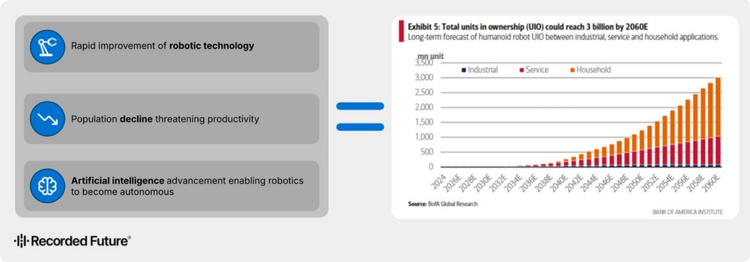
Capital markets have noticed. Unitree filed for a reported $610 million IPO in Shanghai in March 2026, and its R1 humanoid already retails for around $5,500. Analysts expect bill-of-materials costs to fall to $13,000–$17,000 per robot by the early 2030s, and Bank of America projects that as many as three billion humanoid robots will be in operation by 2060. These projections should not be ignored.
The geopolitical shape of the race is already visible. China's 15th Five-Year Plan names embodied AI and brain-computer interfaces (BCIs) as priority technologies; Chinese entities filed 5,688 humanoid robot patents between 2020 and 2025, compared with 1,483 in the US; and Morgan Stanley forecasts 302 million humanoid robots in China by 2050, compared with 78 million in the US.
Today’s battlefields are already adopting AI-powered machines. In April 2026, Ukrainian forces captured a Russian position using only unmanned systems, the first AI-only assault of the war, while American politicians push to designate Unitree a federal supply-chain risk.
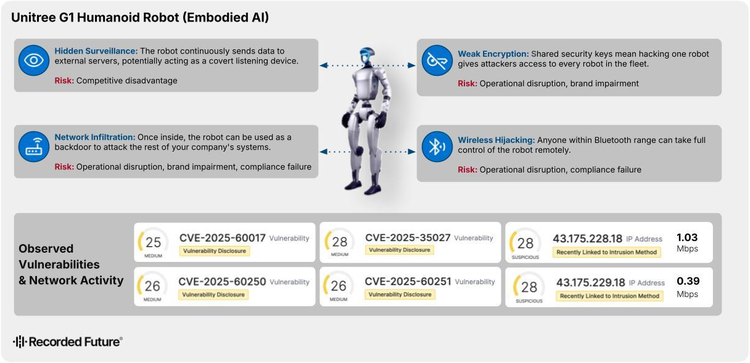
Then there is the uncomfortable question of what happens when the robots are hacked. For instance, researchers found an undocumented backdoor in Unitree's Go1 quadruped that allowed remote access and unauthenticated viewing of live camera feeds. The G1 humanoid was observed exfiltrating multimodal sensor and service-state telemetry to servers every 300 seconds without the operator’s knowledge.
A flaw in the Bluetooth and Wi-Fi provisioning used across multiple Unitree models combined hard-coded cryptographic keys, trivial authentication bypass, and command injection, giving anyone in radio range root access. Because the exploit propagates wirelessly between machines, one compromised unit can seed a physical botnet.
This brings up serious questions about how to ensure the security of embodied AI. For if projections are to be believed, many of us will be living and working around intelligent machines in the years to come.
The Future
The fourth industrial revolution is becoming a story of how critical minerals, energy, chips, models, and machines will be treated less as commercial inputs and more as sovereign capabilities. That means more export controls, critical minerals blocs, strategic stockpiles, and political contests over mineral-rich locations such as Greenland, Antarctica, the Arctic, the seabed, and, eventually, space.
A perfect storm is forming for humanoid robotics. Robotics is advancing quickly and is already being deployed at scale in factories. Large language models are giving machines the ability to process far greater volumes of information, improving their capacity to interpret environments, make decisions, and operate with more autonomy, including in physical spaces. At the same time, demographic decline is accelerating faster than many experts expected, meaning fewer human workers will be entering the labor force.
Cyber operations will run along the AI development chain like electricity through a wire, as mining companies, semiconductor firms, data-center operators, robotics suppliers, and AI model developers become routine intelligence targets.
As carmakers and technology companies continue to apply their mass-production expertise to robots, the pressure to cut costs and move quickly will also test whether security-by-design survives the rigors of commercial reality. This could result in embodied AI producing its first major corporate crisis. It may be a robot-enabled data leak, a factory shutdown, a safety incident, a hijacked fleet, or the mapping of a sensitive facility. A dedicated robot-security industry will likely then emerge, just as antivirus software followed the PC and cloud security followed the data center.
Organizations need to understand their exposure at every link in the AI development chain before events reveal it. The most resilient organizations will be those who understand the whole system, from ore to algorithm to actuator. So move before the threat does, and know exactly what you are looking for.
About Insikt Group®
Recorded Future’s Insikt Group, the company’s threat research division, comprises analysts and security researchers with deep government, law enforcement, military, and intelligence agency experience. Their mission is to produce intelligence that reduces risk for customers, enables tangible outcomes, and prevents business disruption.