The Cyber Threats Behind Space Race 2.0
Background
There were 329 orbital launch attempts in 2025, up from 263 the year before. In the same year, a record 4,517 satellites were placed in orbit. 87% of these satellites were commercially owned; they are part of a space economy that reached $686 billion in 2025 and is set to skyrocket further.
In April 2026, Artemis II completed a crewed lunar flyby, the first humans beyond low Earth orbit since 1972. In March, NASA paused the Gateway station and pivoted to building a lunar base instead. Beijing expects taikonauts on the Moon's surface by 2030 and a functioning International Lunar Research Station by 2035.
The first space race ended with the Cold War, but now that geopolitical competition is escalating, the second space race has begun, and cybersecurity will play a vital role in the outcomes.
This is because thousands of new satellites are computers running software written by people. So is every lander, rover, and relay that follows them to the Moon. They also all have a connection to a ground station on Earth, which is connected to the internet. Therefore, as the second space race accelerates, the risk of cyberattacks affecting space operations is rising exponentially year after year.
Commercial Space Becomes the Target
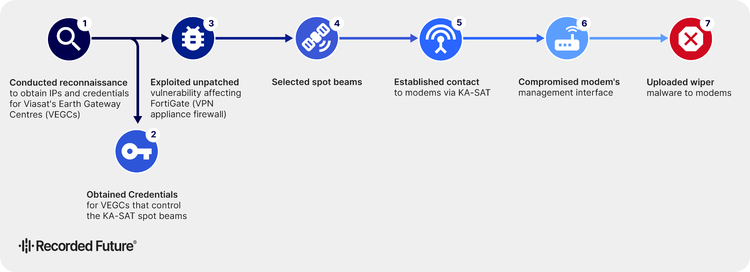
At around five in the morning on February 24, 2022, roughly an hour before Russian armor crossed into Ukraine, tens of thousands of satellite modems across Europe went dark.
Russia had used a weapon called AcidRain, a data-wiping malware tool that targets modems, routers, and satellite communications, to target the KA-SAT broadband network run by Viasat, which the Ukrainian military relied on for command and control. AcidRain was pushed out through the operator's own management network.
The collateral damage extended far beyond the battlefield: around 5,800 wind turbines in Germany lost remote monitoring, and ordinary customers from Poland to France lost their internet access. The UK, US, and EU later attributed the attack to Russia.
Nobody launched a rocket. Nobody fired a jammer. It was a cyberattack that used satellites.
This will be part of the story of the second space race.
Space Operations Have a Postcode
We imagine satellites as remote and therefore safe; however, they are not.
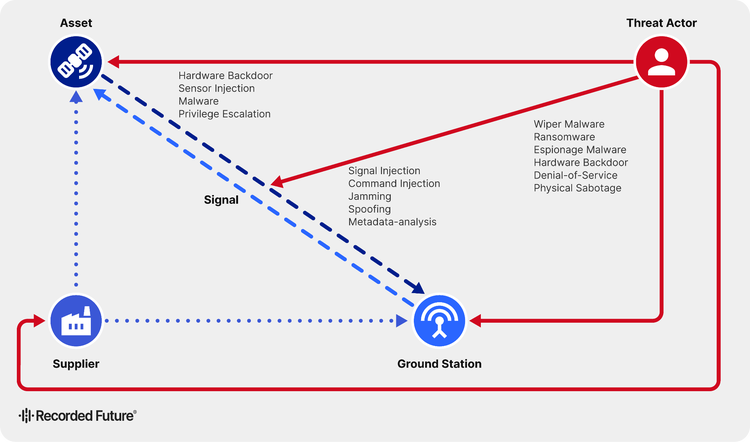
Every satellite has a terrestrial address: the ground stations that command it, the links that carry its telemetry, the user terminals at the edge, and the software supply chain behind it all. That is where attackers go, because that is where the doors are.
The doors are often unlocked. Researchers at UC San Diego and the University of Maryland pointed an $800 dish at the sky and found that roughly half the geostationary satellites they could see were transmitting in the clear: telecommunications backhaul, corporate traffic, military communications.
In March, the NSA and its Five Eyes partners issued joint guidance warning that as low Earth orbit constellations grow, the attack surface open to adversaries expands across the space, ground, and user segments, as well as the supply chains behind them.
Weapons in Orbit, and Companies in the Crossfire
Space militarization is no longer implied.
On September 14, 2026, Air Force Secretary Troy Meink confirmed for the first time that the United States has on-orbit space-control weapons capable of offensive and defensive use.
Nine days later, the UK stood up No. III Space Effects Squadron, with a brief to disrupt, degrade, and deny hostile activity in orbit. Announcing it, the Chief of the Air Staff pointed to five Russian military satellites maneuvering close to two Finnish commercial spacecraft, to weekly Russian attempts to jam British military satellites, and to a £1.4 billion daily bill if the UK lost GPS.
The private sector did not ask to be a combatant, but in an increasingly geopolitically volatile world, it is one.
Starlink kept the Ukrainian army talking and the Ukrainian economy functioning when terrestrial networks were targeted, and in doing so, a consumer broadband product became a military target. The extent to which Ukraine relies on Starlink has become very clear in recent weeks, as it faces service disruptions creating real challenges on the battlefield.
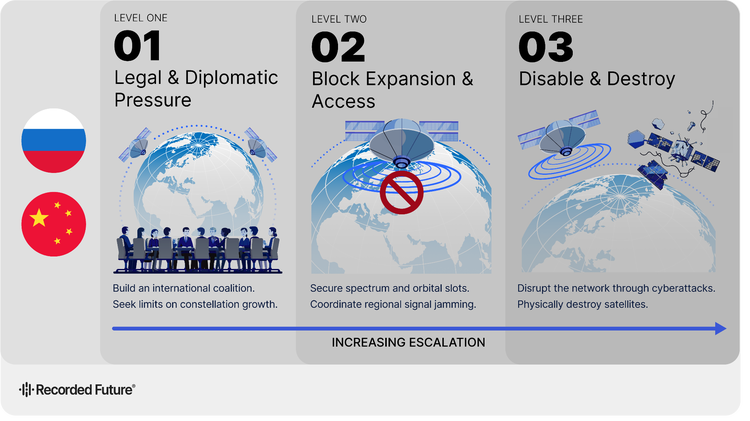
In July, Der Spiegel, Le Monde, and The Insider published documents from a secret China-Russia military-technical forum held in Guangzhou in November 2023. One presentation by two engineers from China's state aerospace corporation was devoted entirely to countering Starlink.
It laid out an escalation ladder: diplomatic and regulatory pressure first, then joint jamming over chosen territory alongside cyber operations and Starlink-specific malware, then, finally, kinetic destruction.
Nobody Touched the Satellite
In March 2025, a group calling itself Lab-Dookhtegan claimed it had cut communications on 116 vessels belonging to Iran's sanctioned tanker and shipping lines.
In August 2025, it struck again, this time disabling 39 tankers and 25 cargo ships. The route in was Fanava Group, a Tehran IT company that supplied the fleet's satellite communications. From there, the attackers gained root access to the Linux terminals aboard each ship, killed the Falcon software that kept the satellite links alive, and took down automatic identification system (AIS) tracking in the process.
According to incident analysis, they had been inside the network for five months before pulling the trigger, wiping storage partitions, logs, and recovery data on the way out.
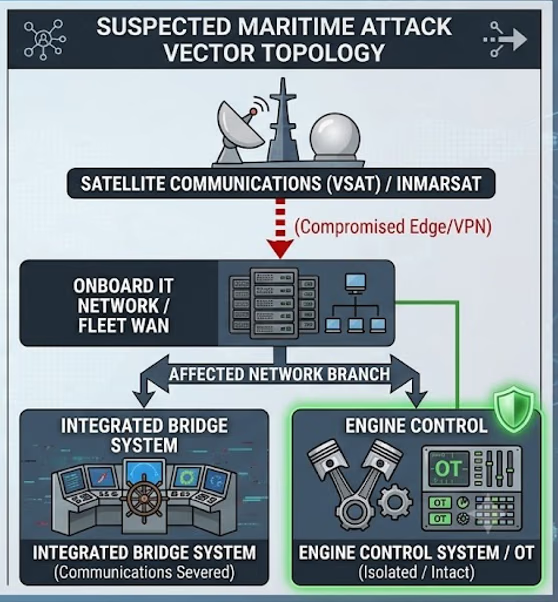
On August 7, 2026, the VL Prosperity, a 333-meter crude carrier bound for Texas, lost its communications for around 30 hours near Gibraltar after its onboard network was compromised. The FBI and Coast Guard cyber teams boarded the VL Prosperity and a second tanker in the Gulf of Mexico before they could reach port, and Washington is reportedly looking at foreign threat actors as the culprit. The technical analysis so far shows where investigators looked first: the satellite terminals and remote maintenance portals that connect a ship at sea to the shore.
Meanwhile, Viasat itself was identified as a victim of Salt Typhoon, a state-sponsored group known for burrowing into American telecommunications.
To take things a step further, SpaceX’s Starlink users were allegedly targeted by the advertising firm Discover-Tech in a suspected effort to locate or monitor users of satellite internet. The incident highlights how users of space-based communications can be surveilled through online advertising, without attackers needing to compromise the satellites themselves.
Pay attention to the pattern. In none of these cases did anyone touch an object in orbit. The attackers went for the vendor, the terminal, the management plane.
When the Data Center Leaves Earth
Last November, a start-up called Starcloud put an Nvidia H100 into orbit and ran a large language model on it. In October 2026, Google launched a prototype for Project Suncatcher, its plan for solar-powered AI clusters in space, carrying four of its TPU chips.
SpaceX says it expects to deploy orbital AI compute satellites from 2028, and in January 2026, it asked the Federal Communications Commission (FCC) to license an orbital data center of up to a million satellites.
Whatever you think of the economics, the direction is clear: Within a decade, a meaningful share of the world's AI compute, and the data that feeds it, could live 300 miles up in space, reachable through ground stations and optical links that someone has to defend.
If this materializes, it will be all the more important to ensure systems are protected from cyberattacks.
The Reality We Have Not Yet Accepted
Launch rates are at record highs and still climbing. The economy built in orbit is heading for trillions of dollars, four-fifths of which are private. Two great powers are racing to build permanent bases on the Moon, and a new era of astropolitics is arriving.
Weapons are confirmed in orbit. And the cheapest, most deniable way to attack any of it runs through the same networks, vendors, and terminals attackers already know how to breach.
So what does securing the sector actually mean? Treating space as critical national infrastructure in law and in budgets. Holding vendors and terminals to the same standard as the spacecraft, because that is where Viasat and Iran’s fleet were breached. Encrypting the links an $800 dish can still read. And widening the threat model beyond nation-states to hacktivists and ad buyers.
In Guangzhou, cyber sat one rung below kinetic destruction. Every incident here happened on that rung, and none required a rocket.
2027 will see an acceleration of the trends discussed. We are being warned.
Space has a postcode. We have a duty to protect it.
Insikt Group: Space and Cyber: The Race Above and the Battle Below
Recorded Future: The convergence of space and cyber: An evolving threat landscape
Insikt Group adheres to responsible disclosure procedures in conducting its research.
About Insikt Group®
Recorded Future’s Insikt Group, the company’s threat research division, comprises analysts and security researchers with deep government, law enforcement, military, and intelligence agency experience. Its mission is to produce intelligence that reduces risk for customers, enables tangible outcomes, and prevents business disruption.