China's Noncombatant Evacuation Operations: 2005–2025
Over the past two decades, noncombatant evacuation operations (NEOs) have emerged as an important tool for protecting China’s overseas interests. To assess China’s NEO capabilities for the US Army War College China Landpower Studies Center’s 2026 Carlisle Conference on the PLA (People’s Liberation Army), Insikt Group built an original dataset of 37 Chinese NEOs carried out between January 2005 and August 2025. This blog post has been adapted from Insikt Group’s conference paper, and our “China 2005–2025 Noncombatant Evacuation Operation Dataset” is attached as a PDF.
One of Insikt Group’s most notable findings is that, over the past twenty years, China has consistently mobilized civilian resources to facilitate NEOs, demonstrating China’s reliance on these resources for NEOs and its capability to call upon diverse instruments of national power to protect overseas interests. During this period, at least 65% of China’s NEOs involved support from Chinese state-owned enterprises (SOEs), private enterprises, or United Front/civil society organizations located in the host country, third-party countries, or China. The contributions of SOEs, private enterprises, and United Front/civil society organizations to China’s NEOs include:
- Organizing evacuation efforts on the ground
- Communicating official instructions
- Providing air, land, and maritime transportation
- Providing relief to evacuees once they arrive in neighboring countries or return to China-
The Chinese Communist Party (CCP) and the Chinese government have continued to take advantage of civilian resources for NEOs since August 2025 — such as for its Iran NEO in early 2026 — and will almost certainly continue to mobilize these resources in the future.
Overview of China’s NEOs
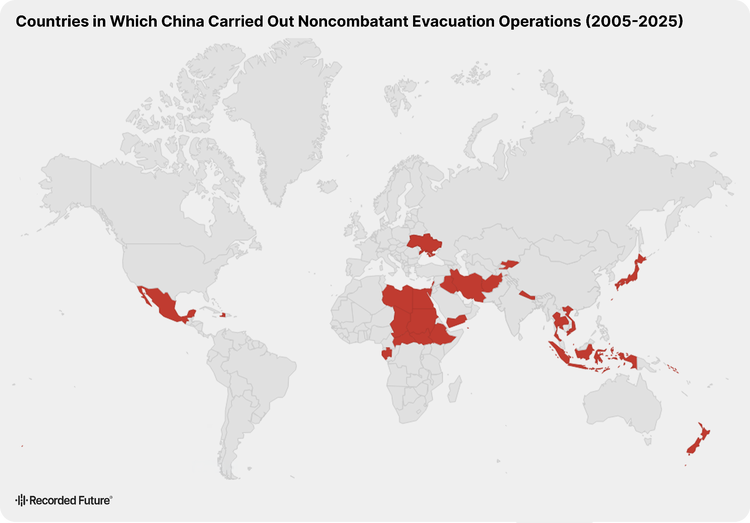
China carried out at least 37 NEOs in 28 different countries between 2005 and 2025 (see image below). China carried out eleven NEOs in Africa, nine in the Middle East, and nine in Asia, with the other eight occurring in the Caribbean, Pacific Islands, Europe, and North America. China conducted multiple NEOs in the Central African Republic, Haiti, Iran, Israel, Kyrgyzstan, Lebanon, Libya, and South Sudan.
Section K of the PDF attached to this blog post provides a summary of each NEO, organized chronologically by country. The other sections of the document (Sections A through J) organize the dataset into ten categories: emergency scenarios, evacuees, transportation methods, foreign coordination/support, high-level leadership, Chinese State, Chinese Military, Chinese SOEs, private Chinese companies, and United Front/civil society. The attached document also provides more details about the contents of each category.
Emergency Scenarios
The majority of China’s NEOs between 2005 and 2025 occurred during civil wars, riots, natural disasters, and other non-interstate conflict scenarios. Of the 37 Chinese NEOs in Insikt Group’s dataset (see Section A), only seven occurred during an interstate conflict, and only one of these seven NEOs took place during a high-end, large-scale conflict: Russia’s invasion of Ukraine in February 2022.
Number of Evacuees
Most of China’s NEOs between 2005 and 2025 did not involve a large number of evacuees. Of the 37 Chinese NEOs in Insikt Group’s dataset (see Section B), only two involved evacuation of greater than 10,000 Chinese nationals, and only three NEOs involved between 5,000 and 10,000 evacuees. The reported number of evacuees varies for many of China’s NEOs, but the median Chinese NEO involved around 490 evacuees.
Transportation Methods
China frequently employed air and land transportation methods during NEOs between 2005 and 2025, and used maritime transportation for some NEOs as well. Of the 37 Chinese NEOs in Insikt Group’s dataset (see Section C), at least 29 involved air transportation methods, at least 21 involved land transportation methods, and at least eight involved maritime transportation methods. Examples of these include chartered planes, PLA Air Force (PLAAF) aircraft, buses, PLA Navy (PLAN) vessels, and Chinese cargo ships.
Foreign Coordination/Support
Chinese authorities typically sought to collaborate with the host country or third-party countries during NEOs between 2005 and 2025. Of the 37 Chinese NEOs in Insikt Group’s dataset (see Section D), at least 30 involved coordination with or support from foreign countries or entities. An example of direct foreign support was Kyrgyzstan's military using armored personnel carriers to transport Chinese nationals to an airport during China’s Kyrgyzstan NEO in June 2010. An example of broader foreign coordination was Chinese authorities negotiating flights and overflights through more than twenty countries during China’s Ukraine NEO in February 2022.
The Party, State, and Military in China’s NEOs
High-Level Leadership
Many of China’s NEOs between 2005 and 2025 appear to have required leadership from the highest levels of China’s party-state system, including individual leaders like the CCP General and organizations like the CCP Central Committee. Of the 37 Chinese NEOs in Insikt Group’s dataset (see Section E), at least twenty involved instructions, interest, or other involvement from high-level leadership within China’s party-state system. Researchers have previously assessed that China’s major NEOs “need political involvement at the highest level,” particularly at a level higher than the Ministry of Foreign Affairs (MFA), which is reportedly constrained by its “relatively low bureaucratic standing” and inability to command the PLA.
Chinese State
Between 2005 and 2025, the MFA was broadly responsible for coordinating NEOs, while China’s diplomatic missions were generally responsible for organizing NEOs on the ground; however, other state entities had significant involvement in some of these operations, particularly during larger, more complex NEOs. Of the 37 Chinese NEOs in Insikt Group’s dataset (see Section F), at least 32 NEOs involved Chinese embassies or consulates, and at least 27 NEOs involved the MFA. In total, Insikt Group observed references to the involvement of twenty different state entities or categories of state entities. For example, during China’s Libya NEO in February 2011, three working groups comprising personnel from the MFA, Ministry of Commerce, State-Owned Assets Supervision and Administration Commission (SASAC), Civil Aviation Administration of China, Ministry of Public Security, Ministry of National Defense, and other relevant departments traveled to Libya to facilitate evacuations.
Chinese Military
The PLA has limited but increasing experience conducting out NEOs. Of the 37 Chinese NEOs in Insikt Group’s dataset (see Section G), at least eight involved elements of China’s armed forces. PLA forces have only deployed for three NEOs, namely the Libya NEO in February 2011, the Yemen NEO in March 2015, and the Sudan NEO in April 2023. These deployments have involved the use of PLAN and PLAAF assets, including multiple Type 054A guided missile frigates, a Type 903 comprehensive supply ship, a Type 052D guided missile destroyer, and IL-76 strategic transport aircraft. In addition to these three deployments, China’s military has reportedly supported at least five other NEOs. For example, Chinese military attachés, who are members of the PLA, reportedly contributed to China’s Kyrgyzstan NEO in June 2010, Libya NEO in July 2014, and Iran NEO in June 2025, in addition to the aforementioned 2011 Libya NEO and 2023 Sudan NEO.
Mobilization in China’s NEOs
Chinese State-Owned Enterprises
China’s party-state frequently mobilized SOEs to support NEOs between 2005 and 2025. Of the 37 Chinese NEOs in Insikt Group’s dataset (see Section H), at least twenty involved support from Chinese SOEs, including fourteen NEOs in which state-owned airlines provided air transportation for evacuees and eight that involved other types of SOEs. Examples of SOEs' contributions to China’s NEOs are listed below.
- During China’s Libya NEO in February 2011, China State Construction Engineering Corporation (CSCEC), China Communications Construction Company (CCCC), Sinohydro, and Gezhouba Group operated four regional command centers under SASAC's unified command. CSCEC and CCCC established temporary CCP branches to organize embarkation and evacuation at ports in Libya; Gezhouba Group coordinated the evacuation of 5,000 people from eleven Chinese enterprises, maintaining communication with China’s embassy to relay instructions to other Chinese enterprises; and Sinohydro organized air transport for evacuees.
- During China’s Ethiopia NEO in November 2020, CCCC set up a temporary shelter for evacuees in an industrial park owned by the company; Gezhouba Group coordinated with the Chinese embassy and other enterprises, mobilizing over 60 vehicles for an evacuation convoy; and China Railway Engineering Corporation also helped coordinate the evacuation.
- During China’s Sudan NEO in April 2023, PowerChina led the evacuation of personnel from Chinese enterprises with guidance and support from SASAC, the MFA, and Chinese embassies in Africa and the Middle East, and China National Petroleum Corporation provided buses to support the evacuation efforts of China’s embassy in Sudan.
- During China’s Lebanon NEO in October 2024, COSCO Shipping sent a cargo ship to evacuate around 80 Chinese nationals to Cyprus. To facilitate the evacuation, the ship’s crew was organized into five teams: "safety assurance, on-site guidance, life support, psychological support, and mechanical support.”
Private Chinese Companies
China has used private companies to support several NEOs between 2005 and 2025, though open-source evidence of such mobilization is relatively limited. Of the 37 Chinese NEOs in Insikt Group’s dataset (see Section I), at least five involved support from private Chinese enterprises, including three NEOs in which private airlines provided air transportation and three that involved other types of private enterprises. For example, during China’s Libya NEO in February 2011, Huawei provided vehicles to China’s embassy in Libya. In China’s South Sudan NEO in July 2016, private security contractor DeWe Security “executed an evacuation plan” to ensure the safety of 330 Chinese civilians (who were likely employees of CNPC, DeWe’s main client in the country) and “led teams of armed locals,” though analysts have suggested that DeWe Security personnel “were unarmed at the time and largely unprepared for this scenario.”
United Front/Civil Society
China’s party-state has mobilized United Front or Chinese civil society organizations to support a variety of NEOs. Of the 37 Chinese NEOs in Insikt Group’s dataset (see Section J), at least thirteen involved contributions from United Front or Chinese civil society organizations. The most significant mobilization of United Front or Chinese civil society organizations likely occurred during China’s Ukraine NEO in February 2022, which involved dozens of United Front or Chinese civil society organizations in Ukraine, in countries neighboring Ukraine, and in China, including overseas Chinese associations, student associations, and chambers of commerce, among others. Examples of the contributions of United Front or Chinese civil society organizations during the 2022 Ukraine NEO are listed below.
- The Chinese Chamber of Commerce in Odessa (敖德萨华商总会) and Diaspora Chinese in Ukraine (乌克兰华人华侨协会) organized bus convoys to evacuate Chinese nationals.
- A Chinese student volunteered as a member of the Odessa Chinese International Student Federation (敖德萨中国留学生会) to assist China’s embassy, consulate, and chamber of commerce with evacuations.
- Chinese organizations in countries like Poland, Slovakia, Hungary, Romania, Moldova, and Germany met Chinese evacuees at border crossings, arranged shelter, and provided supplies.
- The Zhejiang Federation of Returned Overseas Chinese (浙江省侨联) monitored the situation of Chinese nationals in Ukraine, organized information-sharing, and guided Chinese organizations in countries neighboring Ukraine to give assistance to evacuees, among other activities.
About the Author
Zoe Haver is a senior threat intelligence analyst at Recorded Future. Her research focuses on the People’s Liberation Army and China-related security issues. Before joining Recorded Future, she worked on these topics for Radio Free Asia, SOSi’s Center for Intelligence Research and Analysis, the US Naval War College China Maritime Studies Institute, C4ADS, and other organizations. She received her BA from George Washington University and is proficient in Mandarin Chinese.
About Insikt Group®
Recorded Future’s Insikt Group, the company’s threat research division, comprises analysts and security researchers with deep government, law enforcement, military, and intelligence agency experience. Their mission is to produce intelligence that reduces risk for customers, enables tangible outcomes, and prevents business disruption.